
ADR: Meaning, Types and Methods In Detail
ADR Meaning and Nature of Conflict
Conflict is when people do not agree on things. This happens because of differences in what people want what they believe in and what they think is important. Conflict occurs when one person or group feels that another person or group is getting in the way of what they want to achieve. Conflict is a part of how people interact with each other and can happen in our personal lives in social situations at work or in our community. It is closely connected to how people relate to each other and to changes in society. Even though conflict can sometimes seem bad it is not always negative. If we handle conflict in a way it can help us understand each other better work together and solve problems.
Conflict happens everywhere because no two people are alike in what they think how they feel and what they believe. People have needs, expectations and ways of thinking, which makes it impossible to avoid disagreements. Conflict can start because of misunderstandings, poor communication, differences in values, competition or strong emotions. It can happen inside a person, between two people or between groups of people. If we do not handle conflict well it can get worse. Hurt our relationships.. If we deal with it carefully it can create opportunities for us to understand each other better and grow.
Characteristics of Conflict
Conflict has some characteristics.
First it can happen at levels like between individuals, groups organizations and communities. Since everyone has their beliefs, experiences and perspectives disagreements are natural.
Second conflict is universal and unavoidable because people are always going to have differences.
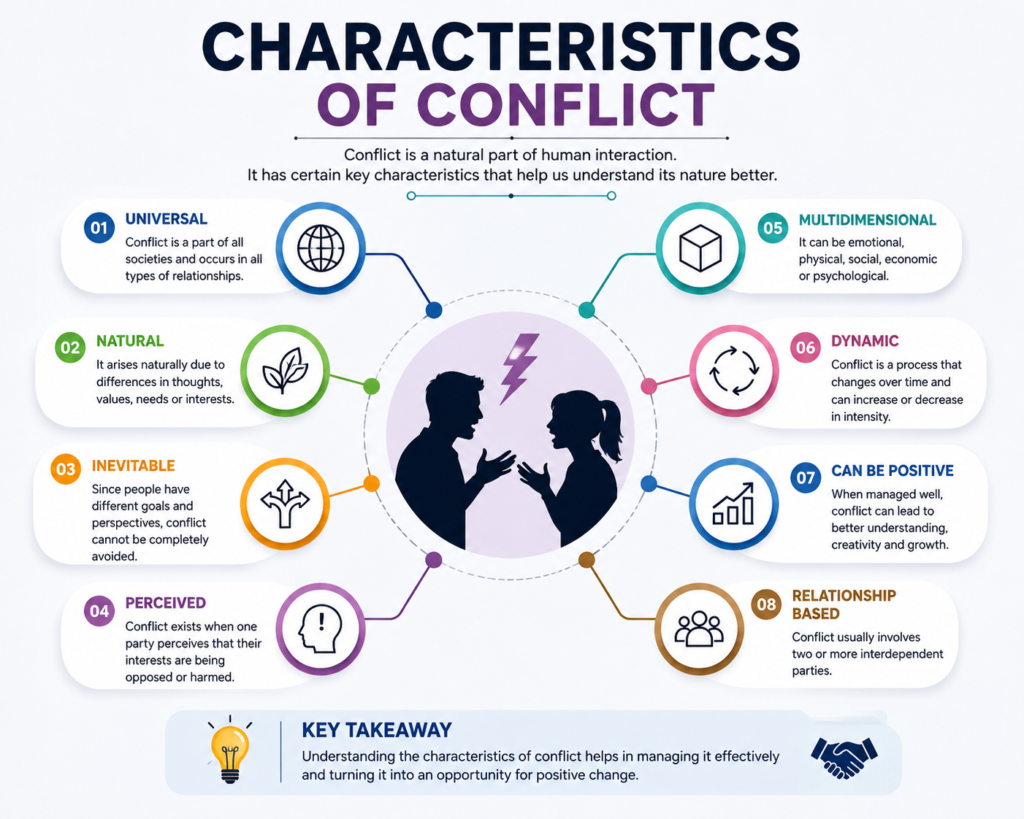
Third conflict happens because people have interests, values or goals.
Fourth how we see things plays a role in conflict because people often understand situations differently which can lead to misunderstandings. Gaps in communication can also make it more likely for disputes to happen. Conflict can be mild or serious depending on the situation. Sometimes it can even lead to positive change if we manage it well.
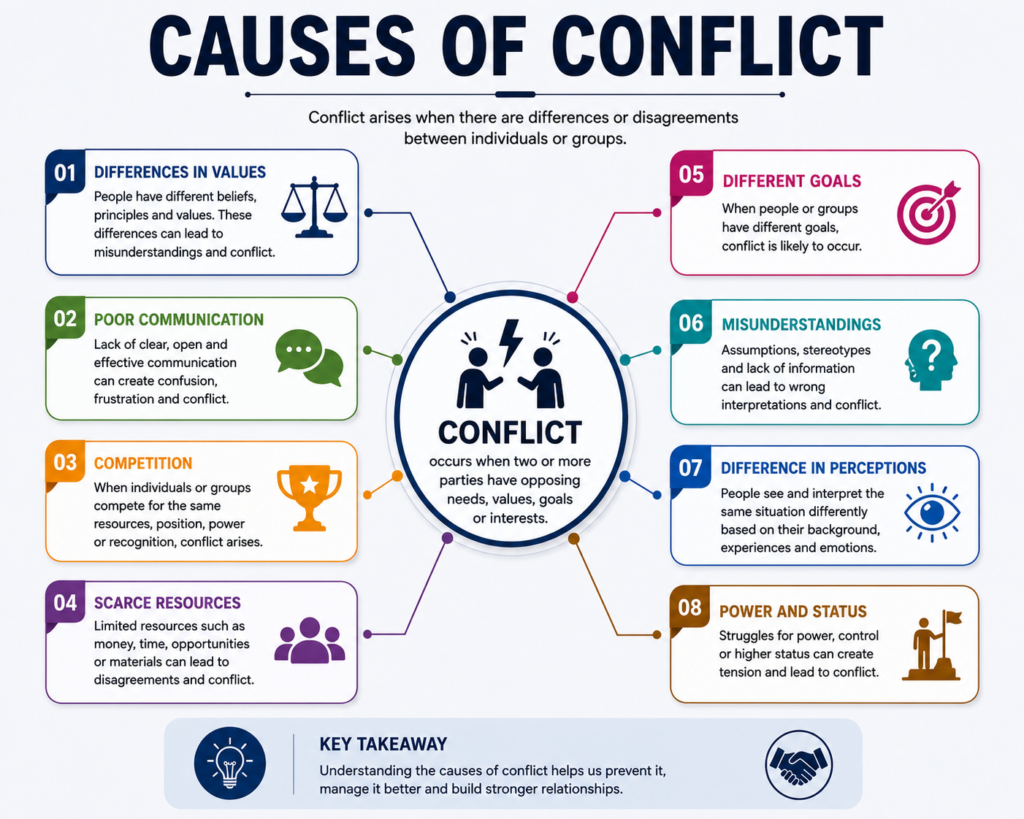
Causes of Conflict
(a) Information Conflict
Information conflict happens when people disagree because they do not have all the facts or they have information. Poor communication, lack of information or different interpretations can cause disagreements. These conflicts often happen when people cannot understand each others perspectives. If people communicate clearly and explain things well these disputes can often be resolved peacefully.
(b) Value Conflict
Value conflict occurs when people or groups have beliefs, principles, morals or ideologies. It happens when one person tries to impose their values or opinions on others or when people strongly disagree on what’s right or wrong. Since people come from backgrounds and experiences value-based disagreements are common and can be hard to resolve.
(c) Interest Conflict
Interest conflict happens because of competition for resources, money, power, authority, time or benefits. It occurs when people think that if one side gets what they want the other side will lose. These conflicts often involve struggles for control, recognition or personal gain. However if people understand each other and negotiate they can find solutions that work for everyone.
(d) Relationship Conflict
Relationship conflict happens because of misunderstandings, mistrust, poor communication or bad behavior between people. Personal tensions, anger, fear, suspicion or lack of trust can make disagreements worse. Since this type of conflict involves emotions and personal relationships it can be harder to resolve than disputes.
(e) Structural Conflict
Structural conflict happens because of inequalities, unfair systems, power imbalances or limited opportunities in society or organizations. It can happen because of access to resources, unfair authority structures or social arrangements that favour one group over another. These conflicts can go on for a time unless fairness and balance are restored.
Kinds of Conflict
(a) Intrapersonal Conflict
Intrapersonal conflict happens inside a person. It occurs when someone feels confused has struggles or finds it hard to make decisions. A person may face conflict when choosing between two options or balancing personal values and responsibilities.
(b) Interpersonal Conflict
Interpersonal conflict happens between two or more people because of differences in opinions, interests, goals or behavior. These conflicts are common in families, workplaces, friendships and social interactions. Misunderstandings and emotional reactions can make interpersonal disputes more intense.
(c) Group Conflict
Group conflict happens between groups or communities when they disagree over goals, interests, responsibilities or resources. It often occurs in organizations, workplaces or communities when members have opinions or priorities.
(d) Organizational Conflict
Organizational conflict happens within institutions or workplaces when disputes arise between employees, employers, departments or management. It usually happens because of differences in authority, responsibilities, policies or allocation of resources. If not resolved properly it can reduce cooperation and efficiency within an organization.
Dispute as a Starting Point of Conflict
Although the terms dispute and conflict are often used together they have meanings. A dispute is a short-term disagreement that can usually be resolved through discussion or settlement. On the hand conflict is deeper and longer-term and it involves emotions, values, interests and personal tensions.
A dispute is often the beginning of conflict. It is the part of the disagreement between parties while conflict includes the hidden causes behind that disagreement. Conflict is like an iceberg, where the dispute’s the part above the surface but deeper issues like mistrust, anger, fear and misunderstandings are hidden underneath.
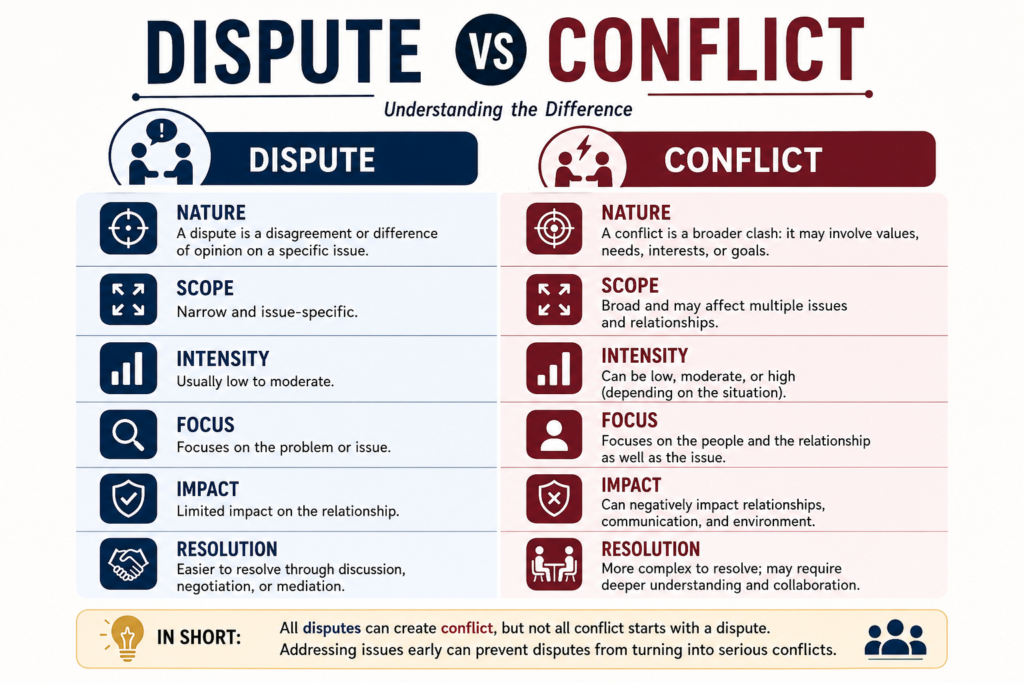
When disputes are ignored or not resolved they can grow into conflicts. A simple disagreement can become more serious over time. Can create long-term hostility between parties. Therefore resolving disputes is important to prevent them from becoming serious conflicts. Early communication, understanding and mediation can help parties solve problems peacefully and maintain relationships.
Modes of Dispute Resolution – Negotiation, Mediation, Arbitration and Adjudication
Disputes are disagreements that arise between individuals, groups organizations or institutions because of conflicting interests, rights, duties or expectations. To resolve these disputes peacefully and efficiently different methods of dispute resolution are used. These methods aim to settle disagreements without hostility and to achieve justice in a fair manner. The common modes of dispute resolution include Negotiation, Mediation, Arbitration and Adjudication.
Negotiation
Negotiation is an direct method of dispute resolution where the parties involved communicate with each other to settle their disagreement without involving any third party. In negotiation both sides identify their concerns discuss solutions and try to reach an agreement that works for everyone. It is a process where the parties themselves control the outcome and make decisions based on mutual understanding.
Negotiation is generally preferred because it is flexible informal cost-effective and saves time. Since no outsider interferes in the process parties are free to discuss their problems and arrive at a mutually beneficial settlement. This method is particularly useful where the parties wish to preserve their relationship, such as family disputes, business disagreements or workplace issues. However negotiation may fail if parties are unwilling to cooperate or if emotions and power imbalances become obstacles to communication.
Features of Negotiation
• It is a process.
• No neutral third party is involved.
• Parties themselves control the discussion and decision-making.
• It is flexible, informal and confidential.
• It aims at reaching an acceptable settlement.
Mediation
Mediation is a dispute resolution process where a neutral third person, called a mediator helps the parties involved resolve their conflict. Unlike negotiation mediation involves a mediator who facilitates communication encourages understanding and helps the parties explore solutions. However the mediator does not impose a decision. Force any settlement upon the parties. The final decision always remains in the hands of the parties involved.
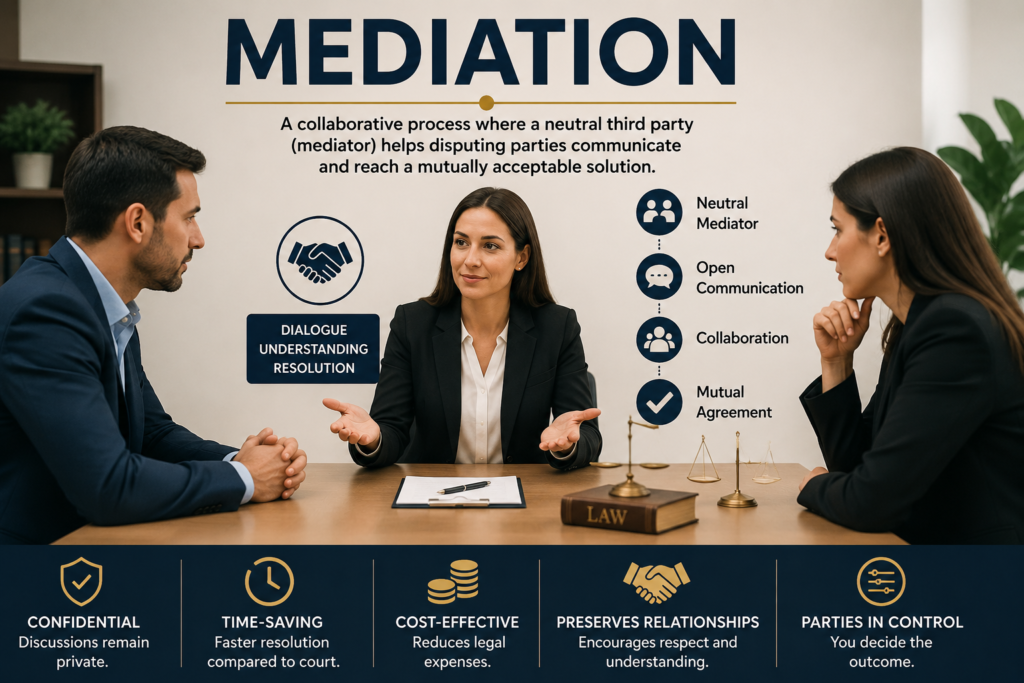
Mediation is considered a -adversarial method of dispute resolution because it promotes cooperation rather than confrontation. It is especially useful when parties want to preserve professional relationships, such as in matrimonial disputes family disagreements, workplace issues or commercial matters. During mediation parties may meet jointly or separately. Discussions are usually confidential. The mediator helps identify the causes of disagreement and assists in finding a practical solution acceptable to both parties.
Mediation is advantageous because it saves time reduces expenses preserves relationships maintains confidentiality and often results in a mutually satisfactory solution. It also reduces the burden on courts by encouraging settlement of disputes.
Features of Mediation
• It is voluntary and non-adversarial.
• A third party (mediator) facilitates communication.
• The mediator does not impose decisions.
• The process is confidential and flexible.
• Parties themselves decide the settlement.
Arbitration
Arbitration is a method of dispute resolution where the parties involved agree to submit their dispute to a person called an arbitrator, who hears both sides and makes a decision known as an award. Unlike mediation the arbitrator has the authority to make a decision after considering evidence, arguments and facts presented by the parties.
Arbitration is generally chosen when parties want a quicker and less formal alternative to court proceedings. It is widely used in contractual and business disputes where parties agree in advance through an arbitration agreement to resolve disputes outside the court. The decision of the arbitrator may be binding or non-binding depending on the agreement, between the parties.
Arbitration is not always binding. It depends on what the parties agree on. In binding arbitration the parties have to do what the arbitrator says. Arbitration is more formal than mediation. Not as formal as going to court. It is flexible. The parties can choose who they want to be the arbitrator. Arbitration is usually faster than going to court.
The Arbitration process is recognized by law so the parties know that the decision will be fair.
Features of Arbitration
- The arbitrator is neutral. Decides the dispute.
- The process is not as formal as a court case.
- The arbitrators decision can be binding.
- The parties usually agree to arbitration beforehand.
- It is often used for business and contract disputes.
Adjudication
Adjudication is when a judge or someone with authority listens to both sides of a dispute and makes a decision that is legally binding. This is the way of solving disputes in court. In adjudication the parties present evidence. Make legal arguments and the judge decides based on the law.
Adjudication is like a fight between two parties and the judge decides who wins. The decision is final. The parties have to do what the judge says.
Adjudication is usually used for disputes like when someones legal rights are involved or when someone has committed a crime.
Even though adjudication provides a decision it can be expensive and take a long time. It can also make the parties angry with each other.
Features of Adjudication
- Disputes are solved by a court or someone with authority.
- A judge makes a decision that’s legally binding.
- It is formal. Follows legal procedures.
- The parties present evidence. Make legal arguments.
- It is like a fight between two parties.
The difference between the ways of solving disputes is that negotiation and mediation are not adversarial. This means they try to get the parties to work together. Arbitration and adjudication are more formal. Someone else makes the decision.
In negotiation the parties talk to each other directly. In mediation someone helps them. In arbitration an arbitrator decides. In adjudication a court decides.
The adversarial process has some problems. It can be expensive. Take a long time. It can also make the parties angry with each other.
The adversarial process is when two parties fight in court and a judge decides who wins. The judge looks at the evidence and the law. Makes a decision.
This process is used in court cases and it is based on winning or losing.
It has some weaknesses. It can be expensive take a time and be emotionally exhausting. It can also damage relationships.
Limitations of the Adversarial Process
- It can be expensive.
- It can take a time.
- It follows legal procedures.
- It is like a fight between two parties.
- It can damage relationships.
- It can cause stress.
- The parties do not have control over the outcome.
Because of these problems there is a need for ways of solving disputes. This means that the parties work together to find a solution.
Consensual resolution
Consensual resolution is when the parties agree on a solution. It is not adversarial. It tries to maintain peace and harmony.
Examples of dispute resolution are negotiation, mediation and Lok Adalat.
These methods encourage communication, flexibility and participation. They help the parties find a solution that works for both of them.
Consensual resolution is necessary because it promotes peace reduces costs and saves time. It also helps preserve relationships.
It creates a -adversarial atmosphere, where the parties work together to solve the problem.
Mediation is a way of solving disputes.
Why Mediation is the Preferred ADR Mode
1. It is Voluntary
Mediation is a voluntary process, which means both parties choose to participate by their own free will. No one can be forced to continue mediation if they do not wish to. This makes the process more cooperative and effective.
2. The Parties Have Control Over the Outcome
In mediation, the parties themselves make the final decision instead of the mediator. The mediator only guides the discussion and helps them communicate. This gives both sides full control over the settlement.
3. It Helps Preserve Relationships
Mediation encourages respectful communication and cooperation between the parties. It avoids unnecessary conflict and hostility that often arise in court cases. As a result, personal, family, or business relationships can be maintained.
4. It is Cost-Effective
Mediation is generally less expensive than going to court because it involves fewer legal procedures and takes less time. Parties save money on legal fees and court expenses. This makes mediation an affordable method of dispute resolution.
5. It is Faster Than Going to Court
Court cases may take months or even years to reach a final decision. Mediation usually resolves disputes in a few meetings or within a short period. This saves valuable time for both parties.
6. It is Confidential
Everything discussed during mediation remains private and is not disclosed to the public. The mediator and the parties are expected to keep the information confidential. This allows the parties to speak openly without fear.
7. The Process is Flexible
Mediation does not follow the strict rules and procedures of a court. The parties can decide the time, place, and manner in which the mediation will take place. This flexibility makes the process more convenient and suitable for their needs.
8. It Focuses on the Parties’ Interests, Not Their Legal Positions
Mediation looks at the actual needs, concerns, and interests of the parties rather than only their legal rights. It encourages practical and mutually beneficial solutions. This often leads to better and long-lasting agreements.
9. It Tries to Find a Solution That Works for Both Parties
The main objective of mediation is to reach a settlement that benefits both sides. Instead of declaring one party the winner and the other the loser, mediation promotes a win-win solution. This increases the chances that both parties will willingly follow the agreement.
10. Reduction of Court Burden
Mediation really helps to reduce the number of cases that go to court. This is because mediation encourages people to settle their issues in a way. By doing this it helps to decrease the amount of work that the courts have to do. This makes the justice system work efficiently.
Role of Mediator
The role of the mediator is very important. The mediator helps people to talk to each other. The mediator does not take sides. Stays neutral. The main job of the mediator is to find out what the issues are get people talking, clear up misunderstandings reduce tension and help people find solutions that work for them. The mediator does not try to decide who is right or wrong. Instead the mediator helps people to reach an agreement that they can both accept.
A good mediator helps people to trust each other stays neutral makes sure everything is fair and creates an atmosphere for people to talk and settle their issues.
There are some situations where mediation works well. These are situations where it’s important to keep relationships intact. Mediation is often used in family disputes, problems between husbands and wives issues about who gets to take care of the kids disagreements at work issues between neighbors complaints from consumers, disputes between businesses and conflicts within communities. In these situations mediation gives people a chance to talk openly and resolve their issues without hurting their relationships in the run.
Advantages of Mediation
Mediation has a lot of advantages. It is quick, less costly private flexible. Does not involve fighting. It helps people to communicate and work together which helps to preserve relationships. Because the people involved create their solution they are more likely to follow the agreement. Mediation also reduces stress. Helps people to find long-term solutions to their problems rather than just temporary fixes.
Limitation of Mediation
There are some limitations to mediation. Even though mediation is very effective it may not work for every dispute. The process only works if people are willing to cooperate and negotiate honestly. If one person does not want to participate or if one person has a lot power than the other mediation can be difficult. Also disputes that involve crimes or issues that need to be decided by a court of law may not be suitable, for mediation.