
Restorative Justice and Gandhian Principles of Conflict Resolution
Theory of Restorative Justice and Its Application
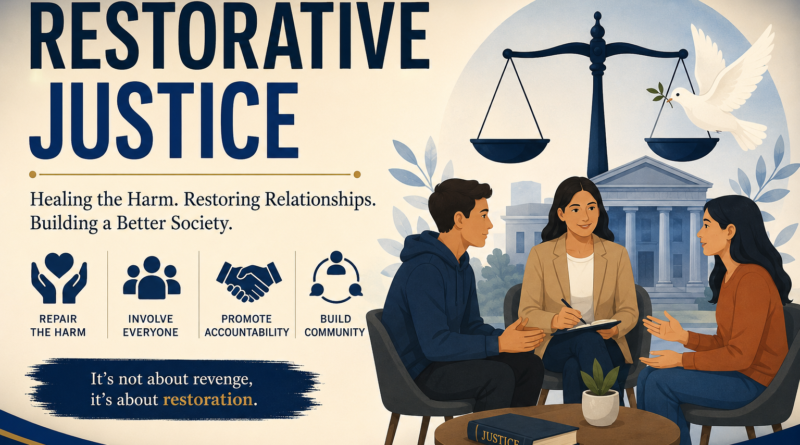
Restorative Justice is a way of looking at justice. It is about fixing the harm that is caused by actions. This is different from the justice system. The traditional system mainly wants to find out who is guilty and punish them. Restorative Justice wants to fix relationships help victims make offenders take responsibility and bring them back into society.
Crime and conflict hurt people, families and communities. So justice should help everyone who is affected. It should try to make things right
The idea of Restorative Justice is that when someone does something they must make things right. They must talk to the person they hurt understand how they feel and help fix the harm.
Restorative Justice
Restorative Justice is about healing, not punishment. It sees crime as a problem between people and communities not a law that is broken. When someone is hurt we must think about what the victim needs what the offender must do and how the community can help.
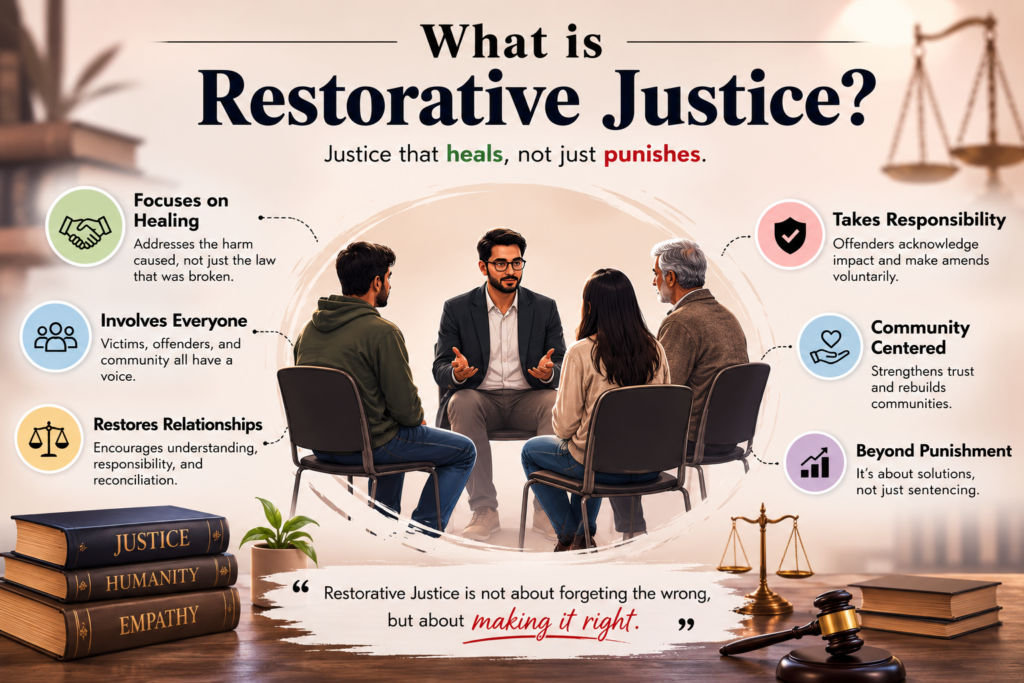
In Restorative Justice offenders must take responsibility for what they did. They must make things right. Of isolating them we want to help them understand what they did and become good members of society.
Victims are important in Restorative Justice. In courts they do not get to say much.. In Restorative Justice they get to say how they feel, what they need and help decide what happens. This helps them feel better.
The community is also important. When someone does something it affects everyone. So community members can help fix things make offenders take responsibility and make society more peaceful.
Principles of Restorative Justice
Repairing Harm
Restorative Justice wants to fix the harm that is caused. It is not about punishing someone. It is about making things right for the victim, offender and community.
Accountability of the Offender
Offenders must take responsibility for what they did. They must make things right. This is important for justice.
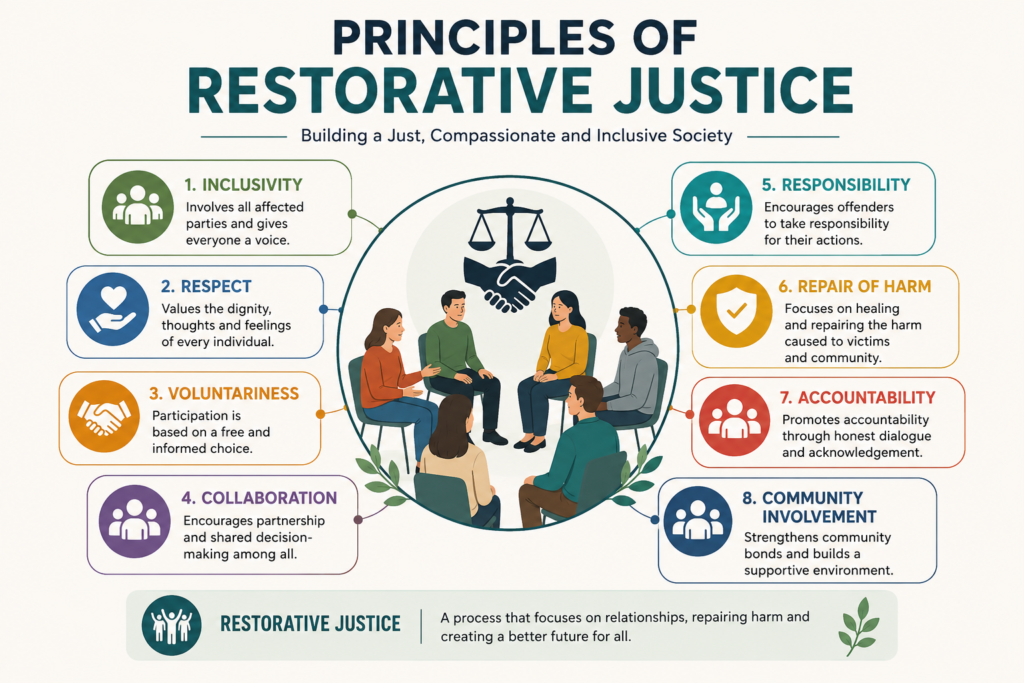
Participation of Victims
Victims get to say what they think and need. They help decide what happens.
Community Involvement
The community is affected by crime. So community members should help fix things and make society more peaceful.
Reintegration
The goal is to make things right and bring offenders back into society. We want to forgive and live in peace.
Voluntary Participation
Everyone must want to take part. We need people to talk and work together.
Application of Restorative Justice
1. Criminal Justice System
Restorative Justice is used in cases especially with young offenders and minor crimes. It helps offenders understand what they did and make things right.
2. Victim-Offender Mediation
This is when victims and offenders talk to each other with a helper. They discuss what happened. Try to make things right.
3. Family and Community Disputes
Restorative Justice helps with family and neighbour disputes. It helps people talk and make things right.
4. Educational Institutions
Schools use Restorative Justice to deal with bullying and conflicts. It helps people talk and make things right.
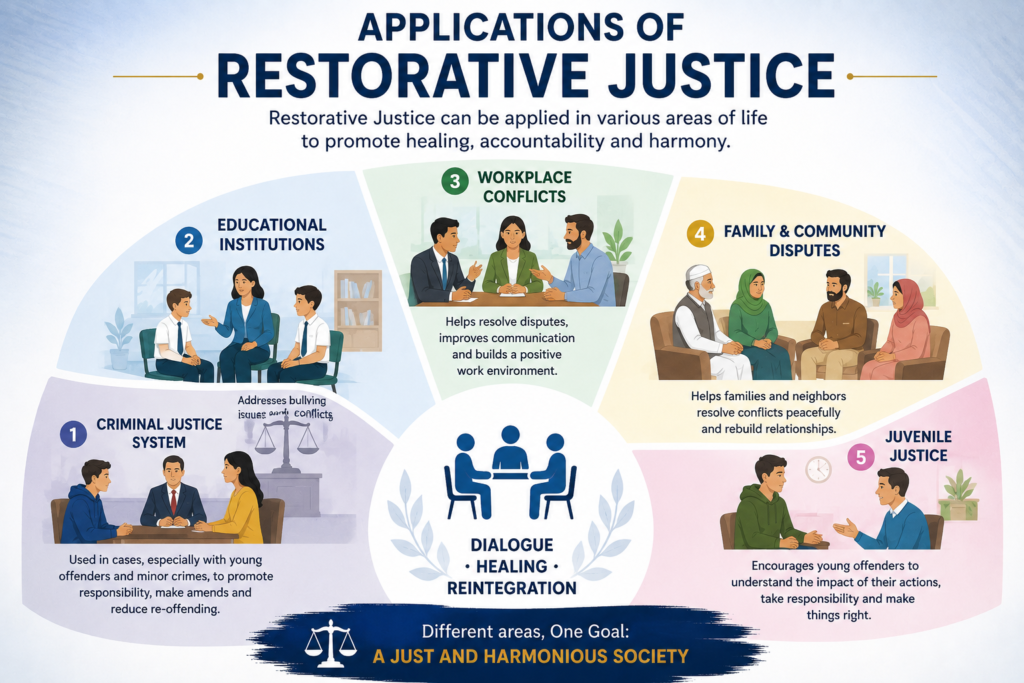
5. Workplace Conflicts
Restorative Justice can help with conflicts at work. It helps people talk and make things right.
6. Juvenile Justice
Restorative Justice is good for offenders. It helps them understand what they did. Make things right.
Advantages of Restorative Justice
Restorative Justice helps victims feel better. It makes offenders take responsibility. It helps people get along and makes society more peaceful. It also helps prevent people from doing things again.
The process is not as confrontational as courts. It focuses on making things right not punishing someone.
Limitations of Restorative Justice
Restorative Justice may not work in every situation. It needs people to want to take part. It may not work with crimes or when people are not willing to cooperate.
Gandhian Principles of Non-Violent Conflict Resolution
Mahatma Gandhi had a way of resolving conflicts. He believed in truth, non-violence, justice and peace. He thought conflicts should be resolved through talking, understanding and mutual respect.
Gandhis philosophy is based on the idea that every person’s important. He believed that lasting peace can only be achieved when disputes are settled without hurting others.
Gandhian Concept of Conflict Resolution
Gandhi thought conflict is natural. Violence is not the answer. He believed that violence may stop disputes for a while. It does not create real peace or justice.
Gandhi emphasized cooperation, not confrontation. He wanted people to focus on everyones welfare and find solutions that promote peace and respect.
Principles of Non- Conflict Resolution
Ahimsa (Non-Violence)
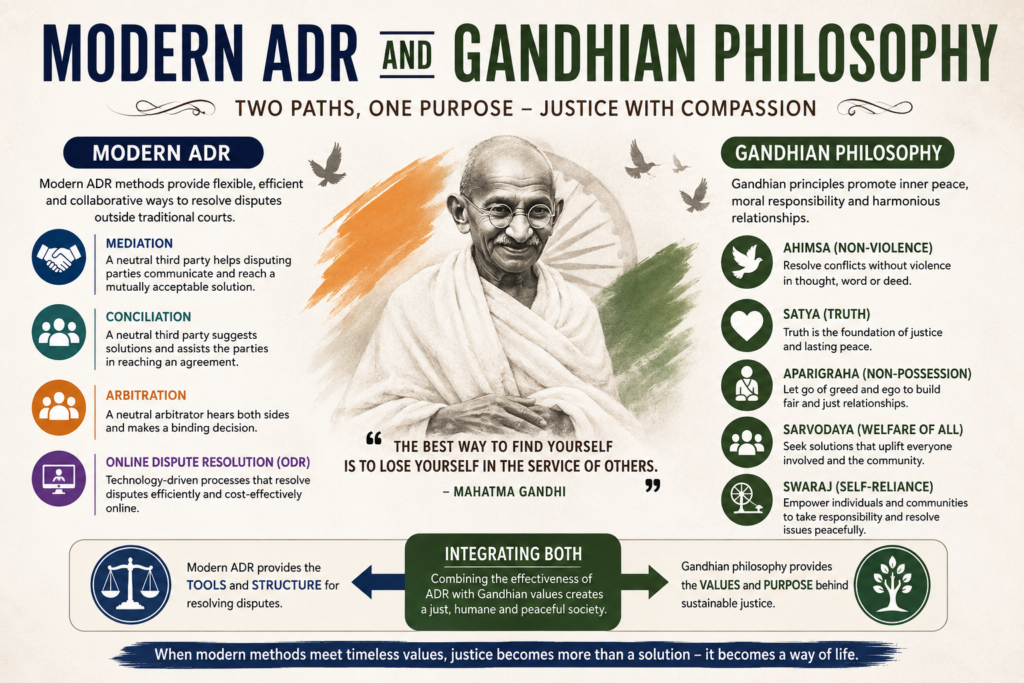
Ahimsa is the most fundamental principle of Gandhian philosophy. It means avoiding physical, verbal, and emotional harm to others. Gandhi believed that violence destroys relationships and creates further conflict, whereas non-violence promotes understanding and peace.
According to this principle, individuals should respond to disputes with patience, compassion, and self-control rather than aggression or retaliation. Non-violence is not a sign of weakness but a demonstration of moral strength and courage. Through Ahimsa, parties can resolve conflicts without causing suffering or hatred.
Satya (Truth)
Truth occupies a central position in Gandhian conflict resolution. Gandhi believed that the search for truth should guide all actions and decisions. Parties involved in a dispute should honestly express their concerns, understand the viewpoints of others, and work towards discovering the truth.
The principle of Satya encourages openness, honesty, and transparency. Conflict resolution becomes more effective when parties avoid deception and focus on finding fair and truthful solutions. Gandhi considered truth and non-violence inseparable because lasting peace can only be achieved when disputes are resolved honestly.
Satyagraha (Force of Truth)
Satyagraha is one of Gandhi’s most significant contributions to conflict resolution. It literally means “holding firmly to truth.” It is a method of resisting injustice through peaceful means without using violence.
Satyagraha involves persuasion, dialogue, moral appeal, and self-sacrifice rather than force or coercion. The objective is not to defeat or humiliate the opponent but to transform their attitude through reason and moral influence. Gandhi believed that every individual possesses a conscience that can be awakened through peaceful resistance and truth.
Respect for Human Dignity
Gandhian philosophy emphasizes respect for the dignity and worth of every individual. Even during conflicts, parties should treat one another with respect and avoid hatred or discrimination. Gandhi believed that every person deserves compassion and understanding regardless of differences in opinion or behaviour.
This principle encourages disputing parties to recognize their shared humanity and work towards solutions that preserve dignity and self-respect.
Tolerance and Understanding
Gandhi advocated tolerance toward differing opinions and beliefs. He believed that conflicts often arise because people fail to understand one another’s perspectives. Therefore, listening carefully and respecting differences are essential for peaceful dispute resolution.
Tolerance promotes constructive dialogue and helps parties identify common interests despite disagreements. By understanding each other’s concerns, disputants can develop mutually acceptable solutions.
Self-Discipline and Self-Control
According to Gandhi, effective conflict resolution requires self-discipline and emotional control. Individuals should not allow anger, hatred, or revenge to influence their actions. Instead, they should remain calm, patient, and committed to peaceful dialogue.
Self-control prevents disputes from escalating into violence and creates an environment conducive to negotiation and reconciliation.
Reconciliation and Forgiveness
Gandhi believed that the ultimate objective of conflict resolution is reconciliation rather than victory. The purpose is to restore relationships and create lasting harmony between parties. Forgiveness plays an important role in this process because it allows individuals to move beyond resentment and hostility.
Through reconciliation, parties can rebuild trust, heal emotional wounds, and establish peaceful relationships for the future.
Gandhian Approach and Modern ADR
The principles developed by Gandhi have greatly influenced ways of resolving disputes, such as mediation, conciliation, negotiation and restorative justice. These methods focus on cooperation talking things through and finding a solution rather than arguing and fighting.
Mediation in particular reflects values because it encourages people to communicate understand each other and find a mutually acceptable solution. Like Gandhis philosophy modern dispute resolution seeks to resolve conflicts while preserving relationships and promoting harmony.
Relevance of Gandhian Principles in Contemporary Society
principles remain highly relevant today, where conflicts arise in families, workplaces, communities and nations. Growing social tensions, political disputes and international conflicts demonstrate the need for methods of conflict resolution.
Non-violent approaches help reduce hostility encourage dialogue and promote peace. Gandhian principles provide guidance for resolving disputes in a manner that respects human dignity, justice and mutual understanding.
Advantages of Gandhian Non- Conflict Resolution
The Gandhian approach promotes peaceful settlement of disputes without causing harm. It preserves relationships encourages respect reduces hostility and creates long-term solutions.
It also strengthens values promotes social harmony and helps individuals develop empathy and understanding toward others. Because the process focuses on reconciliation than punishment it contributes to lasting peace and cooperation among individuals and communities.
Traditional Mediation Practices in Jammu & Kashmir
In Jammu and Kashmir people have been resolving disputes through mediation for centuries. Long before modern courts existed local communities used mechanisms to settle disputes peacefully.
These traditional systems were based on community participation, mutual understanding, social harmony and respect for customs. The primary objective was not to punish individuals but to restore peace maintain relationships and preserve the unity of the community.
Traditional mediation in Jammu and Kashmir reflects the values of cooperation, collective responsibility and reconciliation. Village elders, community leaders, religious figures and local institutions played a significant role in resolving disputes through dialogue and consensus rather than litigation.
Historical Background of Traditional Mediation
The dispute resolution system in Jammu and Kashmir developed as a community-based mechanism where disputes were settled within the village or locality.
People preferred methods that were quick, inexpensive and socially acceptable since access to formal courts was limited. These traditional practices were based on laws, social norms, moral values and collective wisdom.
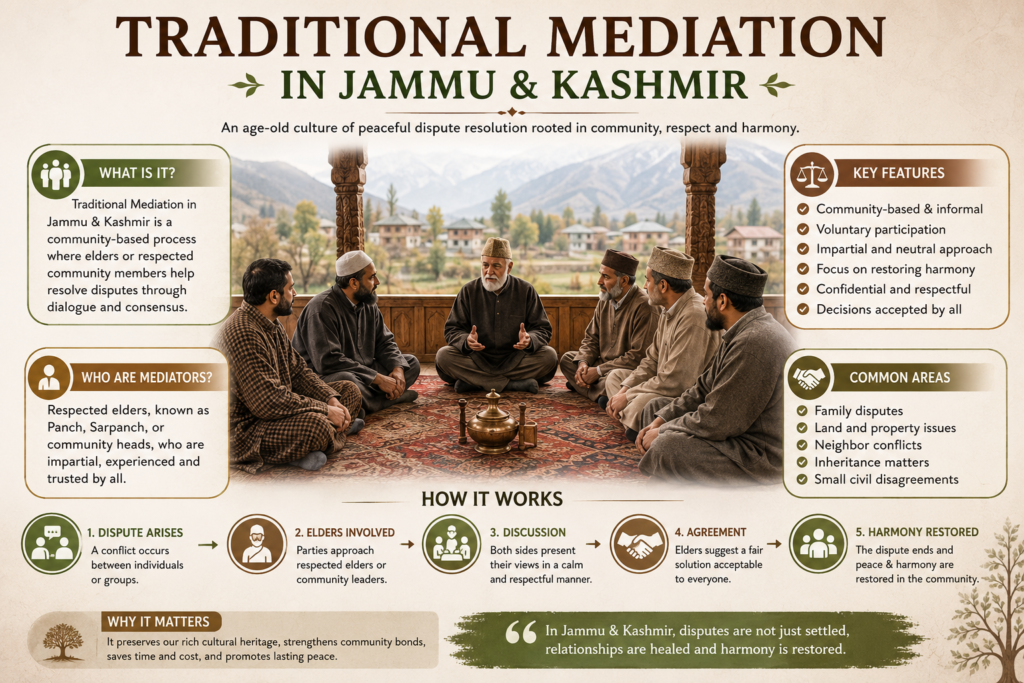
Community members trusted elders due to their experience, impartiality and social standing. Their decisions were generally respected and voluntarily accepted by the parties involved.
The primary goal of these systems was to restore social harmony and prevent conflicts from disrupting community life.
Panchayat System
The Panchayat system was one of the significant traditional mediation practices in Jammu and Kashmir. Panchayats functioned as bodies responsible for addressing disputes and maintaining peace within villages.
Village elders or respected members of society would listen to both parties examine the facts and encourage an acceptable settlement. The emphasis was placed on dialogue, compromise and reconciliation than punishment.
The Panchayat system was particularly effective because the mediators were familiar with customs, social relationships and the circumstances of the dispute. As a result solutions were often practical and acceptable to all parties.
Role of Village Elders
Village elders traditionally served as mediators in disputes involving families, neighbors, land matters, property issues and community disagreements.
Their authority was derived not from legal powers but from social respect and community trust. Elders would bring disputing parties encourage communication and guide them toward a peaceful settlement.
Their experience and knowledge of traditions helped them resolve conflicts in a manner that maintained social harmony. The participation of elders often prevented disputes from escalating into long-term conflicts and preserved relationships within the community.
Role of Religious Leaders
leaders have historically played an important role in dispute resolution in Jammu and Kashmir.
People often approached them for guidance and settlement of disputes because of their authority and influence within society. Religious leaders promoted principles such as justice, forgiveness, compassion and reconciliation.
They encouraged disputing parties to resolve conflicts and restore social harmony. Their involvement was particularly significant in family disputes, matrimonial matters and community conflicts.
The moral and ethical values emphasized by leaders often helped parties reach voluntary settlements and maintain communal peace.
Jirga and Community Councils
In some regions of Jammu and Kashmir disputes were resolved through community councils similar to traditional assemblies.
These gatherings involved members of society who collectively heard the concerns of the parties and proposed solutions. The objective of councils was not merely to determine fault but to restore relationships and maintain community stability.
Decisions were generally reached through consensus and mutual agreement. The collective nature of these councils ensured that the interests of both the disputing parties and the wider community were considered during the resolution process.
Characteristics of Traditional Mediation Practices
Informal Nature: Traditional mediation was highly informal. Did not follow complex legal procedures.
Parties could present their concerns freely without rules or legal formalities.
Community Participation: The community played a role in resolving disputes.
Elders, leaders and respected members contributed to the settlement process.
Emphasis on Reconciliation: The primary objective was reconciliation and restoration of relationships than punishment or victory of one side over another.
Voluntary Compliance: Settlements were generally accepted voluntarily because they were based on understanding and social consensus.
Cost-Effective Process: Traditional mediation involved no financial expenditure making it accessible to all sections of society.
Quick Resolution: Disputes were often resolved promptly without delays ensuring peace and stability within the community.
Importance of Traditional Mediation in Jammu & Kashmir
mediation has played a significant role in maintaining social harmony and peaceful coexistence in Jammu and Kashmir.
These practices provided justice to people living in rural and remote areas where formal legal institutions were not easily available. The system promoted cooperation, mutual respect and collective responsibility.
It helped preserve community relationships. Reduced the need for prolonged litigation. By encouraging dialogue and compromise traditional mediation contributed to stability and conflict prevention.
Many principles underlying mediation, such as consensus-building, community participation and reconciliation continue to influence modern Alternative Dispute Resolution mechanisms.
Relevance to Modern Mediation
Modern mediation shares features with traditional mediation practices.
Both approaches focus on participation, open communication, mutual understanding and peaceful settlement. The role of facilitators, in modern mediation resembles the role played by village elders and community leaders in traditional systems.