
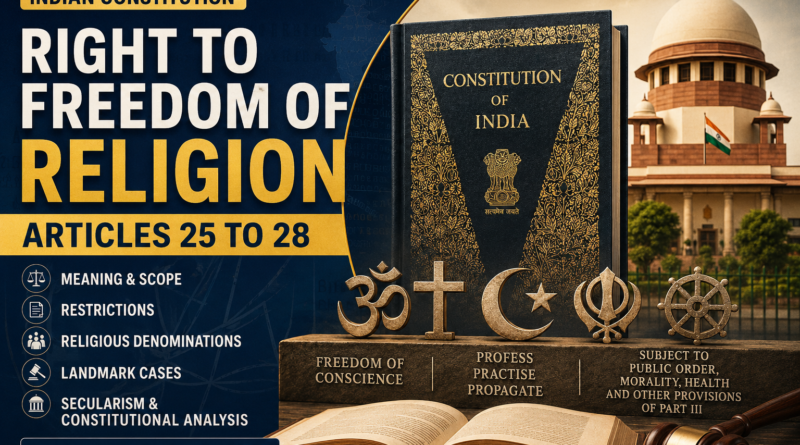
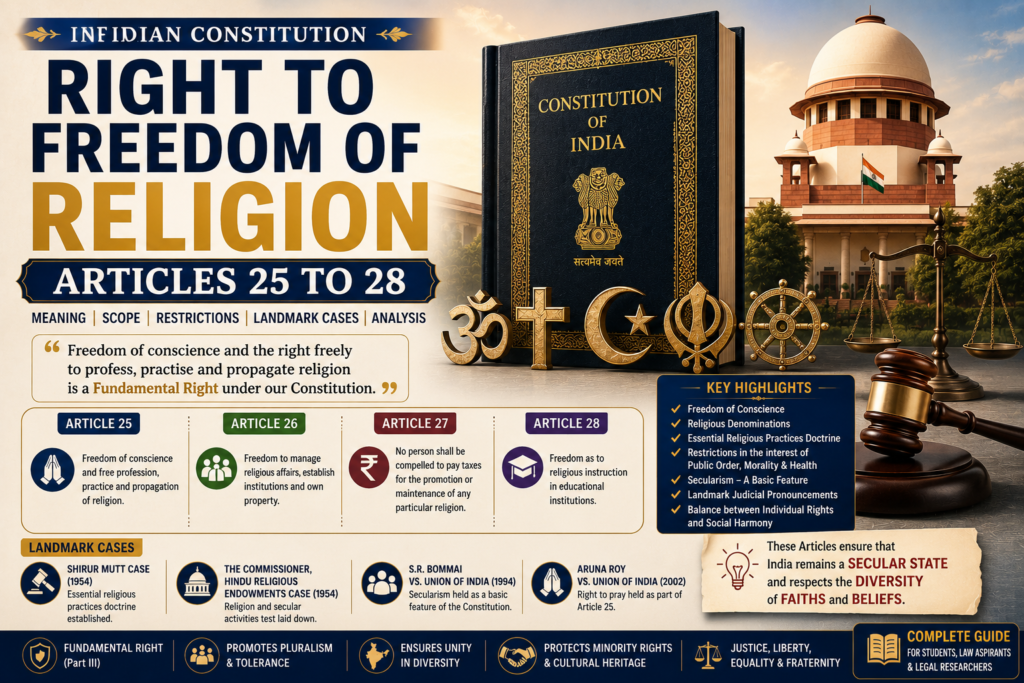
Right to Freedom of Religion Articles 25–28
India is a land of immense religious, cultural and philosophical diversity. People of different religions, faiths, sects and creeds live together inside the same territorial and constitutional borders. Thus, not only does India secure the right to freedom of religion for the citizens based on their innermost belief, but it also promotes the value of coexistence and freedom of choice, individuality, peace and harmony. Hence, The Constitution of India recognises the Right to Freedom of Religion as a Fundamental Right, enshrined in Part III of the Constitution of India, specifically Articles 25-28.
Articles 25-28 provide a wide but qualified relief on the Right to Freedom of Religion for the citizens of India. While articles 25-28 safeguard individual freedoms, they also contain collective rights of religious groups, and the role of the State in regulating certain aspects of the freedom of religion and promoting social reforms. Thus, though the Right to Freedom of Religion is a wide one in India, it is not an absolute right.
Article 25 of the Constitution of India provides that all persons are entitled to the freedom of conscience and the right to freely profess, practice and propagate religion without any discrimination. However, this right is not absolute in nature. The State can restrict the exercise of such freedom of religion, if it adversely affects the public order, morality, health and other rights enumerated in Part III of the Constitution. In addition, the State can also regulate economic, financial, political or other secular matters connected with religious practice, as well as laws concerning social welfare and reform.
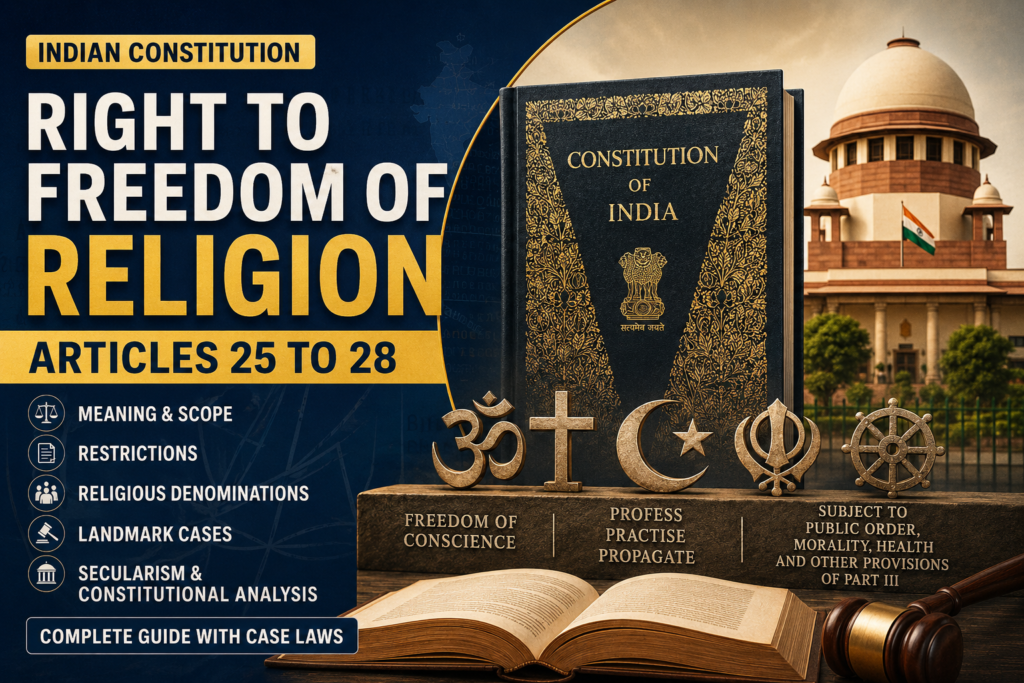
Article 26 of the Constitution of India elaborately discusses the individual and collective aspects of the freedom of religion. Every religious group or section of any religious group, subject to the limitation as provided in article 26, shall have the right to establish and maintain institutions for religious and charitable purposes. In addition, every religious group is entitled to manage its own affairs in matters of religion, and to acquire, possess and administer property in accordance with law.
Article 27 of the Constitution of India states that no person can be compelled to pay any taxes for the purpose of the promotion or maintenance of any particular religion or religious sect. It imposes a restriction on the imposition of taxes, and also highlights the State policy of maintaining a secular character.
Article 28 makes provisions regarding religious instruction in educational institutions, which are administered by the State. It highlights that no religious instruction can be imparted in any educational institution, which is under the exclusive control of the State, except in cases provided in article 28(2). Further, persons attending such institutions cannot be forced to participate in any religious ceremony or practices without the consent of the guardian or the State.
Thus, on a consolidated basis, articles 25-28 of the Constitution of India provide the following freedoms: the freedom of conscience, right to adopt any religious profession, practice or propagation, denominational collective rights, the right to be free from undue religious taxes and restrictions on religious instruction in educational institutions administered by the State.
However, it must also be noted that the Indian Constitution does not provide absolute freedom to practice religion within India. The issues of equality, dignity, public order, morality, health, social reform, secular matters connected with religion, and other Fundamental Rights enumerated in Part III of the Constitution, among others, can impact the freedom of religion. Therefore, the judiciary has played an important role in interpreting the limits and scope of the freedom of religion, and distinguishing between essential and non-essential religious practices.
The interpretation and elaboration of articles 25-28 has led to the formulation of some of the most important doctrines in Indian constitutional law, including the doctrine of Essential Religious Practices. Several important judgments of the Supreme Court of India, including Commissioner, Hindu Religious Endowments, Madras v. Sri Lakshmindra Thirtha Swamiar of Shirur Mutt, Ratilal Panachand Gandhi v. State of Bombay, Rev. Stainislaus v. State of Madhya Pradesh, Bijoe Emmanuel v. State of Kerala and Indian Young Lawyers Association v. State of Kerala have provided invaluable guidance in understanding the nuances of the Right to Freedom of Religion as provided in articles 25-28.
The Right to Freedom of Religion must also be viewed in the larger context of the secular nature of the Indian Constitution. Indian secularism not only permits the protection of the religious interests of all sections of the society, but it is also concerned with preventing any discrimination against any particular group based on religion, securing the rights of minorities, and regulating the relations between the State and religious institutions as necessary or expedient for promoting the general welfare.
Thus, the Indian Constitution provides that while every religious group in India has the right to manage its own affairs, the State can intervene in such matters to the extent necessary for protecting the weaker sections of society or promoting socio-economic reforms. In addition, the Supreme Court of India has held that secularism is not only a policy of the State, but it is also a cardinal principle enshrined in the very fabric of the Indian Constitution, and hence it cannot be easily diluted or disregarded, even in matters of religious practices.
Therefore, the challenge before the judiciary has been to balance the need for protecting the religious interests and freedom of the people with the need to ensure equality, social reform and public order.
This article highlights the Right to Freedom of Religion of the Indian Constitution. It elaborately discusses the Articles 25-28, and throws light on the individual and collective aspects of the freedom of religion, freedom from taxes, restrictions on religious instruction, as well as the limitations and exceptions provided in these articles.
Further, the secular nature and principles of Indian Constitution and doctrines have been discussed for gaining an in-depth understanding of the Freedom of Religion. This article also discusses the important Supreme Court pronouncements on the freedom of religion, as well as the relationship between this fundamental right and other rights. It examines some of the contemporary issues on the freedom of religion to understand the nuances of the Freedom of Religion in India and strike a fine balance between the individual and general welfare.
Historical Evolution of the Right to Freedom of Religion in India Essay
The constitutional rights of Indians to the freedom of religion outlined in Part III did not materialize in isolation. They were preceded by the events of historical importance, namely, the rich and varied experience of religious freedom in India, the introduction of the British colonial government, communal conflicts, social reforms, and debates within the Constituent Assembly.
Religious Freedom: Rich and Varied Experience
India is a country where most of the world’s religions, philosophies, and schools of thought have been present for centuries. On the territory of India, Hinduism and Jainism, Sikhism, and Buddhism developed. Indian philosophers and theologians have long debated religious teachings, methods of achieving salvation, and other issues. Thus, the history of religious freedom in India is the history of society in which many religions live side by side.
In addition, each religion has its own holidays, its own codes of conduct, its own charity, and its own community. Moreover, in India, religion was closely intertwined with caste membership and associated social responsibilities, marriage, private law, and public life in general. Perhaps this is because of the variety of beliefs and the presence of many different religions that persisted over centuries that religious freedom in India was considered a fundamental right.
Nevertheless, the concept of religious freedom in India was inextricably linked with social questions. Some religions did not accept the low caste status, women were deprived of many rights, and some practices, such as sati, were considered shameful. Therefore, in some ways, fighting these inequalities was also a fight for religious freedom. Thus, the right to religious freedom, as well as the need to regulate it, was justified.
Freedom of Religion and the British Colonial Government
In India, the British were confronted with the need to regulate religious affairs. Although they officially adopted a policy of non-intervention, the events of the Revolt of 1857 led to the adoption of many laws concerning Indian religions. In addition, social reforms in British India, such as banning sati and allowing widow remarriage, undermined Muslim and Hindu practices.
At the same time, some laws were passed that regulated endowments for religious needs and established the legal framework for Muslim personal law. Thus, the British were confronted with the problem of determining the place of religion in Indian society. This issue was complicated by the fact that British officials did not have a complete understanding of Indian religions. The principle difficulty facing the authorities was determining the state’s role in regulating or prohibiting Indian social customs.
Constitutional Rights: Development and Emergence
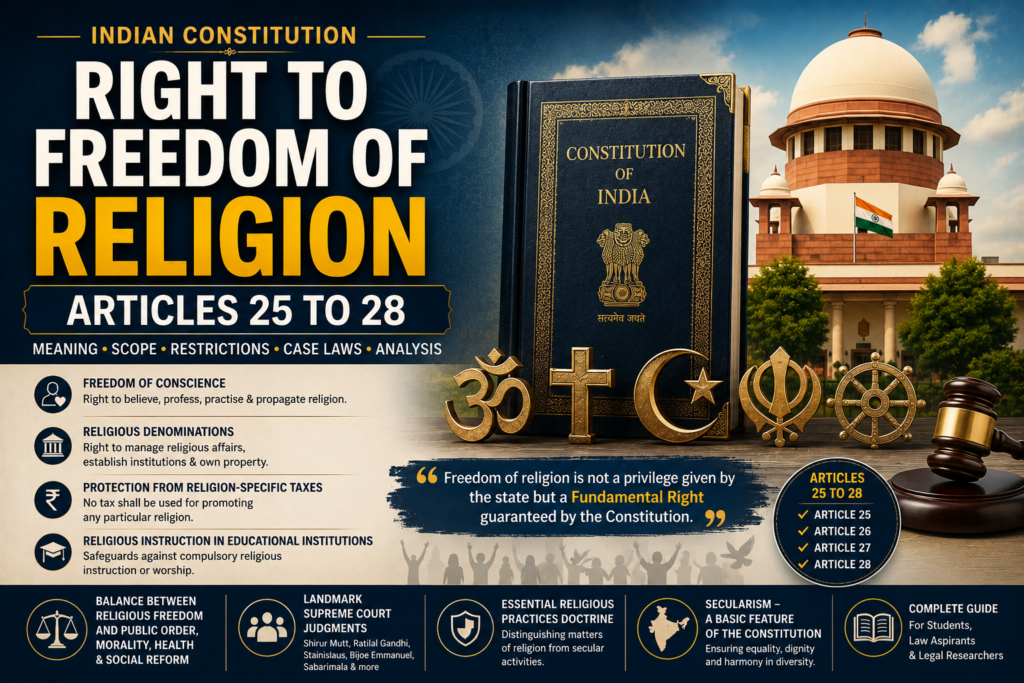
The question of the right to freedom of religion was one of the most pressing issues in the fundamental rights of the Indian Constitution. The draft of the Nehru Report was published in 1928. It laid down the principles of a future Constitution and declared its commitment to social justice and economic equality. Some of the rights described in the report later became part of Part III of the Constitution. In particular, freedom of conscience and the right to the free profession and practice of religion are protected.
The Karachi Resolution of 1931, which enshrined many rights for Indians, also influenced the drafting of the Constitution. The resolution proclaimed the importance of freedom of thought, as well as the free profession and practice of religion. In addition, it established the separation of the state and religion. Thus, the principles outlined in the resolution later served as the basis for part of the Indian Constitution.
Freedom of Religion in the Constituent Assembly
The Constituent Assembly is faced with the need to formulate bills on religious freedom when drafting the Constitution of India. Given the huge number of different religions in India, this issue was raised with great interest in the Constituent Assembly. On the one hand, it was necessary to ensure religious freedom for all. On the other hand, it was necessary to regulate it since there were many controversial issues associated with the implementation of religious practices.
Some of the controversial issues included whether to grant religious freedom only to citizens and not to foreigners, how to formulate the concept of propaganda in a religious context, and to what extent to allow it, whether the autonomy of individual religious associations should be established, and how to relate secular and economic aspects to religion. Moreover, could social reforms take precedence over any religious practices? Should the state finance religious institutions? What place should religious education occupy in state schools?
Constituent Assembly Debates on Freedom of Religion
One of the most contentious issues during the Constituent Assembly debates on the Constitution related to the newly-worded “right to propagate” religion.
While some members raised concerns about propagation and potential issues with conversion, others highlighted the importance of propagation as part of the freedom of religion for the religions where the communication of one’s faith is part of the religion.
Ultimately the word propagation was retained and appeared in the then Article 25.
What the meaning of propagation exactly entailed was left for the Supreme Court to decide, which interpreted it in Rev. Stainislaus v. State of Madhya Pradesh to not include the alleged constitutionally-guaranteed right to convert someone else.
At the same time, the Constituent Assembly was mindful not to allow religious freedom to trample on other legitimate interests, which is why the very structure of Article 25 is notable – while it grants the right to conscience and to practice and propagate one’s religion, another part of the same article preserves the right of Parliament to legislate in areas pertaining to “secular” matters and welfare and reform.
Religious Denominations and Institutional Autonomy
While the focus of the freedom of religion in Article 25 is on the freedom of individuals, the right to religious freedom is not an individual right only, as the Constitution also recognizes the need to safeguard the existence of religious denominations.
That is why Article 26 exists – to preserve the institutional religious freedom for those who wish to organize themselves as religious denominations, and for the sections of such denominations if they choose to divide themselves.
While Article 25(1) focuses on the individual, Article 26 focuses on religious denominations and the institutions they establish.
The Constitution thus recognizes both the individual and institutional aspects of religious freedom. State Funding and Religious Neutrality
The issue of funding was also of concern to the framers, which is why Article 27 exists.
It states that no person can be made to pay taxes “for the promotion or maintenance of any religion,” or “any religious denomination or institution.”
In essence, Article 27 recognizes a fundamental right not to fund any religion, which is an important part of India’s secular outlook.
Article 27 does not simply provide for the neutrality of the state in favor of any religion, but also imposes limits on individuals by protecting them from being obligated to finance the promotion or maintenance of any particular religion.
Religious Instruction and Educational Institutions
The issue of education was particularly challenging because, prior to the Constituent Assembly’s formation, education in India was largely run by religious institutions, including Christian missionaries and Muslim ulema.
At the same time, the new Indian Constitution promotes a secular outlook, which raises the issue of funding for religious educational institutions.
The answer was Article 28. This article preserves the right for educational institutions to provide religious instruction unless they were fully funded by the State.
However, if the State was administering such institutions, which it was in cases of endowments and trusts that required such religious instruction, then such instruction could not be objected to.
Another part of Article 28(3) preserves the rights of anyone attending educational institutions recognized by the State or receiving State aid to refuse to attend any religious instruction or worship, if the instruction or worship did not enjoy the approval of the Constitution.
In short, the Constitution does not impose one-size-fits-all rules on educational institutions with respect to religious instruction. Adoption of Articles 25 to 28
When the Constitution was adopted on 26 January 1950, the Right to Freedom of Religion became a right under the Indian Constitution, a Fundamental Right guaranteed by Part III of the Constitution.
Summing up the rights under Articles 25 to 28, as adopted by the Constituent Assembly, one can list them as:
• right to freedom of conscience and to profess, practise and propagate religion (Article 25);
• rights of religious denominations to manage their religious affairs (Article 26);
• right not to pay taxes for the promotion or maintenance of any particular religion (Article 27);
• rights to regulate religious instruction in educational institutions (Article 28).
The Constitution thus reflects a nuanced approach to the concept of religious liberty that distinguishes between the individual and institutional rights.
Neither does it completely remove religion from the public sphere nor does it allow religious institutions to treat their status as an entitlement to dictate terms to the State.
The Supreme Court would later have an equally important role in interpreting Articles 25 to 28. In cases relating to religious institutions, conversion, and the limits of the right to freely practice one’s religion, as well as cases where other Fundamental Rights took precedence over Articles 25 to 28, it would interpret the exact meaning and reach of the rights under Articles 25 to 28.
Constitutional Philosophy Behind the Right to Freedom of Religion
The Right to Freedom of Religion under Articles 25 to 28 is part of the larger constitutional philosophy of liberty, equality, dignity, fraternity, and, most importantly, secularism. The Constitution recognizes the role of religion in people’s lives while also seeking to ensure that the rights of minorities are protected and that society is governed on principles of liberty, democracy, and social reform rather than religious orthodoxy.
As such, the Constitution fosters a delicate balance between the rights of individuals to religious freedom of conscience, the right to practice and propagate one’s religion, and the rights of religious institutions to manage their religious affairs. At the same time, it imposes limitations on such rights when they conflict with the larger principles of equality and social reform.
Freedom of Religion and the Preamble
The philosophy informing the Right to Freedom of Religion can be found in the Preamble to the Indian Constitution.
The Preamble opens with the words “We, THE PEOPLE OF INDIA, having solemnly resolved to constitute India a SOVEREIGN SOCIALIST SECULAR DEMOCRATIC REPUBLIC,” and proceeds to state that “WE THE PEOPLE OF INDIA DO HEREBY ADOPT, PROMULGATE AND AMEND THIS CONSTITUTION,” which “IN OUR CONSTITUTION WE HOLD THIS TRUTH THAT INDIANA CARRIES THE RIGHT TO EQUAL JUSTICE TO ALL UNDER THE LAW AND RIGHT TO LIBERTY OF THOUGHT, EXPRESSION BELIEF, FAITH & WORSHIP.”
The emphasis in this answer is on the liberty of thought, belief, faith and worship. The very fact that the Preamble mentions the right to liberty of religion along with the rights to freedom of thought, expression, belief, and faith suggests that the freedom of religion in India is interpreted not just in a narrow sense of worship but also as part of the broader liberty of conscience.
Although the word “Secular” in the Preamble was added later by the Constitution (Forty second Amendment) Act, 1976, since its adoption in 1950 the Indian Constitution has stood as a secular document that promotes equality and freedom of religion for all Indians.
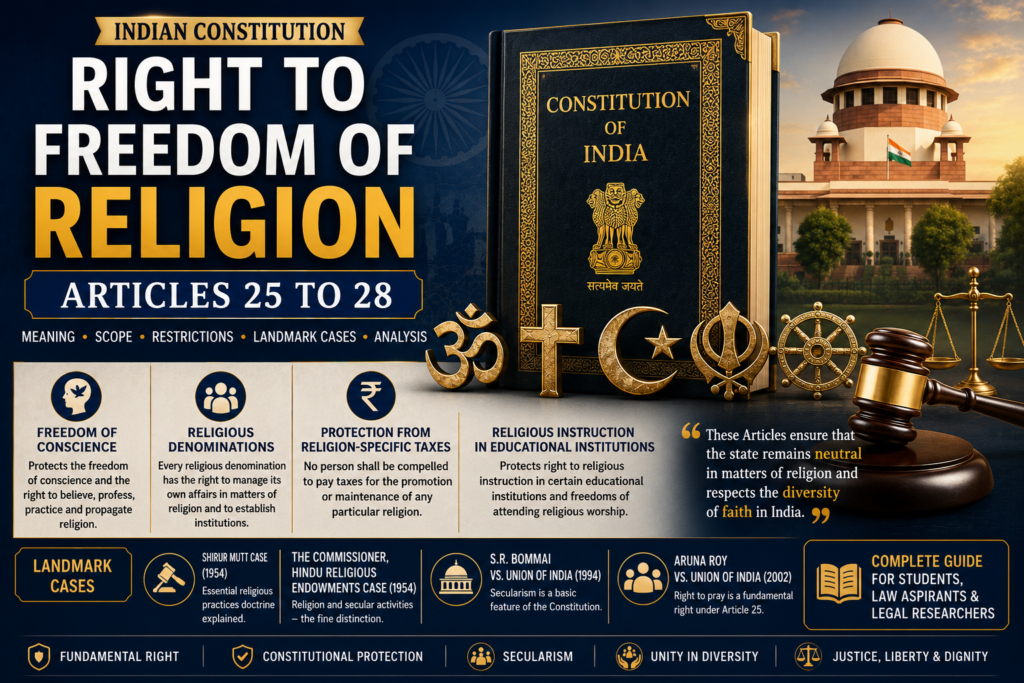
Articles 14, 15, 16, 25, 26, 27 and 28, among others, reflect this secular and progressive outlook of the Constitution.
The Supreme Court has since repeatedly emphasized that even though the word “Secular” was not in the original Constitution, it always was a basic feature of the Constitution.
Liberty of Thought, Belief, Faith and Worship
Liberty is the cornerstone of freedom and the freedom of religion, and in particular the freedom to worship, is one manifestation of such liberty.
A person can have thoughts, beliefs, and faith regarding the meaning of life and her relationship to the creator, and such beliefs can be part of her life and guide her actions – this is why the right to the freedom of religion is intrinsically linked with the right to liberty of conscience.
Article 25 gives such freedom of conscience and the right to profess and practise religion, subject to the limitations stated in the Article. It is important to highlight the freedom of conscience because the protection of one’s innermost thoughts and beliefs is what makes the right to freedom of religion a genuine right.
In other words, one’s innermost thoughts and conscience are guided by one’s individual beliefs, which is why the constitutional rights to freedom of religion also encompass such liberty of conscience.
Freedom of Conscience
The phrase “freedom of conscience” occurs in the Constitution in the formulation “freedom of conscience and religion” in Article 25(1).
Conscience here is used in the sense of that freedom of the individual’s inner world which enables him to embrace or reject, accept or renounce a particular religious belief or conviction, and which is manifested in his or her behaviour subject to the limitations imposed by the Constitution on conduct.
This implies that freedom of conscience differs from the freedom to perform religious practices: the inner core of religious belief is more comprehensive and less subject to official control than the forms and means of its manifestation.
The freedom of conscience is a fundamental right, and its meaning is explained by the fact that differences in beliefs may be manifested in the individual’s conduct, which may be subject to regulation in the interests of society, for example, for health, moral or other reasons, as well as in the interests of protecting the rights of others, and observing other laws of the state.
The Supreme Court has consistently held the view that the right to freedom of conscience and religion is a fundamental right.
This is illustrated by the Supreme Court’s decision in the Bijoe Emmanuel v. State of Kerala (1986) case concerning Jehovah’s Witnesses who refused to sing the National Anthem as an act of conscience.
The Supreme Court ruled that the dismissal of these schoolchildren for refusing to sing the National Anthem was a violation of Articles 19(1)(a) and 25(1) of the Constitution.
The protection of the right to freedom of conscience and religion is particularly important in cases where a citizen’s religious belief differs from the prevailing one.
Religious Freedom and Human Dignity
The right to religious freedom is closely related to another fundamental constitutional value – human dignity.
Dignity is the value of the personality of a human being as a conscious, thinking, and feeling entity capable of forming a view of the world and making decisions based on this vision.
For some people, this inevitably involves religion, while for others it may be associated with a particular way of life.
Therefore, the right to freedom of conscience and religion is related to the right to dignity, which involves respect for the person’s self-consciousness and autonomy.
This is especially important in cases where religious freedom intersects with Article 21, which refers to the right to life and personal liberty.
Today, in constitutional practice, the concept of dignity is increasingly linked with the concepts of privacy, autonomy, and the right to make decisions.
At the same time, the right to dignity can also be violated when, in the name of religious freedom, the rights of other persons are limited.
Thus, when considering religious freedom issues, the Court often has to balance between two or more parties’ rights to dignity and autonomy rather than between the rights of a person and the state.
Religious Freedom and Equality
The principle of equality underpins many aspects of the right to religious freedom.
In particular, Article 14 of the Constitution states that all people are equal before the law and are entitled to equal protection of the law, and Article 15 prohibits discrimination on any grounds, including religion, by the state.
Article 16 of the Constitution also prohibits discrimination on religious grounds in the appointment to state jobs.
These norms imply that no one can be treated as privileged or protected by law only because of their religion, or as unprotected or oppressed, also only because of their religion.
At the same time, in cases where religious groups appeal to the protection of their autonomy in matters of faith, the question of the limits of this autonomy arises, which may be related to issues of equality.
The issues of caste discrimination and the rights of women in religious groups have been the subject of many court cases.
The Constitution provides for the right of all religious groups to freedom of conscience and religion, but at the same time, several articles provide for the possibility of regulation of relations between religious groups and the state.
Thus, Article 25(2)(b) of the Constitution refers to the right of the state to enact laws concerning “social welfare and reform”, including “throwing open Hindu religious institutions of a public character to all classes and sections of Hindus”.
Therefore, the right to religious freedom enshrined in the Constitution is not absolute but is consistent with the principle of equality.
Religious Freedom and Social Reform
An important feature of the Indian Constitution is that it leaves the door open for social reforms, including those related to religion.
This is because Article 25(2)(b) of the Constitution refers to the state’s right to legislate in the field of social welfare and reform.
This wording reflects the idea that the drafters of the Constitution were guided by the principle of social reform within the framework of historical development, which does not contradict the rights of citizens.
Therefore, when considering controversial socio-cultural issues, the Court has to take into account the possibility that a particular practice may have a social and cultural significance, but at the same time may be subject to regulation by law.
This nuance is important because, in disputes about the observance of a particular practice, its religiousness or cultural significance may be invoked as a reason for its protection or, on the contrary, for its regulation.
Thus, the Indian Constitution, unlike the concept of secularism as understood in the West, leaves the door open for social reforms, including those touching on religious practices, and for their development within the framework of the rule of law.
Religious Pluralism
Another fundamental principle of the Indian Constitution that has significance for the issue of religious freedom is religious pluralism.
Pluralism in a broad sense is the view that a democratic society is a habitat for many religions and ideologies, as well as for different social and cultural communities, each of which must have the right to develop within the framework of the law.
Articles 25 and 26 of the Constitution provide for not only individual but also collective religious freedom.
They do not say explicitly that only the majority have the right to practice their religion, and the minority must adapt to them.
On the contrary, the rights enshrined in these articles are especially important for those who adhere to a particular religion, which differs from the dominant one.
Thus, the concept of religious pluralism is linked to the idea of tolerance, which, however, is not enough for building a democratic society.
Constitutional pluralism means that in a democratic society there can be, and should be, collectives and institutions with different worldviews, each of which must develop within the framework of the rule of law, and within the limits of observance of human rights and freedoms.
Fraternity and Religious Tolerance
The Preamble to the Constitution mentions fraternity as a fundamental principle of the Constitution, which is associated with the fact that India is a multi-ethnic and multi-religious country.
Fraternity means the sense of community, mutual understanding, and the feeling of equality among people.
It is this approach that should predetermine the development of relations between different religious groups.
It is natural that people who adhere to different beliefs cannot be united by complete identity of views.
However, in accordance with the principle of fraternity, they should develop a common culture of coexistence based on respect for each other’s dignity and autonomy.
Thus, the right to religious freedom and the right to equality are inalienable rights that should be respected by everyone, including state authorities.
Their observance is essential for building a democratic society.
Individual and Collective Aspects of Religious Freedom
As mentioned above, Articles 25 and 26 of the Constitution guarantee religious freedom both for individuals and for religious associations.
The wording of Article 25 begins with the phrase “all persons” and then refers to the right of every person to freedom of conscience and the right to profess and practice any religion.
At the same time, Article 26 refers to the right of every religious denomination or any of its sections to manage religious and charitable property, to regulate religious life, and to exercise other rights.
Positive and Negative Aspects of Religious Freedom
Freedom of religion can also be viewed as having positive and negative aspects.
The positive aspect protects a person’s right, subject to constitutional limitations, to adopt or hold a particular religion and to manifest and spread it.
The negative aspect protects a person from coercion by the State to accept or participate in a particular religious practice.
Article 28(3) provides a classic example of such a protection. It prohibits a person attending an educational institution under the State’s control or receiving state aid from being forced to receive religious instruction or to attend worship in the institution or its premises without the consent of the State.
Thus, freedom of religion also includes a negative aspect that protects a person from coercion in the sphere of religion.
Freedom of Religion Is Not Absolute
Despite the importance of freedom of religion, it is not absolute.
Article 25(1) explicitly makes the right to freedom of religion subject to the following qualifications:
public order, morality, health, and the other provisions of Part III.
Similarly, Article 26 makes the denominational rights set out in it subject to public order, morality, and health.
In addition, Article 25(2) makes the right to freedom of religion subject to state regulation of “economic, financial, political, or other secular activities” connected with religious practice and provides for state laws on social welfare and reform.
Thus, the Constitution does not grant absolute freedom of religion or absolute freedom for religious associations.
The Constitution does not provide for a complete separation of religion and the State.
Instead, it seeks to balance various interests: the need for religious freedom against the need for public order and social reform, the rights of religious associations against the state’s authority to regulate matters of public interest, and so on.
Constitutional Morality and Religious Freedom
In modern Indian constitutional law, the concept of constitutional morality has also entered the discussion of religious freedom.
Constitutional morality is a broad concept that, roughly speaking, implies fidelity to the principles and spirit of the Constitution, not only those norms that enjoy social approval.
The concept of constitutional morality is closely related to the discussion of religious freedom insofar as the application of constitutional morality may require a person to abandon traditional religious practices that violate constitutional principles such as equality, dignity, or the right to freedom of conscience.
The Sabarimala litigation, Indian Young Lawyers Association v. State of Kerala , is an example of such a discussion. The various opinions expressed in this case touched on many aspects of the freedom of religion, including Articles 25 and 26, raised questions of equality and dignity, and addressed constitutional morality.
Since some of the ideas expressed in this litigation have since been further developed in other cases, it is important to understand that constitutional morality is not a principle according to which all religious practices may be declared unconstitutional. On the contrary, in order to understand the place of religion in the modern Indian state, it is necessary to study the texts of the Constitution and specific cases that discuss them.
Constitutional Balance: The Foundation of Articles 25-28
In a nutshell, the philosophy of Articles 25-28 is based on the idea of constitutional balance.
The Constitution protects the inner freedom of conscience and the right to express it through various religious practices, as well as the autonomy of religious associations in matters related to religion. At the same time, it imposes restrictions on state financing of religious associations, provides for state regulation of economic and other secular aspects of religious practice, and places restrictions on religious practice in educational institutions.
In other words, the Indian Constitution takes into account the need for both religious freedom and social order, and the state’s need to regulate society based on the principles of equality and social justice.
Thus, the Right to Freedom of Religion in India should be interpreted in a way that allows for the development of society within the framework of constitutional law, ensuring not only the freedom of conscience, religion, and the right to equality but also the authority of the state to ensure social order and implement social reforms.
Secularism under the Indian Constitution
Secularism is one of the principles of the Indian Constitution, and it underlies many aspects of the freedom of religion. The concept of secularism is so closely related to the concept of freedom of religion that the two terms are sometimes used interchangeably. However, it is important to distinguish between them.
In essence, secularism is a principle that determines the relationship between the State and religious associations, as well as the mutual relationship between different religious associations. It is also important to understand that secularism does not imply a complete separation of religion and the State. The Indian Constitution allows for state involvement in regulating matters of religion.
The Indian Constitution does not establish any particular religion as the state religion. At the same time, it protects the rights of religious associations, ensuring their separation from the state, as well as protecting individuals from discrimination based on religion. Thus, Indian secularism is not based on the principle of an absolute separation of church and state but rather on a set of constitutional norms that protect religious associations and ensure equality between them.
Meaning of Secularism
In the broadest sense of the word, secularism is the principle that the State does not support or oppose any particular religion and that the separation of church and state is necessary.
A secular state does not require people to renounce their religion or observe their religious practices only in private life.
Secularism is a principle that regulates the relationship between the State and religious associations, and it does not require people to renounce their religion.
Thus, secularism should not be confused with atheism, which is a belief that God or gods do not exist.
Atheism is a worldview, while secularism is a principle that guides the actions of the State.
A secular state can consist of both atheists and religious people.
Secularism and the Preamble
The Preamble to the Indian Constitution explicitly states that India is a “Sovereign Socialist Secular Democratic Republic.” The word “Secular” was added to the Preamble by the Constitution (Forty-second Amendment) Act, 1976.
However, this does not mean that secularism was not part of the original Constitution. Although the word “secular” did not appear in the original Preamble, many of the provisions of the Constitution guarantee freedom of religion and equality before the law regardless of religion. In particular, Articles 14, 15, 16, and 25-28 of the Constitution contain norms reflecting secularism.
Thus, the Forty-second Amendment Act of 1976 did not create a new constitutional principle but rather enshrined secularism in the Preamble to the Constitution.
In addition, it is worth noting that the Preamble to the Indian Constitution also reflects the principle of liberty, which is explicitly mentioned in the text of the Preamble. In particular, the Constitution guarantees “liberty of thought, expression, belief, faith and worship,” which also reflects the principle of secularism.
Indian Model of Secularism
The Indian model of secularism differs from the Western one in that it allows for a more extensive interaction between the State and religious associations.
In particular, the Indian Constitution allows the state to regulate certain aspects of religion, for example, economic, financial, or political ones. At the same time, the state is obliged to respect the autonomy of religious associations in other areas. This approach is based on Articles 25(2)(a) and 25(2)(b), which state that the state may regulate or restrict “economic, financial, political, or other secular activity which may be associated with religious practice” and “social welfare and reform, including the throwing open of Hindu religious institutions of a public character to all classes and sections of Hindus.”
Thus, the Indian Constitution does not separate religion and the State but rather sets out a list of issues in which the two may interact. This approach is more flexible than the Western one, which is based on the principle of separation of church and state.
Indian and Western Models of Secularism
When discussing the differences between the Indian and Western models of secularism, it is important to recognize that there is no single Western model. There are several variations of secularism in different countries, such as the United States, France, and the United Kingdom. Each of these countries has its own approach to the relationship between the State and religion.
In particular, the US model of secularism is based on the First Amendment to the Constitution, which prohibits the establishment of any state religion and protects the right to free exercise of religion. At the same time, the French model of secularism, or laicism, is based on more strict separation of church and state. The UK model of secularism is different in that it has an established church, the Church of England, but at the same time, other Christian churches have the right to exist and practice their religion.
Constitutional Provisions Reflecting Secularism
Although Articles 25 to 28 deal primarily with freedom of religion, the secular nature of the Constitution is also evident from other articles.
Article 14 – Equality Before Law
Article 14 of the Constitution provides that all people are equal before the law and are entitled to equal protection of the law.
This principle of equality underpins secular government because the state has to act objectively towards individuals and groups.
Article 15 – Prohibition of Discrimination
Article 15(1) of the Constitution prohibits the state from discriminating against any person on the basis of religion, race, caste, sex, place of birth or any combination of these.
It will be seen that religion is specifically enumerated as a prohibited ground of discrimination.
Article 16 – Equality of Opportunity in Matters of Employment
In addition, Article 16 provides for the principle of equality of opportunity in employment.
Article 16(2) prohibits the discrimination against citizens in employment or matters connected with employment on the grounds of religion, race, caste, sex, race, place of birth, residence or any of them.
Article 25 – Freedom of Conscience and Religion
Turning to Articles 25 to 28, it may be noted that Article 25 confers on all people the right to freedom of conscience and the right to practise and propagate religion.
It is the most comprehensive of all Articles in the Constitution dealing with religious freedom in the individual capacity.
Article 26 – Freedom to Manage Religious Affairs
In turn, Article 26 lays down the freedom in respect of religious denomination or any section thereof.
This Article gives religious freedom a collective as well as institutional dimension.
Article 27 – Freedom as to Payment of Taxes for Promotion of Religion
In the same vein, Article 27 of the Constitution imposes a restriction on the state as regards the levy of taxes for the purpose of promoting or maintaining any particular religion or religious denomination.
Article 28 – Religious Instruction and Worship
Similarly, Article 28 deals with religious instruction and worship in educational institutions bearing a relationship to the state.
Articles 29 and 30 – Cultural and Educational Rights
It is also pertinent to note Articles 29 and 30 of the Constitution which deal with cultural and educational rights.
Like Articles 25 and 26, Articles 29 and 30 may be said to reflect the secular character of the Indian Constitution.
However, Articles 29 and 30 must not be seen merely as supplements to Articles 25 and 26.
They embody distinct freedoms guaranteed to the citizens of India.
Article 25 of Indian Constitution
Article 25: Freedom of Conscience and Free Profession, Practice and Propagation of Religion
Article 25 is the most important fundamental right in the Constitution as it protects the right of freedom of conscience and the right to freely profess, practice and propagate religion. However, Article 25 also recognises that such freedom is qualified by certain restrictions.
Article 25 is important because it protects not only the innermost belief but also some of the outer manifestations of religion. It also makes it clear that the state can regulate certain secular matters connected with religion and can legislate for social welfare and reform.
Thus, Article 25 seeks to strike a balance between the individual’s conscience and the state’s compulsions, between the right to propagate religion and the rights of others, between individual liberty and social order, and between individual freedom and the state’s reforming initiatives.
Text and Structure of Article 25
Article 25 is headed:
“Freedom of conscience and free profession, practice and propagation of religion.”
This Article can be conveniently divided into four parts.
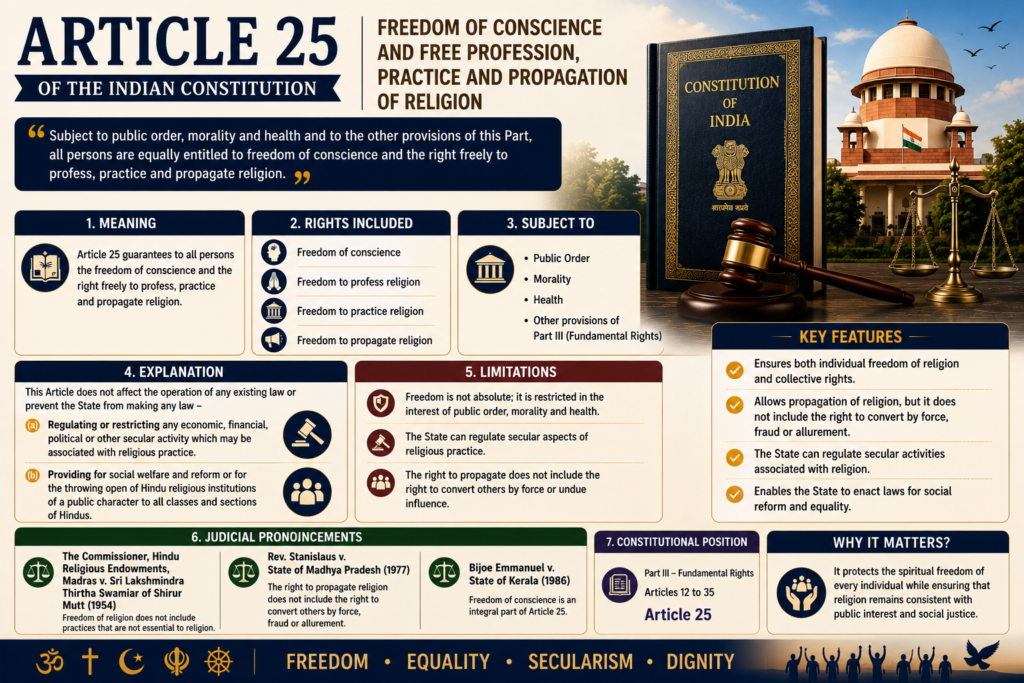
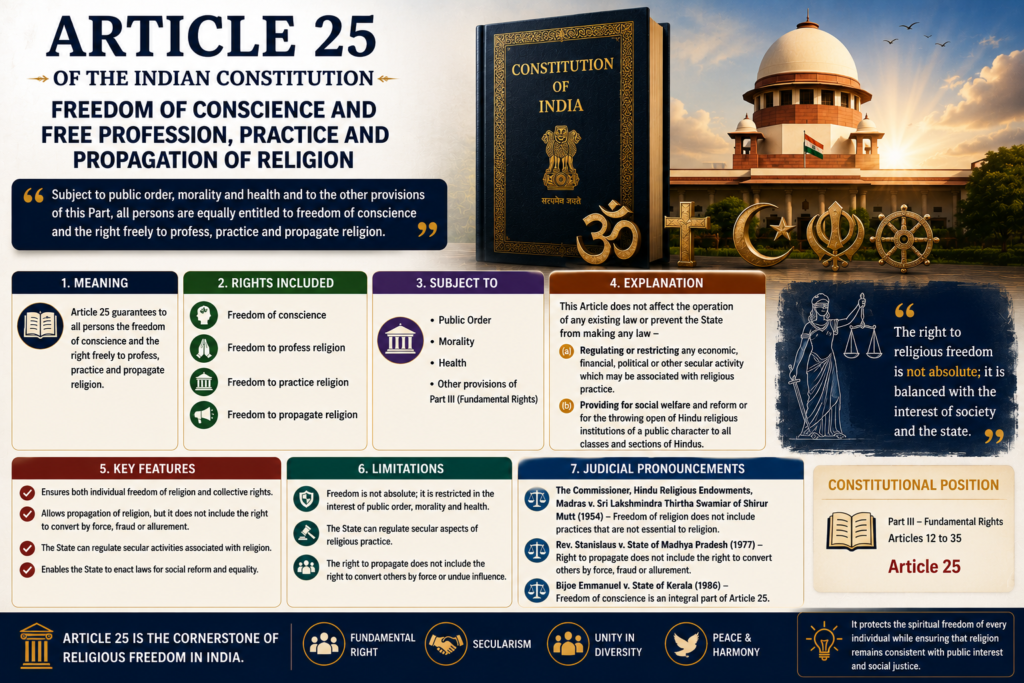
The first part, which consists of Article 25(1), states that all persons are entitled to freedom of conscience and to freely profess, practice and propagate religion, subject to public order, morality, health and other provisions of Part III of the Constitution.
The second part, which consists of Article 25(2), states that nothing in Article 25 shall prevent the state from making laws regulating or restricting any of the secular activities associated with religious practice or from making laws providing for social welfare and reform.
The third part consists of two explanations to Article 25. Explanation I provides that for the purposes of Article 25, the wearing and carrying of kirpan shall be deemed to be included in the profession of the Sikh religion.
Explanation II provides that for the purposes of Article 25(2)(b), references to Hindus shall be deemed to include persons professing the Sikh, Jaina and Buddhist religions. Correspondingly, references to Hindu religious institutions are to be read as references to religious institutions of the Sikh, Jaina and Buddhist religions.
Thus, Article 25 has to be read as a whole, keeping in mind its various parts and explanations.
Article 25(1): The Core Guarantee
Article 25(1) provides, in substance, that subject to public order, morality, health and other provisions of Part III of the Constitution, all persons are entitled to freedom of conscience and to the right to freely profess, practice and propagate religion.
These terms need some elaboration as they represent different aspects of the right to religious freedom.
Freedom of conscience basically refers to the innermost belief, which may include a wide range of convictions, religious or otherwise. To profess religion, on the other hand, means to openly declare or manifest one’s faith.
To practise religion means to perform or observe religious duties, rites, rituals or ceremonies. To propagate religion means to spread or teach one’s religious beliefs.
It is important to distinguish between these terms as the Constitution protects not only the innermost belief but also the outer manifestations of religion, subject to certain restrictions. Thus, Article 25 provides for a measure of protection for all levels of religious practices, from the innermost conviction to the outermost manifestations.
Article 25 Is Available to “All Persons”
One of the most important features of Article 25 is that it says that these rights are available to “all persons”.
Thus, the rights guaranteed by Article 25 are not limited to citizens of India.
This is an important distinction because some of the other fundamental rights, such as those enumerated in Article 19, are expressly available to citizens only.
The expression “all persons” in Article 25, therefore, makes the rights conferred by it available to everyone who is subject to the Constitution, including foreign nationals. The Supreme Court has consistently taken a broad view of the expression “all persons” in Article 25.
In Ratilal Panachand Gandhi v. State of Bombay, for instance, the Supreme Court said that the guarantee of Article 25 is available to all persons and is not restricted to citizens of India.
The significance of this observation is enormous as it means that even a foreigner can rely on Article 25 to protect his or her religious freedom.
Article 25 Protects Both Belief and Manifestation
Article 25 protects both the innermost belief as well as the outermost manifestations of religion.
The former is expressed in the freedom of conscience and the latter is reflected in the rights to profess, practise and propagate religion. One may crudely distinguish between the two by saying that the former is the internal aspect of religion while the latter is the external aspect.
However, it is important to remember that the two are not always the same. The State cannot dictate what a person may believe in, but it can regulate his or her external manifestations of religion, provided such regulation is not an unreasonable restriction on his or her religious freedom.
A person’s profession and practice of religion can be regulated if it affects public order, morality, health or other rights conferred by Part III of the Constitution.
Thus, a religious procession or the use of loudspeakers for religious purposes may be regulated if it causes inconvenience to the public or if it is contrary to public order or morality. The management of religious institutions or funds or the collection of religious taxes may also be regulated if it affects public order or morality or health or other rights guaranteed by the Constitution.
It is important to understand that religious freedom cannot be asserted in a manner that causes injury to other people or to public order, morality or health. Thus, when assessing whether a particular law or order is a valid restriction on religious freedom, it is necessary to look at the nature of the activity as well as the nature of the restriction.
Article 25 Protects Religious Freedom, but the Right Is Not Absolute
The freedom of conscience and the right to freely profess, practise and propagate religion are subject to certain restrictions. Article 25(1) begins with the words:
“Subject to the provisions of this Constitution and subject to public order, morality and health…”
This means that no one can claim an absolute right to religious freedom. Religious freedom can be regulated if it affects public order, morality and health. It can also be regulated by the other provisions of Part III of the Constitution. These restrictions are discussed below.
Public Order
The freedom of conscience and the right to freely profess, practise and propagate religion are subject to public order.
This means that the state can regulate or restrict any religious activity if it is necessary to maintain public order. Religious processions, as noted earlier, may be regulated if they cause inconvenience to the public or if they are contrary to public order. A person may have a fundamental right to hold a procession, but he or she cannot exercise this right in a manner that causes inconvenience to the public or disrupts public order.
The state can impose restrictions on such processions so long as they are consistent with the other fundamental rights conferred by the Constitution.
Morality
Article 25 is also subject to morality. The concept of morality is not easy to define as it can change over time and vary from community to community.
There have been several debates about whether morality should be determined by the majority community or not. In the context of modern Indian jurisprudence, the term “morality” has acquired a new dimension as the Constitution now guarantees various rights to citizens. Consequently, morality cannot always be defined by the majority community as it has to take into account the rights of minorities as well.
The relationship between morality, constitutional morality and religious freedom will be discussed later as this issue has acquired great significance in recent years, particularly in connection with conflicts between various fundamental rights.
Health
Article 25 is also subject to health. This means that the state can regulate any religious activity if it is necessary to maintain or restore public health. Regulation of sanitation, for instance, is an important measure for maintaining public health. Such regulation may incidentally restrict certain religious activities, but it will not be considered an unwarranted restriction on religious freedom.
Other Provisions of Part III
This is perhaps the most important qualification to the right to religious freedom.
Article 25 expressly states that the rights conferred by it are subject to the other provisions of Part III of the Constitution.
Part III of the Constitution contains various other fundamental rights, including the right to equality, the right to freedom, the right to education, the right to freedom of religion, the right to life and personal liberty and the right to constitutional remedies, among others.
Thus, the various rights conferred by Part III have to be read together with Article 25. This becomes particularly important when one fundamental right conflicts with another. The question of whether and to what extent Article 25 can override Articles 14, 15, 17, 19 and 21, for instance, has generated a lot of discussion and litigation.
Article 25(2): Power of the State to Regulate and Reform
Article 25(2) is also an extremely important part of the Constitution. Even though Article 25(1) guarantees the right to religious freedom, Article 25(2) makes it clear that the state can legislate on certain matters.
The state can legislate on two types of matters:
(a) Regulation of secular activities associated with religious practice; and
(b) Laws providing for social welfare and reform, including the throwing open of Hindu religious institutions of a public character to all classes and sections of Hindus.
(a) Regulation of Secular Activities Associated with Religious Practice
The state can regulate or restrict any economic, financial, political or other secular activity associated with religious practice. This clearly shows that not every activity carried out by a religious organisation is a religious activity.
Some activities, such as financial transactions, management of property, recruitment and other commercial activities, may be regulated by the state even if they are carried out by religious organisations.
This distinction between religious and secular activities carried out by religious organisations has been crucial in many court cases. The famous Shirur Mutt case, for instance, turned on this very distinction. This case, which concerned the management of a Hindu mutt or monastery, will be discussed in detail later.
(b) Social Welfare and Reform
The second part of Article 25(2) makes it clear that the state can legislate for social welfare and reform.
This includes legislation throwing open Hindu religious institutions of a public character to all classes and sections of Hindus.
This part of the Article shows that the Indian Constitution does not give absolute freedom to religious organisations. It also shows that the Indian Constitution has a reformist character as it enables the state to intervene even in matters pertaining to religion.
In fact, social reform was one of the main objectives of the Constitution as it sought to end social evils such as untouchability and to promote social equality. Article 25(2) clearly states that the state can legislate for social reform even in matters pertaining to religion.
Explanation I to Article 25: The Sikh Kirpan
Explanation I to Article 25 provides that for the purposes of this Article, the wearing and carrying of kirpans shall be deemed to be included in the profession of the Sikh religion.
This clearly shows that the Sikh kirpan is considered to be an integral part of the Sikh religion. Explanation I is important because it brings the kirpan within the scope of Article 25. However, it should also be noted that very few other religious practices have been specified in the Constitution. In fact, no other religious practice has been specifically mentioned in any of the fundamental rights.
Explanation I should therefore be read with the rest of Article 25, including the various restrictions and qualifications that apply to this fundamental right.
Explanation II to Article 25
Explanation II to Article 25 clarifies that for the purposes of Article 25(2)(b), references to Hindus shall be deemed to include persons professing the Sikh, Jaina and Buddhist religions. Correspondingly, references to Hindu religious institutions are to be read as references to religious institutions of the Sikh, Jaina and Buddhist religions.
It is important to note that Explanation II applies only to Article 25(2)(b). It should not be read as a general declaration that the Sikh, Jaina and Buddhist religions are the same as Hinduism.
Individual Religious Freedom under Article 25
Article 25 has to be read with Article 26 as the two Articles deal with related but distinct subjects.
The main difference between the two is that Article 25 protects the rights of individuals while Article 26 protects the rights of religious organisations. Article 25 deals with matters concerning conscience and the profession, practice and propagation of religion while Article 26 deals with the management of religious organisations, institutions or places of worship, including the management of property and funds belonging to them.
Thus, while Article 25 protects the right of an individual to change his or her religion or to propagate one’s religion, Article 26 protects the right of a religious organisation to manage its affairs freely.
The two Articles can be distinguished but they cannot be separated as various disputes concerning religion often concern both Articles.
Religious Freedom and Secular Activities
One of the most important principles concerning Article 25 is that religion and secular activities associated with religion are not the same.
A religious organisation may engage in a variety of activities, some of which may be genuinely religious in nature while others may be of a purely secular nature.
Article 25(2)(a) makes it clear that the state can regulate or restrict any economic, financial, political or other secular activity associated with religious practice.
This distinction between religious and secular activities carried out by religious organisations has proved to be extremely crucial in a number of court cases. In fact, this distinction has provided the basis for the development of the Essential Religious Practices doctrine. This doctrine, which was articulated by the Supreme Court, holds that in order to determine whether a particular practice is a fundamental part of a religion, the court has to distinguish between religious and secular activities carried out by religious organisations.
Relationship between Article 25 and the State
Article 25 does not create a situation in which the state has absolute authority over religion or in which the state has no authority at all over religious organisations.
It strikes a balance between the two by distinguishing between different aspects of religion.
On the one hand, the Constitution protects the individual’s right to conscience, profession, practice and propagation of religion. On the other hand, the Constitution also enables the state to intervene in matters concerning public order, morality and health, to regulate secular activities carried out by religious organisations, and to legislate for social welfare and reform.
It is therefore the job of the court to determine where a particular dispute falls within this framework. This is the reason why Article 25 has generated so much litigation.
Meaning of Freedom of Conscience, Profess, Practise and Propagate Religion
Article 25(1) provides that all persons are entitled to the freedom of conscience and the right freely to profess, practise and propagate religion subject to public order, morality, health and the other provisions of Part III. The four freedoms protect both the inner freedom of conscience and the outer freedom of manifestation of religion.
Freedom of Conscience
Freedom of conscience means the freedom of a person to form, hold and follow his beliefs and convictions in matters of religion. It is the inner freedom of a person to decide what to believe in religious matters according to his conscience without coercion. It is a wider concept than merely the freedom to belong to a certain religion. It also protects the individual from being forced to believe or hold a certain religion against his conscience.
The freedom of conscience is illustrated by the Supreme Court decision in Bijoe Emmanuel v. State of Kerala (1986). The Court ruled that the expulsion of school children belonging to the Jehovah’s Witness faith for refusing to sing the National Anthem was a violation of Articles 19(1)(a) and 25(1) of the Constitution. The children stood up while the National Anthem was being played but refused to sing it on the grounds of their religious beliefs. According to the Supreme Court, their fundamental rights to freedom of conscience and profession of religion were violated.
Freedom of conscience thus protects a person’s inner freedom of belief and choice of religion.
Right to Profess Religion
The word “profess” means to declare or openly avow one’s religion. The right to profess religion is therefore the right to declare or openly avow one’s religion. Whereas freedom of conscience protects a person’s inner freedom of belief and choice of religion, the right to profess protects his freedom to declare or openly avow his religion.
Profession of religion may therefore take various forms including declaring one’s religion or making known one’s religious beliefs and practices. It may also involve manifesting one’s religion by words or symbols or by other conduct or signs generally recognised as religious.
An illustration of the right to profess religion is provided in Article 25 itself. Explanation II to Article 25 states that for the purpose of this Article, the wearing and carrying of kirpans shall be deemed to be included in the profession of the Sikh religion. It follows that the right to profess religion protects a person’s freedom to manifest his religion by words or symbols or by other conduct or signs generally recognised as religious. It thus goes beyond the mere freedom of conscience.
Right to Practise Religion
The right to practise religion means the right to observe religious practices of one’s choice. Religious practices may take various forms including prayer, worship, religious services, festivals, observances, rites, ceremonies and pilgrimages. The right to practise religion therefore protects a person’s freedom to perform such practices.
In Commissioner, Hindu Religious Endowments, Madras v. Sri Lakshmindra Thirtha Swamiar of Shirur Mutt (1954) the Supreme Court ruled that religious practices include not only beliefs and doctrines but also acts of worship in pursuance of such beliefs and doctrines. The Court held that the right to practise religion is therefore not merely a negative right but also a positive one.
However, the right to practise religion is subject to the restrictions imposed by law in the interests of public order, morality and health and other provisions of Part III. In addition, Article 25(2)(a) authorises the State to regulate or restrict economic, financial or political rights in relation to religious practices. It follows that Article 25 protects religious observances while at the same time allowing for regulation of the secular aspects of religious practices.
Right to Propagate Religion
The word “propagate” means to spread or transmit something. The right to propagate religion therefore means the right to spread or transmit one’s religious beliefs and doctrines. It is a right to explain, preach and teach one’s religion to others subject to the restrictions provided in the Constitution.
The right to propagate religion may therefore take various forms including preaching, teaching, counselling, discussion or distribution of religious literature. However, it is important to note that the right to propagate religion is different from the right to convert others to one’s religion. The right to propagate religion is the right to spread one’s religion while the right to convert others is the right to persuade another person to change his religion.
In Rev. Stainislaus v. State of Madhya Pradesh (1977) the Supreme Court held that the word “propagate” means to spread or transmit one’s religious beliefs and doctrines. The Court ruled that Article 25 does not confer a fundamental right to convert another person to one’s religion. The reason for this ruling is that Article 25 protects the right to freedom of conscience of all persons. The right to propagate religion by one person must therefore be balanced against the right to freedom of conscience of another person.
Difference between Conscience, Profess, Practise and Propagate
| Expression | Meaning | Simple Example |
| Conscience | Freedom to hold one’s own religious beliefs and convictions | Believing in a particular faith according to one’s conscience |
| Profess | Freedom to openly declare or express one’s religion | Openly identifying oneself as a follower of a religion |
| Practise | Freedom to perform religious rituals, worship and observances | Offering prayers or participating in religious ceremonies |
| Propagate | Freedom to communicate and spread religious teachings | Peacefully explaining or preaching the teachings of one’s religion |
These four expressions demonstrate the broad scope of Article 25. Conscience protects internal belief; profession protects its outward acknowledgment; practice protects religious observance; and propagation protects the communication of religious teachings. Together, they provide comprehensive protection to individual religious liberty, subject to the constitutional limitations contained in Article 25.
Restrictions on the Right to Freedom of Religion under Article 25
The Right to Freedom of Religion, as guaranteed under Article 25, is a Fundamental Right, but it is not an absolute right. Article 25(1) explicitly provides that the rights under clause (1) are subject to public order, morality, health and the other provisions of Part III.
These exceptions allow the state to regulate the exercise of religious freedoms to the extent necessary to protect public order, morality, and health, but state actions are not free from scrutiny.
Public Order
Article 25(1) explicitly makes the freedom of conscience and the right to practise and propagate religion subject to public order and morality. ‘Public order’ refers to the peace, security and stability of the State.
In other words, where a particular religious activity takes place in a public space, the regulation of such activities by the state for the purpose of maintaining order and safety, including traffic management, fall under this category.
Moreover, the exercise of religious freedom cannot override duly enforced laws meant to preserve public order.
It is particularly important to balance the competing demands of different religious groups in a plural society. There is nothing wrong in different communities practising their religion freely, so long as the freedom of one community does not undermine the freedom of others.
In other words, although the state is bound to uphold the right to religious freedom, it is not obligated to tolerate practices that could threaten public order, even if such practices are conducted in the name of religion.
Morality
Under Article 25, the freedom of conscience and the right to practise and propagate religion are also subject to morality.
In other words, morality can also be used as a justification to restrict the exercise of religious freedoms. The concept of morality is relevant when a certain aspect of a religious practice is challenged as immoral.
The issue of morality often overlaps with the issue of equality and discrimination and comes up when a particular religious practice discriminates against some members of society based on caste, gender or other factors.
Modern jurisprudence on the Indian Constitution provides scope for balancing different fundamental rights and the principles of equality and dignity enshrined in the preamble. The issue of constitutional morality first came up before the judiciary in the Sabarimala case (Indian Young Lawyers Association v. State of Kerala) in the context of religious customs and practices of temples.
It is important to note that the concept of morality in the Indian Constitution does not mean that any law or action that happens to be ‘immoral’, ‘undesirable’ or ‘not liked by a certain group’ can be challenged. The application of this exception in a particular case has to be interpreted within the larger framework of the Constitution.
Health
The Right under Article 25 is further subject to the state’s interest in maintaining and protecting public health.
In other words, any law that seeks to regulate the exercise of religious freedom to the extent of protecting and promoting public health is a reasonable restriction under the Constitution. Religious faith alone cannot override duly enacted laws aimed at protecting, promoting and maintaining public health.
The regulation of religious activity under this exception includes health and safety guidelines applicable to crowds, such as regulating large gatherings for religious meetings or ceremonies, and noise pollution laws applicable to areas around religious places.
Religious activities that use loudspeakers are an example of how the freedom to propagate religion under Article 25 is limited by state law to prevent harassment and nuisance.
Other Provisions of Part III
The most important restriction that the Right to Religious Freedom under Article 25 is subject to, is the other provisions of Part III. Part III of the Constitution deals with Fundamental Rights. The phrase “other provisions of this Part” must, therefore, be read as the “other Fundamental Rights”.
In other words, when considering whether the exercise of religious freedom by one person or group violates the rights of another person or group, the Court must balance one fundamental right against another fundamental right.
Thus, while interpreting Article 25, the Court is bound to consider Articles 14 (equality before the law) and Article 15 (prohibition of discrimination), Article 17 (abolition of untouchability), Article 19 (rights of citizens) and other relevant fundamental rights. A similar issue arises in cases involving Article 21 (protection of life and personal liberty) of the Constitution.
What this means in practice is that when the exercise of the Right to Freedom of Religion by an individual or institution affects another person in ways that prejudice his or her Fundamental Rights, freedoms and interests, the court must consider those interests in accordance with Articles 14 and 15 of the Constitution.
For example, religious freedom does not allow one to discriminate against or harass others on the grounds of religion, gender, caste and other protected grounds. In cases where such issues arise, it would be a mistake to apply Article 25 without reference to Articles 15 and 21.
Restrictions under Article 25 and the Rights of Others
The various restrictions on the exercise of the Right to Freedom of Religion guarantee the co-existence of rights.
In other words, although we have the fundamental right to believe in and follow any religion we choose, it does not give us the right to violate the fundamental rights and freedoms of others in the name of religion. The right to propagate religion does not include the right to convert people by force, as the Supreme Court held in Rev. Stainislaus v. State of Madhya Pradesh (1977).
Article 25(2): State Regulation and Social Reform
Article 25(1) safeguards freedom of conscience and the right freely to profess, practise and propagate religion. However, the Constitution does not make all activities connected with religion completely insulated from the reach of the State. Article 25(2) makes it explicit that the State is empowered to regulate certain secular aspects of religious practice and that it may legislate for social welfare and reform.
According to Article 25(2), nothing in Article 25 shall prohibit the State from
(a) regulating or restricting any economic, financial, political or other secular activity associated with religious practice
and
(b) making laws for social welfare and reform, including the throwing open of Hindu religious institutions of a public character to all classes and sections of Hindus.
Thus, Article 25(2) seeks to strike a balance between the individual’s right to religious freedom and the State’s jurisdiction to regulate certain aspects of religion.
Purpose of Article 25(2)
The framers of the Constitution felt that a blanket freedom for all activities, associated with religious practices, would be against the public policy of the country. Religious institutions of various kinds undoubtedly perform exclusively spiritual functions. However, they may also engage in economic activities, accountancy and auditing, management, financing arrangements, collection and utilisation of funds, management of property and administration of the organisation.
The Constitution draws a distinction between religious activity and secular activity associated with religion. At the same time, Article 25(2)(b) makes it clear that the State is also entitled to take measures for social welfare and reform, even when they affect matters of religion.
Thus, Article 25(2) contains two distinct powers:
Article 25(2)(a): Regulation of secular activities associated with religious practice,
and
Article 25(2)(b): Social welfare and reform.
Article 25(2)(a): Regulation of Secular Activities Associated with Religion
Article 25(2)(a) permits the State to legislate for regulation or restriction of any economic, financial, political or other secular activity associated with religious practice.
This is one of the most important articles in the Constitution because it recognises that in practice, religion and secular administration often go together. Thus, a temple, mosque, church, gurdwara, monastery, math, etc., may perform various activities apart from the directly spiritual ones. Each of these institutions may own property, collect donations, maintain staff, keep accounts, make budgets and handle administrative functions. The fact that a particular function is performed by a religious institution does not make it exclusively religious so as to be beyond the jurisdiction of the State.
Religious Activity and Secular Activity
The distinction between religious activity and secular activity associated with religion is crucial to an understanding of Article 25(2)(a). The basic division is between matters of solely religious interest and matters of a secular nature, even if connected with religion. For instance, the form in which a particular religious ceremony is performed may raise questions of religion. On the other hand, maintenance of accounts or management of property may usually be regarded as secular issues.
Why Can the State Regulate Secular Activities? Why is this a Problem?
Without Article 25(2)(a), a religious organisation could claim that every activity performed by it was protected by the Right of Religious Freedom simply because it was done by them.
The Constitution therefore recognises that although the freedom of religion is a fundamental right, this right does not automatically bestow complete immunity on all associated economic, financial, political, and administrative acts done in relation to the religious practice.
For instance, if a religious organisation has a large amount of property, or is a major receiver of donations, various laws governing economic activity or the prevention of mismanagement may apply to its secular dealings, so long as other fundamental rights are respected.
The guiding constitutional principle is that:
association with religion does not override the fact that an activity may be primarily economic, financial, political or administrative in nature.
Economic Activity
Article 25(2)(a) specifically mentions economic activity.
As such, religious organisations may perform various economic acts, and may even derive some of their income from these activities.
If the activity performed is primarily economic, the state may lawfully regulate or restrict it, regardless of whether the money earned would be used for directly religious purposes.
Similarly to other secular matters associated with religion, economic matters connected to religion may be regulated in the interest of ensuring accountability of religious organisations, without violating their religious freedom.
Political Activity
Article 25(2)(a) also specifically mentions political activity associated with religion.
A political activity merely performed in the name of a religious organisation or practice, cannot simply become a religiously protected practice which is no longer subject to the ordinary laws of the land.
In this respect the Constitution recognises the fundamentally secular nature of a political system which is based on the rule of law.
The right of religious freedom does not extend to providing blanket exemptions for violations of generally applicable political laws and regulations by religious organisations.
“Other Secular Activity” Associated with Religion
The phrase “other secular activity” means that besides economic and political activity, regulation of other secular matters associated with religion also fall under the scope of Article 25(2)(a).
Administrative or managerial matters may, depending on the context, be regulated so long as they are secular.
The focus is on the nature of the activity rather than the status of the person or organisation performing it.
Shirur Mutt Case and the Religious Secular Distinction
The most important case concerning the distinction between religious and secular matters associated with religion is Commissioner, Hindu Religious Endowments, Madras v. Sri Lakshmindra Thirtha Swamiar of Shirur Mutt (1954).
The Supreme Court recognised the fact that religion is not wholly confined to the beliefs and doctrines held by a member of a religion.
As such, acts performed in accordance with one’s religious beliefs and doctrines also fall under the umbrella of religion.
At the same time however, the Court held that the Constitution recognised a distinction between religious matters, and other matters associated with religion which are secular in nature.
This distinction between religious and secular matters associated with religion is very important, since it provides the basis for the regulation of matters pertaining to the management, administration, finance, and even economic activity of religious organisations.
The Shirur Mutt judgement therefore served as the foundation for the subsequent development of the Essential Religious Practices doctrine in cases dealing with Articles 25 and 26 of the Constitution.
Limitation on the Regulatory Authority of the State under 25(2)(a)
Although Article 25(2)(a) does not grant the state the authority to totally control aspects of the secular organisation of a religious organisation, it simultaneously allows for regulation of these matters.
The fact that some aspects of the functioning of a religious organisation are secular does not mean that all aspects of them are subject to absolute governmental control.
It is therefore important to distinguish between:
regulation of secular matters associated with religion, and
total governmental control over protected religious matters.
Although it may be entirely constitutional to regulate financial matters of a religious organisation, it would likely not be constitutional for the state to dictate the theological doctrines of a given religious organisation.
Similarly, the regulation of the property administration of a religious organisation would differ fundamentally from the regulation of the state’s interference with the essential religious practices of said organisation.
The constitutionality of any regulation must therefore be analysed in terms of the specific nature of the regulation.
Article 25(2)(b): Social Welfare and Reform
Article 25(2)(b) addresses the social reform dimension of religious freedom.
It empowers the state to make laws:
providing for social welfare and reform
or
throwing open Hindu religious institutions of a public character to all classes and sections of Hindus.
This part of the Constitution demonstrates that the framers of the Constitution did not intend for the new Constitution to totally disregard the need for social reform, even in spheres traditionally dominated by religious customs, codes and practices.
The Constitution was enacted in a country where many social evils had long been perpetuated, and defended, on religious grounds.
The framers therefore recognised the need to preserve the right of the state to undertake social reform, even in areas which had previously been considered to be exclusively religious.
Meaning of “social welfare and reform”
The terms “social welfare” and “reform” which appear in 25(2)(b) are broad.
They serve to indicate that the state has the authority to enact laws which remove social disabilities so as to promote social justice so far as the Constitution permits.
It must therefore be noted that:
although the Constitution provides for the free exercise of religion, this freedom is not absolute, and social practices which involve disabilities cannot be protected on the grounds that they are religious or traditional.
It must also be noted that:
although the Constitution permits laws to be made to provide for social welfare and reform, such laws must be tested against the Constitution in order to determine their validity.
Temple Entry and Article 25(2)(b)
The most obvious reason why the framers felt the need to include a provision concerning social reform in the Constitution was the long-standing social evil of untouchability associated with the Hindu religion.
The Constitution therefore permits laws to be made “for the throwing open of Hindu religious institutions of a public character to all classes and sections of Hindus.”
Various Hindu temples had long been barred by untouchability from admitting depressed classes and communities of Hindus into their premises.
By including this provision, the Constitution seeks to ensure that social reform, such as temple entry laws, can be undertaken without being impeded by claims of religious freedom.
It must be stressed that:
Article 17 of the Constitution abolishes untouchability altogether, while Article 25(2)(b) clearly allows for legislation ensuring temple entry by all classes and sections of Hindus, including those who were hitherto banned from entering temples on religious grounds.
What does “religious institutions of a public character” mean?
An important point to note is that the provision does not merely state that laws may be made for throwing open “Hindu religious institutions,” but “of a public character.”
The issue of whether a particular temple falls under the definition of a “public” institution may be of relevance to the discussion of temple entry and social reform.
A public institution would therefore stand in contrast to a private institution, and the two may have differing constitutional weight in the context of temple entry.
This distinction is extremely important and has spawned much litigation around the interpretation and scope of Articles 25 and 26 of the Constitution.
Sri Venkataramana Devaru v. State of Mysore
An important case regarding the interpretation of Article 25(2)(b) is Sri Venkataramana Devaru v. State of Mysore (1958).
This case dealt with a dispute regarding a temple belonging to the Gowda Saraswath Brahmin community, and touched upon the extent to which this community may refuse entry to all classes and sections of Hindus on the basis of their religious beliefs.
The Supreme Court had the task of interpreting the exact relationship between Article 26(b) and 25(2)(b).
It held that although the rights conferred by Article 26(b) are wide and far-reaching, the Constitution does allow for social reforms and welfare measures which may affect Hindu religious institutions of a public character.
As such, the Court made it clear that the right to manage Hindu temples, as conferred by Article 26(b) is not absolute and must be tempered by the rights of other Hindus to utilise these temples, which are protected by Article 25(2)(b).
This case is therefore relevant to the discussion of Article 25(2)(b) as it provides a glimpse into the manner in which the Supreme Court balances between the different constitutional rights in cases concerning temple entry disputes.
The discussion of the relationship between Articles 25 and 26 will be continued in due course when discussing the topic of social reform more broadly.
Meaning of “Hindus” for 25(2)(b)
An important clarification appears in Explanation II to Article 25.
Explanation II to Article 25 states that for the purposes of this Article references to Hindus include persons professing the Sikh, Jaina and Buddhist religions. Similarly, references to Hindu religious institutions are to be read as references to religious institutions of the Sikh, Jaina and Buddhist religions. The words “for the purposes of sub-clause (b) of clause (2)” are crucial since this Explanation only applies to sub-clause (b) of clause (2) of Article 25.
However, it is not to be read as a blanket endorsement that persons professing Sikh, Jaina or Buddhist religions do not have a religion of their own.
Article 26: Freedom to Manage Religious Affairs
Article 26 of the Constitution safeguards the collective and institutional aspects of religious freedom. While Article 25 protects the rights of every individual to practice his or her religion, Article 26 enumerates the various freedoms of every religious denomination or any section of it.
The Constitution of India not only safeguards the right of freedom of conscience but also permits every religious group to manage its institutions so long as it does not violate the orders of the state in matters of public order, morality, and health.
Text of Article 26
Freedom to manage religious affairs
Subject to public order, morality, and health, every religious denomination or any section thereof shall have the right
(a) to establish and maintain institutions for religious and charitable purposes;
(b) to manage its own affairs in matters of religion;
(c) to own and acquire movable and immovable property;
(d) to administer such property in accordance with law.
Nature and Scope of Article 26
Article 26 of the Constitution safeguards the right of every religious denomination to manage its own affiliated institutions. Every religion usually necessitates various kinds of organizations for its worship, administration, teaching, charity, and preservation of the customs and traditions associated with it. These aspects are not merely individual but collective in character.
Though the rights conferred by Article 26 are fundamental, they nevertheless do not extend to all activities of the religious denomination. The Constitution makes a clear distinction between matters of religion and secular administration associated with a religious denomination. This is evident from the text of Article 26 itself.
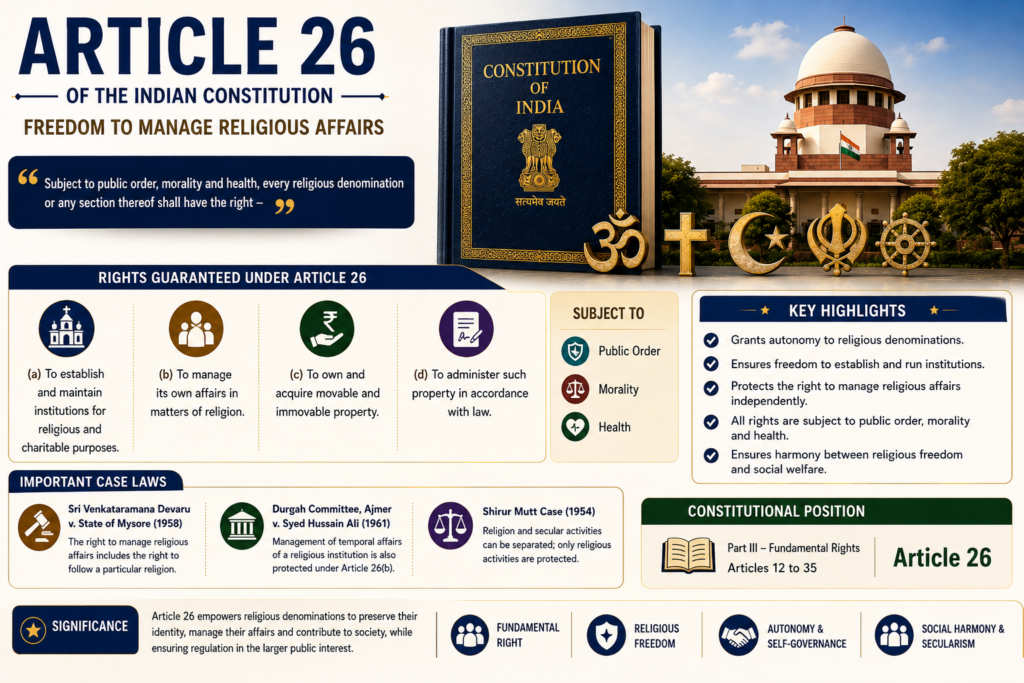
The Constitution specifically provides in Article 26(b) that the management of religious affairs shall be free from state control and shall be administered by the religious denomination itself. On the other hand, the management of property in accordance with law is mentioned specifically in clause (d) of the same article.
The expression “in accordance with law” clearly indicates the relative position of the two kinds of administration. State control over the secular administration associated with the religious denomination is not prohibited by the Constitution. On the other hand, the autonomy in the matter of management and administration is absolute so long as it does not contravene the principles of public order, morality, and health.
Who can claim rights under Article 26?
Unlike the fundamental rights conferred by Article 25, the Constitution does not specifically mention “all persons” in Article 26. Instead, it makes a reference to “every religious denomination or any section thereof.” Therefore, in order to claim the various rights enumerated in Article 26, every person must first prove that he belongs to any religious denomination or any section of it.
In order to understand the exact meaning of the term religious denomination, let us refer to the judgment of the Supreme Court in Shirur Mutt case.
Meaning of Religious Denomination
In order to understand the exact scope and applicability of Article 26, it becomes imperative to understand the exact meaning of the term “religious denomination”.
The Constitution does not provide a definition of the term ‘religious denomination’. The Supreme Court has, however, interpreted the expression on several occasions.
The Supreme Court, in this case, states that the word denomination means a distinct religious group or set of persons having common faith or organization or distinctive name or any combination of the foregoing.
In other words, the Constitution makes reference to the following three characteristics of a religious denomination:
The members of a religious denomination have common faith or system of beliefs.
There is a common organization among the members.
There is a distinctive name by which such a religious group may be identified.
The three characteristics of a religious denomination as stated above have been recognized by the Supreme Court in Shirur Mutt case.
Religious belief
The members of a religious denomination have common faith or system of beliefs. A common faith or system of beliefs is the most basic requirement for forming a religious denomination. There must be some religious bond or covenant that unites the members of a religious group. The religious belief could be in the form of doctrines, convictions, teachings, traditions, or forms of worship peculiar to the group.
It is not necessary, however, that all members of a religious denomination share all the principles and tenets of that system of faith. There can be variations and differences within a religious denomination. For example, Islam comprises several schools of thought and different sects, each of which follows slightly different religious practices and beliefs.
Common organization
Another essential characteristic of a religious denomination is a common organization. There must be some form of organizational structure through which the members of a religious group can exercise collective worship and hold on to their religious beliefs.
It is not necessary, however, that the common organization possess the characteristics of a corporate body. The organizational structure of a religious denomination could range from a formally incorporated organization to an informal group of persons having common religious beliefs.
Distinctive name
A religious denomination must also have a distinctive name. The name by which a group of persons calling itself a religious denomination is known must be clearly ascertainable. The distinctive name of a religious denomination is also indicative of its basic beliefs and doctrines.
A religious denomination usually takes its name from the system of faith or beliefs it professes. However, it may also take its name from the founder of the denomination or the place where it came into existence.
A denomination need not be the same as a religion
It must be understood that a religious denomination is not identical to a religion. A religion refers to the entire body of doctrines and practices that are peculiar to one or more religious denominations. In other words, there may be more than one denomination practicing the same religion. For example, Christianity comprises various sects and denominations such as Catholicism, Lutheranism, Methodism, etc. Each one of them is a separate religious denomination, but they all believe in and practice Christianity.
It should also be noted that the Constitution recognizes not only religions as well as denominations but also sections of denominations. The term ‘any section thereof’ has, therefore, been specifically mentioned in Article 26. It must be noted that every denomination of every religion recognized by the Constitution safeguards not only the rights of the whole group but also those of its sections.
Examples from the Supreme Court cases
The question whether a particular religious group falls within the definition of a religious denomination has on several occasions been considered by the Supreme Court.
In Shirur Mutt case, the Supreme Court made specific reference to the Madhwa Section and the institution of the Mutt to determine whether they could be considered to be a distinct religious denomination.
On similar lines, in S.P. Mittal v. Union of India, the Supreme Court had to determine whether the followers of Sri Aurobindo and the organization of Auroville constituted a religious denomination under the Constitution. The case shows that organizing an entire group of people around a single philosophy or a teacher does not automatically confer the status of a religious denomination on the group. It is necessary to consider the nature of such a group in order to determine whether it constitutes a religious denomination under the Constitution.
N. Adithayan v. Travancore Devaswom Board, and other similar cases considering the jurisdiction and administration of religious institutions also make specific references to the question whether a particular religious group falls within the definition of a religious denomination.
Religious denomination and Sabarimala
A similar issue of whether a group of people could be considered a religious denomination had arisen in the much-publicized Sabarimala case. The issue was whether the devotees of Lord Ayyappa could be considered a religious denomination.
The issue assumed relevance because if the devotees of Lord Ayyappa were to be considered to be a religious denomination under the Constitution, then they would be entitled to claim all the fundamental rights enumerated in Article 26. The majority verdict delivered by the Supreme Court in Indian Young Lawyers Association v. State of Kerala , however, declined to consider the devotees as a religious denomination. Justice Indu Malhotra disagreed with the majority view on several issues in the Sabarimala case.
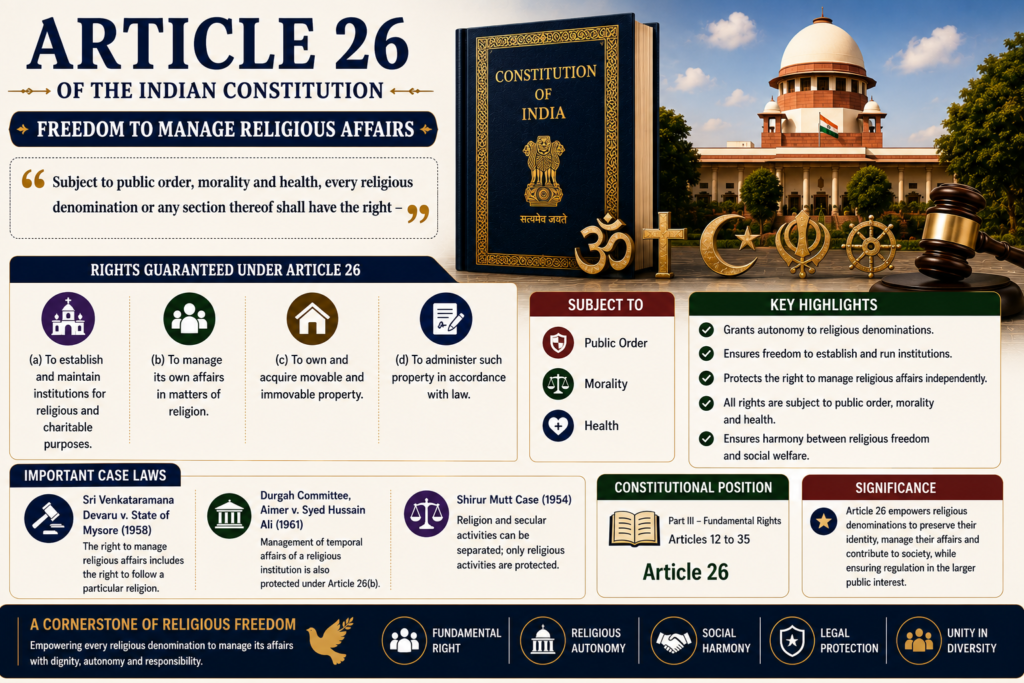
The importance of the denominational status is that if a group is to be considered a religious denomination, it would then be entitled to claim various rights under the Constitution. The devotees of Lord Ayyappa, if they were to be considered as a religious denomination, could claim the rights conferred by clauses (a) to (d) of Article 26. The Sabarimala ruling, therefore, shows that not every group of people who practice the same system of beliefs or religion would be entitled to claim denominational status.
Religious denomination vs religious community
The expressions religious denomination and religious community are not synonymous. A religious community denotes a wider term than a religious denomination. The term religious community refers to all persons who believe in the same religion, whereas the expression religious denomination refers to groups of persons who believe in the same system of faith and organization. It must be noted that a particular religious tradition may incorporate more than one system of faith as well as organization.
The group claiming the protection conferred by a religious denomination under the Constitution must fulfill the criteria specified by the Supreme Court in order to claim denominational status. It is evident from the Sabarimala case that a group of persons believing in the same system of faith and organization would become entitled to claim the status and benefits conferred by a religious denomination.
Why denominational status matters
Denominational status under Article 26 matters because it entitles every religious group that fulfills the criteria of a religious denomination to various rights under the Constitution.
The Constitution provides that every religious denomination has the right
(a) to establish and maintain institutions for religious and charitable purposes;
(b) to manage its own affairs in matters of religion;
(c) to own and acquire movable and immovable property; and
(d) to administer such property in accordance with law.
It is, therefore, evident that denominational status grants a wide range of rights to every religious group that fulfills the criteria of a religious denomination. That is why courts have to first ascertain that a particular religious group satisfies the conditions necessary to fulfill the criteria of a religious denomination before entertaining a petition seeking protection of fundamental rights under Article 26.
It must be noted, however, that even if a group fulfills the requirements of a religious denomination, it would still not possess complete autonomy. The rights conferred by Article 26 are subject to the overriding directions of the state in matters of public order, morality, and health.
The different rights conferred by the Constitution on every religious denomination are set out in clauses (a) to (d) of Article 26. It is, therefore, essential to understand the exact nature of the right that is being claimed in order to determine whether a particular right falls within the scope of Article 26.
Religious Denomination and the Shirur Mutt Case
The case of Commissioner, Hindu Religious Endowments, Madras v. Sri Lakshmindra Thirtha Swamiar of Shirur Mutt , popularly known as the Shirur Mutt case was one of the earliest cases before the Supreme Court of India regarding the interpretation of the freedom of religion provisions in the Constitution.
In this case, the Supreme Court ruled that a religious group may possess both, autonomy in matters of religion as well as the right to regulate its own secular affairs so long as such regulation does not impinge on the rights of other citizens.
The Constitution thus safeguards the autonomy of every religious denomination so long as it does not violate the principles of public order, morality, and health. It is evident from the judgment delivered in Shirur Mutt case that a religious group should not be subjected to an absolute veto by the state in matters of religion, administration, and property.
The Supreme Court, therefore, recognizes the distinction between religious affairs of a group and its secular administration.
Significance of Article 26
Article 26 of the Constitution of India is significant from the perspective of religious freedom because religious freedom would have been limited and restricted if the Constitution did not specifically safeguard the right of every religious group to manage its own institutions.
While Article 26 grants extensive autonomy to every religious group in matters of religion, it nevertheless restricts such autonomy from overriding the powers of the state in matters of secular administration, public order, morality, and health. It is therefore necessary to understand the scope and limitation of denominational rights in order to evaluate the applicability of various provisions of Article 26.
The first step in this direction is to understand the exact meaning and scope of the expression religious denomination.
The next important step is to determine whether a particular group satisfies all the criteria necessary to constitute a religious denomination.
What is a religious denomination under Article 26?
The Constitution does not explicitly define the term ‘religious denomination’. However, referring to the Shirur Mutt case, we can discern three characteristics that constitute a religious denomination.
These characteristics are as follows:
Common faith or system of beliefs
Common organization
Distinctive name
Common faith or system of beliefs
Every religious denomination essentially requires a common faith or system of beliefs that binds all the members of the group together. A common faith or system of beliefs could be in the form of doctrines, convictions, teachings, traditions, or forms of worship peculiar to the group.
However, it is not necessary that all members of a religious denomination share all the principles and tenets of that system of faith. There can be variations and differences within a religious denomination. For example, Islam comprises several schools of thought and different sects, each of which follows slightly different religious practices and beliefs.
Common organization
There must be some form of organizational structure through which the members of a religious group can exercise collective worship and hold on to their religious beliefs. It is not necessary, however, that the common organization possess the characteristics of a corporate body. The organizational structure of a religious denomination could range from a formally incorporated organization to an informal group of persons having common religious beliefs.
Distinctive name
Every religious denomination must also have a distinctive name. The name by which a group of persons calling itself a religious denomination is known must be clearly ascertainable. A religious denomination usually takes its name from the system of faith or beliefs it professes. However, it may also take its name from the founder of the denomination or the place where it came into existence.
A denomination need not be the same as a religion
A religion refers to the entire body of doctrines and practices that are peculiar to one or more religious denominations. In other words, there may be more than one denomination practicing the same religion. For example, Christianity comprises various sects and denominations such as Catholicism, Lutheranism, Methodism, etc. Each one of them is a separate religious denomination but they all believe in and practice Christianity. It should also be noted that the Constitution recognizes not only religions as well as denominations but also sections of denominations. The term ‘any section thereof’ has, therefore, been specifically mentioned in the Constitution.
The three characteristics of denominations as enshrined in the Shirur Mutt case have been applied by the Supreme Court in several cases considering the applicability of Article 26. In Shirur Mutt case itself, the Supreme Court refers specifically to the Madhwa Section and the institution of the Mutt.
On similar lines, in S.P. Mittal v. Union of India (1983) , the Supreme Court had to determine whether the followers of Sri Aurobindo and the organization of Auroville constituted a religious denomination under the Constitution. The case shows that organizing an entire group of people around a single philosophy or a teacher does not automatically confer the status of a religious denomination on the group. It is necessary to consider the nature of such a group in order to determine whether it constitutes a religious denomination under the Constitution.
N. Adithayan v. Travancore Devaswom Board , and other similar cases considering the jurisdiction and administration of religious institutions also make specific references to the question whether a particular religious group falls within the definition of a religious denomination.
Religious denomination and Sabarimala
A similar issue of whether a group of people could be considered a religious denomination had arisen in the much-publicized Sabarimala case. The issue was whether the devotees of Lord Ayyappa could be considered a religious denomination.
The issue assumed relevance because if the devotees of Lord Ayyappa were to be considered to be a religious denomination under the Constitution, then they would be entitled to claim all the fundamental rights enumerated in Article 26.
The majority verdict delivered by the Supreme Court in Indian Young Lawyers Association v. State of Kerala , however, declined to consider the devotees as a religious denomination. Justice Indu Malhotra disagreed with the majority view on several issues in the Sabarimala case.
The importance of the denominational status is that if a group is to be considered a religious denomination, it would then be entitled to claim various rights under the Constitution. The devotees of Lord Ayyappa, if they were to be considered as a religious denomination, could claim the rights conferred by clauses (a) to (d) of Article 26.
The Sabarimala ruling, therefore, shows that not every group of people who practice the same system of beliefs or religion would be entitled to claim denominational status.
Religious denomination vs religious community
The expressions religious denomination and religious community are not synonymous. A religious community denotes a wider term than a religious denomination. The term religious community refers to all persons who believe in the same religion, whereas the expression religious denomination refers to groups of persons who believe in the same system of faith and organization. It must be noted that a particular religious tradition may incorporate more than one system of faith as well as organization.
The group claiming the protection conferred by a religious denomination under the Constitution must fulfill the criteria specified by the Supreme Court in order to claim denominational status. It is evident from the Sabarimala case that a group of persons believing in the same system of faith and organization would become entitled to claim the status and benefits conferred by a religious denomination.
Article 27: Freedom as to Payment of Taxes for Promotion of Any Particular Religion
Article 27 of the Constitution of India adds another dimension to the fundamental rights conferred on citizens in respect of religion. It states that no person can be obligated to pay taxes that are specifically appropriated to promote or maintain a particular religion or denomination.
While Articles 25 and 26 confer individual and institutional religious freedoms, Article 27 specifies a separate ground of secularism: namely, that the State shall not force people to fund, through taxation, the promotion or maintenance of a particular religion or religious denomination.
Text of Article 27
The text of Article 27 reads:
“No person shall be compelled to pay any taxes the proceeds of which are specifically appropriated in payment of expenses for the promotion or maintenance of any particular religion or religious denomination.”
Therefore, when interpreting this Article, one has to consider that for its provisions to apply, the following cumulative conditions must be satisfied:
there must be a tax;
a person must be obligated to pay that tax;
the proceeds of that tax must be specifically appropriated;
and that appropriation must be for the promotion or maintenance of any particular religion or religious denomination.
Therefore, even if the State spends money on something connected with religion, unless those funds are specifically appropriated to that end, Article 27 does not apply.
Purpose of Article 27
The most obvious purpose of Article 27 is that the State cannot use its taxing powers to force people to fund the promotion or maintenance of any particular religion. For example, if the State decided to levy a tax on everybody on pain of penalty, and specifically allocated the proceeds of this tax to promote the doctrines or maintain the places of worship of a particular religious group, the very idea behind Article 27 would be violated.
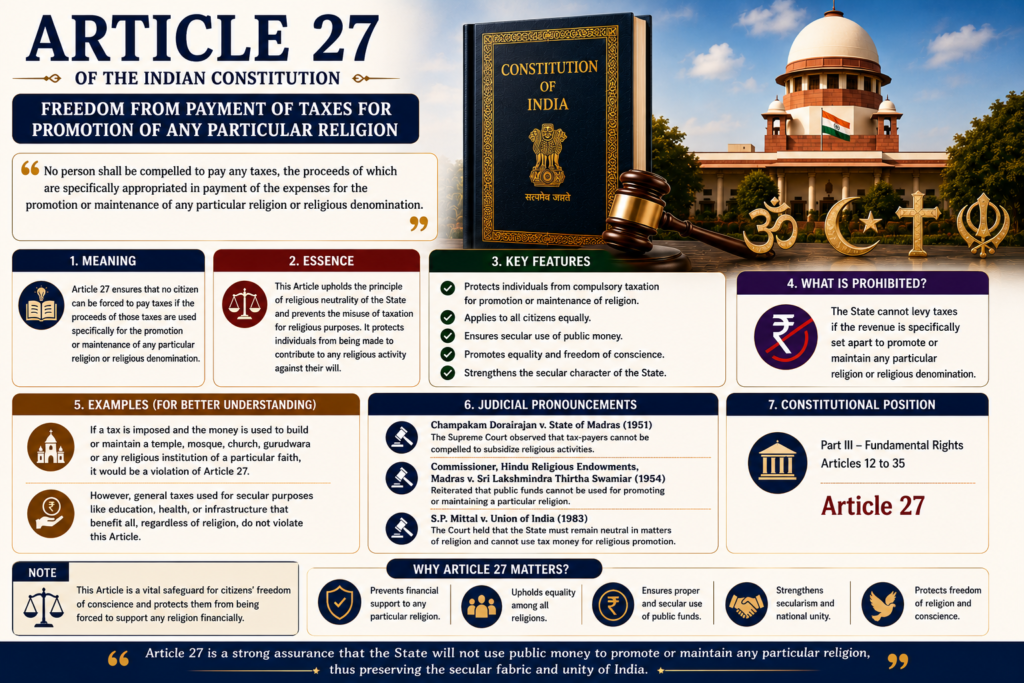
The guiding principle of Article 27 is that a person cannot be compelled to fund through taxation the promotion or maintenance of any particular religion.
Therefore, Article 27 essentially seeks to uphold the secular nature of the Indian polity.
Meaning of “specifically appropriated”
The phrase “specifically appropriated” is of particular importance in this Article.
Article 27 does not prohibit the spending of public funds on anything connected with religion.
This Article specifically targets those taxes that are specifically appropriated to further or maintain a particular religion or religious denomination.
Therefore, when assessing whether a particular law violates Article 27, one has to examine the connection between the tax and the purpose for which it is spent.
Constitutionally speaking, there is a big difference between a tax that was specifically imposed to promote a particular religion and general public expenditure that happened to benefit a religious group or institution.
Therefore, if the State spent public funds on something connected with religion but not specifically appropriated to further that religion, such expenditure would not violate Article 27. In other words, there is a constitutional distinction between things done specifically for a religion and things done for the public that happen to benefit a religion.
Meaning of “particular religion or religious denomination”
As per Article 27, taxes cannot be levied for the promotion or maintenance of “any particular religion or religious denomination”.
It is important to understand what is meant by the term “particular religion or religious denomination”.
The word “particular” is used because the problem occurs when the State obliges people to fund the promotion or maintenance of a distinctly identified religion or denomination. Therefore, a tax specifically appropriated to further or maintain a particular religion would violate Article 27.
Tax and fee: An Important Distinction
One of the most important issues related to Article 27 is the distinction between a tax and a fee. Article 27 speaks of taxes, not fees. Therefore, the imposition of a fee does not necessarily violate Article 27. The concept of a fee is distinct from a tax.
A tax is a levy imposed by the State for the general welfare of society. A fee, on the other hand, is compensation received by the State for performing certain official services.
Therefore, when examining the validity of a certain charge under Article 27, it is important to distinguish between a tax and a fee. Naturally, a tax is a compulsory contribution, while a fee can sometimes be optional.
Constitutionally speaking, there is no requirement that a fee should be related to a particular service; it is sufficient for a fee to be connected with regulation, administration, services, or a particular statutory scheme.
Therefore, when the State regulates religious institutions and imposes any fees connected with that regulation, those fees do not necessarily violate Article 27.
Shirur Mutt Case: Tax vs Fee
The distinction between a tax and a fee was examined in the Shirur Mutt case . This case revolves around an ordinance imposing a levy on mutts (a kind of a Hindu monastery). The question before the Supreme Court was whether this levy was a tax or a fee.
The significance of this distinction lies in the fact that if the levy imposed on mutts was a tax, it would violate Article 27, but if it was a fee, it would not. The Supreme Court examined the fine imposed on mutts and held that it was a fee and not a tax. It is important to note that the Court emphasized the wording of the ordinance when determining the nature of the levy.
Prafull Goradia v. Union of India
The Shirur Mutt case was cited again in the Prafull Goradia case . In this case, the petitioner argued that the State’s expenditure on Haj (a pilgrimage undertaken by Muslims) was a violation of Article 27. The Supreme Court rejected this argument, stating that for such expenditure to violate Article 27, it would have had to be specifically appropriated for the promotion or maintenance of Islam.
Therefore, even though the subsidy on Haj was spent on something connected with religion, since it was not specifically appropriated to further that religion, the expenditure did not violate Article 27.
The relevance of the Shirur Mutt case to the Haj subsidy issue lies in the fact that even if the subsidy on Haj is regarded as a tax, it does not violate Article 27 because there is no proof that the subsidy was specifically appropriated to promote Islam. It is important to note that the Haj subsidy policy was changed after this case, so it is better to consider this case from a purely constitutional perspective.
Article 27 Does Not Completely Prohibit State Interaction with Religion
Article 27 does not prohibit every interaction between the State and religion. For example, as mentioned above, if the State spends public funds on maintaining or promoting religion, that would violate Article 27 only if those funds were specifically appropriated for that purpose.
However, the State can spend public funds on something connected to religion as long as it is not specifically appropriated to further that religion. For example, the police may be deployed to protect a temple, but that does not mean that the deployment violates Article 27. Maintaining law and order, controlling crowds, preserving historical buildings, ensuring security, controlling traffic and sanitation – all of that can be done at a temple without specifically appropriating funds to further religion.
Therefore, it is evident that the mere fact that expenditure relates to a religious place does not make it specifically appropriated for the promotion or maintenance of that religion.
Indian Secularism and the Constitution
Secularism is one of the most important principles in the Indian Constitution. In essence, the Constitution guarantees religious freedom but does not prescribe anyState religion . In addition, the State cannot use its fiscal powers to further any particular belief. At the same time, Indian secularism does not prescribe total separation between the State and all religious matters, as Articles 25 and 26 permit regulation of religion and even state control of secular matters pertaining to religion. Thus, the provisions of the Constitution relating to religion are a combination of various principles.
For example, while Article 25(1) guarantees freedom of conscience and the right to profess, practise and propagate religion, Article 25(2) permits State regulation of secular matters pertaining to religion, such as charitable gifts, marriage and divorce, matters of public health and morality, and social reforms.
Meanwhile, Article 27 prohibits the use of State resources to further or maintain a particular religion or denomination.
Therefore, Indian secularism embodies a number of principles, one of which is that the State cannot use public funds (i.e. funds obtained through compulsory taxation) to specifically appropriate funds to further or promote a particular religion.
Difference between Articles 25, 26 and 27
When examining the differences between Articles 25, 26 and 27, it is important to note that each of them serves a different purpose.
While Article 25 protects the religious freedom of individuals, Article 26 protects the institutional rights of religious denominations. At the same time, Article 27 protects citizens against compulsory taxation for the promotion or maintenance of any particular religion.
Therefore, Articles 25 and 26 protect religious freedom and the rights of religious institutions, but they do not prohibit the use of State funds for the promotion or maintenance of religion. By contrast, Article 27 specifically prohibits such use of State funds.
To summarise:
Article 25 → protects individual religious freedom
Article 26 → protects denominational religious institutions
Article 27 → prohibits compulsory taxation for the promotion or maintenance of a particular religion
Significance of Article 27
Article 27 is significant because it puts limitations on the fiscal powers of the State. It does not prohibit allState interaction with religion, but it specifically prohibits the use of State resources for the promotion or maintenance of any particular religion. Therefore, Article 27 serves as a useful reminder that while the State can regulate various aspects of religion, as long as they concern secular matters, those regulations cannot be enforced through compulsory taxation.
Article 28: Freedom as to Attendance at Religious Instruction or Religious Worship in Certain Educational Institutions
Article 28 of the Constitution deals with the issue of religious instruction and religious worship in certain educational institutions and, like other articles from XXV to XXVIII, upholds India’s secularism. Articles 25 to 28 of the Constitution protect the right to freedom of conscience and ensure the rights of religious groups to manage their affairs while also protecting against compulsory state taxes for the propagation or maintenance of a particular religion. At the same time, Article 28 raises a related but somewhat different issue about the limits of religious instruction or worship in educational institutions with regard to the State.
Article 28 does not establish one uniform rule for all educational institutions in India. Instead, it raises various nuances depending on the particular educational institution’s status in relation to the State.
Article 28(1) refers to educational institutions that are entirely maintained by the State through its funds.
At the same time, Article 28(2) makes an exception for educational institutions administered by the State that were established under an endowment or trust which stipulates that religious instruction must be provided in them.
Finally, Article 28(3) refers to persons attending educational institutions recognised by the State or receiving state aid and establishes certain protections for them in relation to religious instruction or worship.
Understanding Article 28 correctly is crucial because the article does not prohibit “religion in educational institutions” in general – the actual language reflects a more nuanced reality.
Article 28(1): Prohibition of Religious Instruction in Educational Institution Totally Maintained by the State
According to Article 28(1), religious instruction in any educational institution wholly maintained by the state shall not be provided. The language of this section is the strongest among all of Article 28’s sections, establishing a total prohibition.
The key phrase is “wholly maintained out of the State funds.” Thus, when an educational institution is fully funded by the government, the state is prohibited from providing religious instruction in it. The reasoning behind this prohibition is straightforward – public funds collected by a secular state should not fund religious instruction in educational institutions.
For instance, if a public educational institution is fully government-funded, the government cannot provide religious education in it because such a programme would, first and foremost, endorse one particular religion. Therefore, according to Article 28(1), religious instruction in educational institutions that are totally maintained by the state shall not be provided.
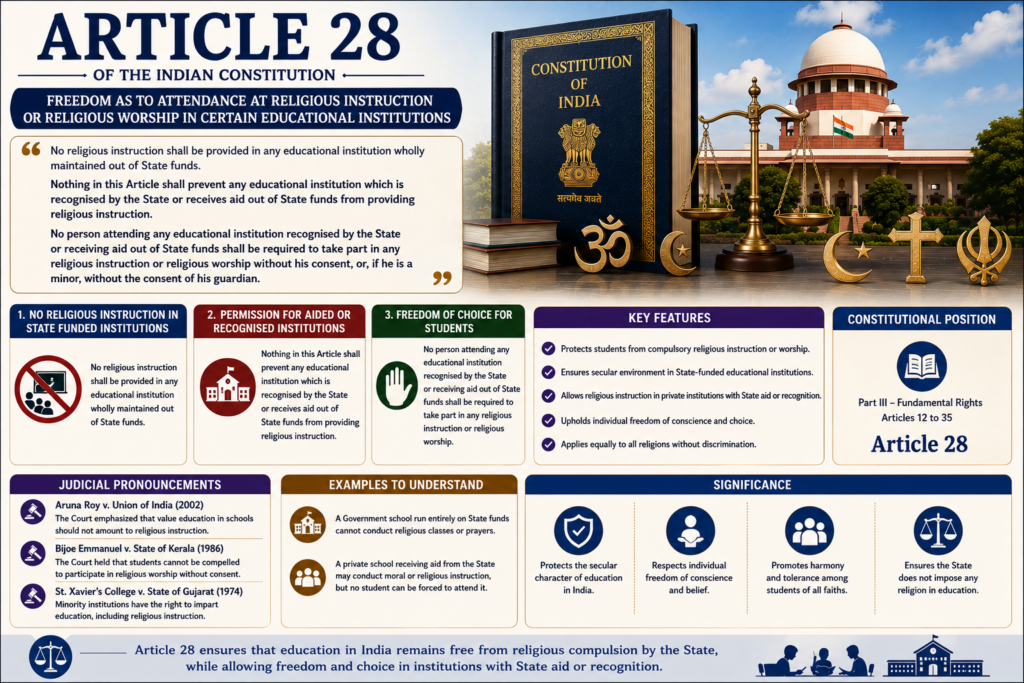
However, it is crucial to note that the word “wholly” means that any organisation that receives only part of its funding from the State does not fall under the jurisdiction of Article 28(1). Educational institutions that are “state-aided,” meaning that they receive partial funding from the State, are explicitly referred to in Article 28(3).
Religious Instruction’s Definition
The next crucial point is that Article 28 makes a distinction between religious instruction and the mere study of religion. Religious instruction refers to the teaching of any particular religious denomination’s doctrines, tenets, beliefs, practices, or principles.
Thus, if a school instructs its students regarding the tenets or practices of a particular religion, it may fall under the scope of Article 28. However, if a school teaches the history of any particular religion or faith, or discusses it within the context of history, philosophy, or comparative religion, it does not fall under Article 28’s jurisdiction. Religion in such cases is viewed as one of the subjects of study rather than a guiding principle of life that one has to believe in.
The Court of India elaborated on the difference between teaching of and instruction in religion in the case of Aruna Roy v. Union of India and clarified that the former does not fall under the jurisdiction of Article 28.
Education concerning religions, its philosophies, values, and cultural heritage does not necessarily entail religious instruction prohibited by Article 28(1). This is especially important in a multicultural and multireligious country like India, where numerous religious traditions have had significant influence on the country’s history, society, literature, art, culture, and politics. Therefore, a secular state is not obliged to remove religion from school curriculums entirely.
It is important to understand that the aim of Article 28(1) is to prohibit state-sponsored religious instruction in educational institutions, including public universities.
Article 28(2): Exception for Educational Institutions Established by an Endowment or Trust and Administered by the State
The language of Article 28(2) states that the prohibition of Article 28(1) shall not apply to any educational institution administered by the State but established under an endowment or trust which requires that religious instruction shall be imparted in such institution.
This article applies to educational institutions that exist under an endowment or trust but are administered by the State. Such educational institutions, according to Article 28(2), are not subject to the total prohibition outlined in Article 28(1).
First, let us note that an endowment is a donation of money or property made to an institution with specific restrictions or stipulations as to its use. When an educational institution is established, endowed, or placed under trust, its foundation deed can stipulate that religious instruction should be provided in it. Such restrictions or stipulations can be religious and/or educational.
Thus, when such an educational institution falls under the administration of the State, the State is obliged to respect the terms of the endowment or trust and cannot refrain from providing religious instruction simply because the institution is placed under its administration. Thus, Article 28(2) clearly states that the prohibition outlined in Article 28(1) shall not apply to such educational institutions.
In sum, two requirements must be met for Article 28(2) to apply: an educational institution must be established under an endowment or trust, and this endowment or trust must stipulate that religious instruction shall be provided in such institution. Therefore, one should interpret Article 28(2) as a limited exception rather than a general rule that allows the State to provide religious instruction in all educational institutions administered by it.
The Purpose behind Article 28(2)
When interpreting Article 28(2), it is important to understand that the Constitution aims to respect the secular principles in all spheres while also protecting the rights of religious minorities to establish educational institutions. For instance, if a pious person or a charitable organisation establishes an educational institution under trust with the stipulation that religious education shall be provided in it, it would be unfair to the trust’s creator to revoke this right simply because the administration of the trust falls under the State. Therefore, in accordance with Article 28(2), the State acknowledges such trusts as valid and is obliged to respect them.
Thus, it is crucial to understand the difference between “administration” and “establishment.” An educational institution can be established under an endowment or trust and administered by the State. A trust can stipulate that religious instruction must be imparted in the educational institution, but the State cannot disregard this stipulation simply because it administers the institution.
The distinction between these concepts is essential for understanding how Article 28 works. The language of the Constitution suggests that the secularism upheld by the Constitution does not require removing any religious features from institutions administered by the State.
Article 28(3): Freedom from Compulsory Religious Instruction or Worship
Finally, Article 28(3) states that no person attending an educational institution recognised by the State or receiving aid from the State shall be subjected to compulsory religious instruction or worship in such institution or in premises attached to it without the consent required by the Constitution.
This article raises the issue of protection from state-sponsored coercion to participate in religious activities. The article specifically refers to instruction and worship, distinguishing between instruction in religion and instruction concerning religion discussed earlier.
Thus, according to Article 28(3), no person attending such an educational institution can be compelled to participate in religious instruction or worship without the consent required by the Constitution.
Unlike Article 28(1), which totally prohibits religious instruction in educational institutions established by the State, Article 28(3) refers to educational institutions recognised by the State or receiving state aid. Furthermore, unlike Article 28(1), which prohibits religious instruction, Article 28(3) prohibits compulsory religious instruction and worship.
Educational Institutions Recognised by the State
In particular, Article 28(3) explicitly refers to educational institutions recognised by the State. Recognition by the State and total maintenance by the State are two different concepts. An educational institution can be established and administered by private organisations but recognised by the State.
Therefore, such an institution would not fall under the jurisdiction of Article 28(1) but would receive certain protections under Article 28(3). Thus, students attending such educational institutions would be protected from being subjected to compulsory religious instruction or worship without the consent of their guardians or themselves, depending on their ages.
State-Recognised Educational Institutions Versus State-Maintained Educational Institutions
Furthermore, educational institutions that are state-aided, meaning that they receive partial support from the State, are explicitly referred to in Article 28(3). However, such educational institutions are not subject to the total prohibition outlined in Article 28(1). Thus, one should interpret Articles 28(1) and 28(3) as referring to different categories of educational institutions.
This is especially important in a country like India, where many educational institutions are established and administered by private organisations but recognised and/or partially funded by the State.
Religious Instruction and Worship
Finally, it is crucial to note that Article 28(3) explicitly refers to both religious instruction and worship. Instruction in religion and instruction concerning religion have been discussed previously. Similarly, worship can be interpreted in two ways: worship in religion and worship concerning religion.
However, unlike instruction in religion, which refers to instruction in any particular religious denomination’s doctrines, beliefs, practices, etc., worship in religion refers to any form of devotional acts that are characteristic of a particular religion or denomination, such as praying or other forms of worship.
Therefore, an institution covered by Article 28(3) cannot compel a person to engage in worship in religion without the required consent. Such an institution cannot avoid the jurisdiction of the article by calling devotional exercises “worship in religion” – the Constitution explicitly refers to both instruction and worship. Furthermore, Article 28(3) explicitly refers to worship in the institution and in premises attached to it.
Consent under Article 28(3)
Furthermore, according to Article 28(3), no person attending an educational institution shall be subjected to compulsory religious instruction or worship without the consent required by the Constitution. The concept of consent is crucial in interpreting Article 28(3).
A person can give or withhold consent to participate in religious instruction or worship; for children, such consent shall be given by their parents or legal guardians. Therefore, when such consent is given, the person may participate in religious education and worship; when such consent is not given, they cannot be subjected to compulsory religious instruction or worship.
Thus, when interpreting Article 28(3), it is crucial to distinguish between adults and children, between people capable of giving consent and those who cannot give consent. In the case of the latter, the guardians’ or parents’ consent shall be treated as the only constitutionally valid consent.
Article 28 and the Freedom of Conscience
Article 28 is closely related to Article 25, which guarantees the right to freedom of conscience. In particular, Article 25 ensures that all persons have the right to freedom of conscience and to practise any religion, as well as the right not to practise any religion. Article 25, however, also stipulates that no person shall be subjected to any disability, restriction, or punishment by reason of their religion or faith or of their religious practice. In other words, the right to freedom of conscience also encompasses the right not to believe or to practise any religion.
Therefore, the freedom from compulsory religious instruction or worship stipulated in Article 28(3) reflects the negative aspect of freedom of conscience.
Article 28 and Minority Educational Institutions
Article 28 is also closely related to Articles 29 and 30 of the Constitution, particularly Article 30, which stipulates that all minorities, whether based on religion or language, have the right to establish and administer educational institutions of their choice. Therefore, when the State recognises or funds minority educational institutions, it should respect their autonomous choice of educational and religious principles. Such institutions, however, should also respect the rights of students not to participate in religious instruction or worship without the required consent.
Thus, when interpreting Articles 28 and 30, it is important to remember that both the rights of minority educational institutions and the rights of students not to participate in religious instruction or worship are protected by the Constitution.
Article 28 and Secularism
Article 28, in turn, is closely related to the principle of secularism enshrined in the Indian Constitution. India is a secular state, which means that it does not have an official religion and that no citizen can be forced to adopt a particular religion.
According to Article 28, when it comes to educational institutions, this principle necessitates a few distinctions. First, educational institutions that are totally funded by the State may not provide religious instruction. Second, educational institutions administered by the State but established by an endowment or trust that stipulates that religious instruction shall be provided in them are exempt from this prohibition.
Finally, educational institutions that are state-recognised or receive state aid are prohibited from forcing students to participate in religious worship or instruction without the required consent.
Therefore, although the Indian Constitution does not prohibit the teaching of religion in educational institutions, it does prohibit state-sponsored religious instruction in educational institutions totally funded by the State and also provides protection against coercion to participate in religious instruction or worship for those attending educational institutions recognised or aided by the State.
Teaching Educational Philosophy Derived from Different Religious Traditions
It is also important to discuss whether educational institutions can teach educational philosophy derived from different religious traditions. As mentioned earlier, education concerning religions and religious practices, including their history and philosophy, does not fall under the jurisdiction of Article 28. Thus, teaching the philosophical and ethical tenets of different world religions, as well as discussing their history and cultural impact, does not constitute a violation of Article 28.
For instance, it is entirely permissible for educational institutions to teach students about the principle of ahimsa in Jainism and Buddhism, as well as Hindu vegetarianism. In addition, it is not prohibited to discuss Bhakti and sufism mysticism and how they influenced Indian philosophy, literature, and art. Therefore, the question of the permissibility of teaching religion in educational institutions boils down to the distinction between instruction in religion and instruction concerning religion.
Summary
All in all, there are three subsections of Article 28, each of which stipulates slightly different rules regarding religious instruction or worship in educational institutions.
First, according to Article 28(1), religious instruction in any educational institution wholly maintained by the State shall not be provided. Second, state-administered educational institutions established by an endowment or trust which stipulate that religious instruction shall be provided in them are exempt from this prohibition. Finally, according to Article 28(3), no person attending an educational institution recognised by the State or receiving aid from the State shall be subjected to compulsory religious instruction or worship in such institution without the consent required by the Constitution.
Thus, to summarise the provisions of Article 28, one can remember three key points: first, wholly state-maintained educational institutions may not provide religious instruction; second, state-administered educational institutions established by an endowment or trust with the stipulation that religious instruction should be provided in them are exempt from this prohibition. Finally, state-recognised or state-aided educational institutions may not compel attendance of religious worship or instruction without the consent required by the Constitution.
The importance of distinguishing between wholly state-maintained educational institutions and those that are only state-recognised or state-aided cannot be underestimated because it would be wrong to apply the provisions of Article 28(1) to all educational institutions that receive any state funding.
The Importance of Article 28
Ultimately, the provisions of Article 28 serve to balance several constitutional rights. First and foremost this article protects the secular nature of the Republic by ensuring that educational institutions cannot provide religious instruction using state funds.
At the same time, Article 28(2) recognises the right of minorities to establish educational institutions with religious instruction by exempting such educational institutions from the jurisdiction of Article 28(1) if they are established by an endowment or trust. Finally, as mentioned above, Article 28(3) stipulates that no person can be subjected to religious instruction or worship without the required consent.
Thus, when it comes to the teaching of religion in educational institutions, the Constitution strikes a delicate balance between the right of the state to remain secular and the right of minorities to establish educational institutions guided by religious principles as well as the rights of individuals not to participate in such instruction without the required consent.
Most importantly, the Constitution does not prescribe a blanket prohibition of religious instruction in educational institutions; instead, it makes several crucial distinctions between educational institutions that are totally funded by the State and those that are not, those that are established by an endowment and those that are not, and those where religious instruction is compulsory and those where it is not.