
Article 12 and Article 13 under Indian Constitution
One of the cardinal features of the Constitution of India is Fundamental Rights. These rights form part of Part III of the Constitution (Articles 12-35) which protects the liberty, equality and dignity of individuals and subjects governmental action to constitutional limits. Fundamental Rights safeguard the individuals from arbitrary Governmental powers and provide constitutional remedies in the event the individuals’ Fundamental Rights are infringed.
However, prior to studying the individual Fundamental Rights we must look into two basic questions, against whom these Fundamental Rights are enforceable and what is the effect of a law violating the Fundamental Rights. The source of the answers of these two questions can be found in Article 12 and Article 13 of the Indian Constitution.
Article 12 provides definition of ‘State’ for the purposes of Part III of the Constitution. Importance of this article lies in the fact that it defines the subjects against whom the Fundamental Rights can be invoked generally. ‘State’ is defined in a very liberal way and it does not restrict itself only to the Central and State Governments, or even the Parliament and Legislature of each State. It also includes local authorities and all other authorities within the territory of India or under the control of the Government of India. Through interpretation of other authorities’, and of a instrumentality or agency of a State, has been widely expanded by the Supreme Court of India over the years.
On the other hand, Article 13 of the Constitution deals with the law that are inconsistent to the Fundamental Rights. The article declares that ‘all laws in force in the territory of India immediately before the commencement of this Constitution in so far as they are inconsistent with the provisions of this Part shall be void to the extent of such inconsistency’. It deals both with pre-Constitution as well as post-Constitution laws and has played a crucial role in the development of judicial review in India.
A number of constitutional developments have originated as a result of interpretation of Article 13 such as Doctrine of Severability, Doctrine of Eclipse and the Doctrine of Waiver of Fundamental Rights. Besides, the conflict between Article 13 and the amendatory power under Article 368 of the Constitution, has led to some of the most fundamental and crucial judgments delivered by the apex court such as in the case of Shankari Prasad Union of India, I. C. Golaknath State of Punjab and Kesavananda Bharati State of Kerala.
Hence, Article 12 and Article 13 pave the way for the Fundamental Rights provided in Part III of the Constitution. While the former restricts and prescribes the scope of ‘State’, the latter places restrictions on the State’s power to legislate, if that law is in contradiction to the latter.
Article 12 of the Indian Constitution – Meaning of State
Meaning of State Indian constitution Article 12 states what exactly ‘state’ means in the chapter of part III of the Indian constitution. In other words when fundamental rights of individuals in India are to be protected against the powers of any authorities, institutions or organizations; we have to understand about the definition of the State so that they can be held in responsible at their duty.
Article 12 provides:
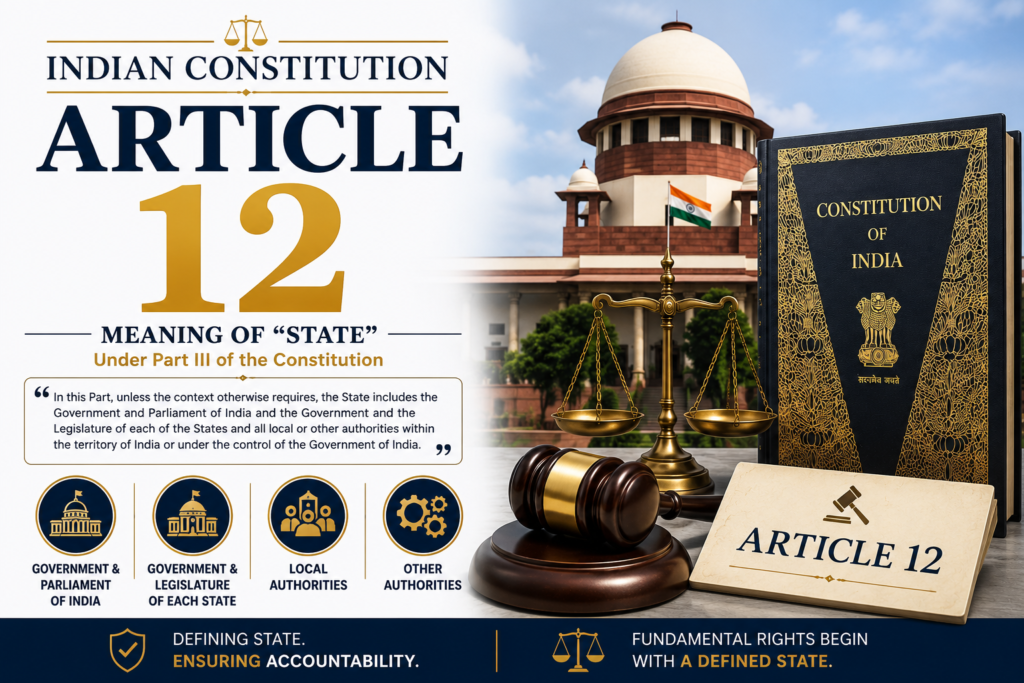
“In this Part, unless the context otherwise requires, the State includes the Government and Parliament of India and the Government and the Legislature of each of the States and all local or other authorities within the territory of India or under the control of the Government of India.”
Explanation of what constitutes ‘State’ under Article 12:- Article 12 presents a non-exhaustive, inclusive definition of the term ‘State’ and means that the authorities which have been directly referred to in the given Article need not be the only ones that may qualify as a State. The judiciary has played an important role in construing what are the meanings of the words ‘other authorities’ to fall under the State for the purpose of enforcing Fundamental Rights.
Authorities that fall within ‘State’ under Article 12
Based on Article 12, the State falls into the following authorities which have been clearly defined as fall under the term State:
1 Government and Parliament of India
2 Government and Legislature of each State
3 Local Authorities
4 Other Authorities
Firstly, secondly and thirdly are not very difficult to construe since they directly mention government, legislative and local government bodies. Fourthly, on the other hand, the words ‘other authorities’ is too broad a term and have been extensively interpreted in order to determine what it encompasses.
According to Article 12, the “state” included various entities in the following categories :
1. Government and Parliament of India
The Government of India and Parliament of India fall under the first part of Article 12. It refers to the Union Government and the Union legislature.
The union legislation comprises of lok sabha and rajya sabha.
Any act of the union government and any law passed by the parliament come under the purview of the fundamental rights given in part III of the Indian constitution. Hence any acts of the Central Government and laws of Parliament which infringe on these rights, shall be brought in the Indian courts of law.
2. Government and Legislature of Each State
Like the union government and parliament, the Government and Legislature of Each State have been expressly included in the definition of “state” as well. The states have the legislative and executive branches which are accountable to the constitutional rights under part III.
They includes local level decision makers or bodies which administer a local areas that are designated as or part of those administrative levels. The same could be State legislatures.
3. Local Authorities
Local authorities like municipality, municipal corporation, district board, gram sabha are not essentially covered under government. However, they have the powers to form the local administrative structures of the public services.
The term also included panchayati raj bodies, improvement trusts and irrigation boards etc.. The courts usually included all the institutions established by the statutes for performing local or public administration functions. Thus they are to make responsible under Article 12 as well.
4. Other Authorities
An essential component of the meaning of “state” is “other authorities” under Article 12 of the Constitution.
This term is neither specifically nor exhaustively defined in the constitution of India. It’s the judiciary which have, through various judgments had to interpret and expand the definition of ”other authorities”, so as to provide the protection of the fundamental rights to a greater section of people to have rights not subject to an infringing law or action of such authorities.
Early one’s to include such authorities were through a broad interpretation that authorities created by or under law; in whom powers are granted, by law to carry out governmental functions is considered a “state.” The courts further refined this into that fact that, if there is such a degree of functional or administrative control of the State over such bodies which indicates their essential part to be of an “agency” or an “instrumentality” or the State, then such bodies will be included. Hence such “other authorities” will be subject to Article 12.
An example is the R.D. Shetty vs. International Airports Authority of India case of 1979 which established the doctrine of “instrumentality or agency” of the State.
The Supreme Court widened this meaning further in Ajay Hasia’s case, where it has held that if an operation of a corporation is as an indispensable part of the governmental function or powers of the State it would be considered an “other authority” for the purpose of Article 12. Hence to conclude an “authority” will fall under the term “other authorities” if it is created by or under any law, and clothed with statutory power. In addition if the authority performed governmental functions as an agency or instrumentally of the state for a public purpose or performs some state functions, by such a body, it shall fall under “other authorities”.
Hence will be deemed a “state” for the purpses of article 12, all of which are subject to fundamental right 12 of Constitution.
Definition of “other authorities” in Article 12: The term “other authorities” is an important part of the definition of “State” in Article 12 of the Indian Constitution. Though bodies like the Central Government, State Governments, Parliament, State Legislatures, and local authorities are mentioned explicitly, the word “other authorities” is not defined in the Constitution. Since it is not defined, the interpretation of the phrase “other authorities” has evolved through the judgments of various courts to accommodate changing roles of government functions over time.
In time, the scope of Article 12 has been expanded by the Supreme Court to such organizations which are intimately related to the government and have been conferred with powers under any law.
This part is highly significant as modern governance is increasingly carried out through different entities such as statutory corporations, government companies, boards, societies, etc. All of which can be held to be the “State” within the meaning of Article 12 if they satisfy conditions established by the judiciary thus making the actions performed by these bodies subject to the Fundamental Rights enumerated in Part III.
University of Madras v. Shantha Bai
In this case, the scope of “other authorities” as given in the Indian Constitution was interpreted very restrictively. The Court applied the principle of ejusdem generis to hold that as the specific term “local authority” comes after government and legislature. Therefore the specific authorities implied in the meaning of “other authorities” should also be of like nature, implying governmental functions. Consequently, the University was held not to be a State under the Indian constitution in the given set of facts.
In this context it could be reasoned that as the major functions of the universities at that time did not fall within governmental or governmental Functions nor performed some quasi governmental functions.
Rajasthan State Electricity Board v. Mohan Lal
In a path-breaking judgment by the Indian Supreme Court in Rajasthan State Electricity Board v. Mohan Lal, the court interpreted and broadened the interpretation and meaning of “other authorities”. The Supreme Court clearly disagreed that the phrase“ other authorities” could have been interpreted in a strict restricted sense which would only mean something governmental in nature which would in effect exclude from the definition of the word “State”, the myriad agencies or companies created to perform diverse functions which come in relation to many governmental Functions by the virtue of specific enabling provisions.
According to the Supreme Court, the ‘other authorities’ has to read in expansive way and not by giving restricted 9461} Interpretation to it, to the end that every such authority that has statutory origin or power is not excluded from the purview of Article 12. So, every person or body of persons should, to fall within the purview of Article12, satisfy at least one requirement. That the authority must be created by the Constitution, or a statute. That power conferred by law is conferred on him by the Constitution, or a statute.
That such power either would otherwise be authority of government or the authority used would have been authority if he would not of fact have acted; and in other circumstances, this would also apply to non sovereign powers. ‘Other authorities’ includes even corporations like electricity boards etc in Rajasthan State Electricity Board Case in fact in this case the Apex Court held that Rajasthan State Electricity Board is a State although it was exercising its powers which were commercial. The significance of the Case The case made the interpretation of Article 12 very broad with the decision that any authority constituted by Constitution or statute could fall within definition.
The wide interpretation is extremely critical given increasing use of statutory corporations, boards, autonomous organizations etc for performing governmental functions today in an extensive scale to serve, “to take advantage in the context of welfare state”. An ‘organization instrument for govern’ should include bodies functioning as arms for the state or for the purpose to serve “public interest”. Hence such bodies are subjected to limitations enforced by Article 14 – 32.
However the meaning of “Other Authorities” was once again challenged when it came to ‘organs of government’ with which there existed no explicit or directly identifiable statutory origin/connection to the state. For that the need to extend it more led to development of ‘the concept of agency or instrumental for governance’ to take hold.
The State under Article 12: Instrumentality or Agency.
The term ‘State’ as used in Article 12, is not just restricted to the traditional government departments or authorities. As the concept of welfare state took roots, various government and economic functions began to be carried out by entities like statutory corporations, government companies or registered societies. The very significant question therefore rose whether these autonomous corporate bodies, that had been performing numerous public functions on behalf of the state, could also be treated as ‘State’ and thus be governed by the fundamental rights.
To answer this question, the Supreme Court developed the concept of an ‘instrumentality or agency of the State’. An entity is considered to be an instrumentality or agency of the State if its relationship with the government is such that ” in substance, it functions as an instrumentality or agency of the Government.”
We can trace the evolution of this concept from the series of supreme court pronouncements.
Sukhdev Singh v. Bhagatram
This case forms a landmark pronouncement by broadening the definition of ‘State’ under Art 12. In this case the Supreme Court held the following three statutory corporations to be ‘authorities’ within the meaning of Art 12:
1. Oil and Natural Gas Commission (ONGC);
2. Life Insurance Corporation of India (LIC);
3. Industrial Finance Corporation of India (IFCI);
The court was of the opinion that because these corporations carried on a public function, and possessed certain statutory powers and substantial government control, they could be classified as ‘authorities’ under Art 12. It further added that the government cannot escape constitutional restrictions by the mere creation of a statutory corporation.
In this case Justice Mathew’s observation that the corporations were in fact the ‘instrumentality or agency of the state’ gained special significance and helped lay the groundwork for the subsequent tests.
Ramana Dayaram Shetty v. International Airport Authority of India (1979)
In this case the Supreme Court ruled that the International Airport Authority was an instrumentality or agency of the State and thus subject to Art 14 of the Indian Constitution. The judgment held that the authority could not get rid of its constitutional obligations by incorporating itself as an independent corporate entity.
The court also identified several criteria the satisfaction of which will render an entity an instrumentality or agency of the State. These criteria are discussed below in the chapter ‘Other Authorities’.
Ajay Hasia v. Khalid Mujib Sehravardi
The supreme court examined the case of Regional Engineering College which had been established and administered by society under the Jammu and Kashmir Registration of Societies Act. It was held that even though there was no statute which directly created the society, the mere form in which a corporate body or agency is constituted could not be the decisive test.
The court said that ‘it is really immaterial whether the legal form of the entity is that of a corporation, society or a registered society…
The crucial test is whether it is an instrumentality or agency of the Government.’
1. Tests laid down in Ajay Hasia v. Khalid Mujib
In Ajay Hasia v. Khalid Mujib Sehravardi (1981) , the apex court set forth a comprehensive list of factors to be considered in determining whether an entity is an instrumentality or agency of the state.
1. Entire Share Capital Held by Government
If the entire share capital of a corporation is held by the government, it is a substantial indication that it may be an instrumentality or agency of the state. Government shareholding implies governmental interest and involvement. However, it is not a definitive criterion and needs to be assessed along with other factors.
2. Extensive Financial Assistance
If the financial assistance received by the body from the government significantly meets the expenditure of the organization, such dependence on government finances can be considered a strong indicator of its being an agency of the state. However, ordinary grants or periodic financial allocations by themselves do not make a body state. The emphasis is on the deep dependency for functioning and existence.
3. State-Conferred or State-Protected Monopoly
A monopoly status conferred or protected by the state on an organization is another factor that may point to it being an instrumentality of the state. This status indicates a special relationship and control exercised by the government. It serves as an indicator rather than an exclusive test.
4. Deep and Pervasive State Control
Significant governmental control over the organization’s policy, administration, decision-making, finance and appointments, suggests it might be an instrumentality of the state. The extent and intensity of the control is the vital consideration and not just any form of regulatory power.
5. Functions of Public Importance Closely Related to Governmental Functions
The nature of the organization’s functions is also taken into account. If the functions are of public importance and align with the functions conventionally carried out by the government, the body may be deemed an instrumentality or agency of the state. It is important to note that merely performing a public duty does not automatically make the entity a state under Art 12 as indicated in the Zee Telefilms Ltd. V. Union of India case.
6. Transfer of a Government Department
Another strong signal occurs when a Department of Government is already being run by the Government which then has a transfer of that department to a corporation or other separate body.
The fact that the Government may be transferring a part of itself to a separate legal entity does not permit the Government to contract out of its constitutional obligations. When a basically governmental department is transformed to a corporation still maintaining a considerable control of the Government it may be a significant indicator towards its being a state instrument.
Single Test Not Sufficient
As has been elucidated in the Ajay Hasia case, the aforementioned factors are indicators, not mechanical tests. One factor being present does not automatically mean a body is “State”; the effect of all circumstances is to be considered. This point has been subsequently clarified and elaborated in Pradeep Kumar Biswas v. Indian Institute of Chemical Biology (2002), the apex court stating that after a totality and aggregate consideration of the factors, the essential inquiry: whether the financial, functional and administrative control of the Government over the body is pervasive and not merely regulatory?
Pradeep Kumar Biswas vs. Indian Institute of Chemical Biology
The doctrine on an instrumentality or agency of the state was further examined by the apex court of the country in Pradeep Kumar Biswas vs. Indian Institute of Chemical Biology (2002). Pradeep Kumar Biswas case is a well-cited and critical reference of deciding an instrumentality/agency within the ambits of the expression ‘state’ of the Indian Constitution by virtue of the Constitution of India under Article 12.
The foremost question placed before the Supreme Court was to decide whether the organisation registered by the society called Council of Scientific and Industrial Research (CSIR), which is not an traditional department of government, whether could also be included as the expression ‘state’ within the ambits of article 12 of the constitution. The organisation was registered under Societies Registration Act. So there had to be assessment of the government influence over the said organization.
A seven member bench of the Supreme Court bench was dealing with the matter, majority among them held that the CSIR is covered as a ‘state’ within the ambit of Article 12.
The Tests Laid Down by the Supreme Court
The Supreme Court while determining this issue stressed that the list of factors identified in previous cases including Ajay Hasia could not be regarded as a rigid and an inflexible mould which could be applied uniformly to all organisations as a mechanical formula. Rather all the circumstances of an individual case had to be taken into consideration and a cumulative evaluation should be made.
The important fact that needs to be established, on a reading of all the surrounding circumstances into record regarding a particular institution is that whether it is financially dominated by or under its control; functionally or administratively dominated by or under the control of the government; The very type of the control of government is to be considered. Control must not merely be regulatory control but of such degree which indicates governmental dominance over such body.
1. Financial Domination
The degree of dependency upon the government for finances. This includes source of funding and extent and quantity of such finance. It is necessary to find a link between government financial support and control of the entity.
2. Functional Domination
The Court considers if the function(s) carried out by an entity are related to state functions and if government exerts substantial control over those functions. It is a consideration whether the operation of an entity is a vital state function.
3. Administrative Domination
The nature and extent of governmental participation in administration. Factors like composition, board members, appointment of key persons, decision making powers, regulatory supervision, day to day operations of an organisation. Pervasive administrative control means substantial government control.
Pervasive control vs regulatory control
Another critical aspect of the Pradeep Kumar Biswas case is the differentiating control from mere government regulation. A myriad of organisations; corporations, companies, co-operatives, registered society, trusts; etc may come under some form of governmental control but that does not necessarily makes them falling under the ambit of “state” under the scope of Article 12. The extent of control has to be significant enough to be considered pervasive to be the instrumentality of the state.
Why Government Regulation automatically State under Article 12?
Instead, what matters is the substance and the degree of control over the functioning of such organisation.
Why CSIR was held to be State Considering the total background on functioning, structure, funds, control of government etc, the majority in the Supreme Court found a strong connection to the government in CSIR that it ought to be taken as a “State” for the purposes of Article 12 of the Constitution. This meant CSIR had to remain constitutionally bound by all fundamental rights.
Significance of Pradeep Kumar Biswas Case
Pradeep Kumar Biswas expanded the ‘instrumentality’ or ‘agency’ doctrine established over the past decades by the Supreme Court. The following table sums up the progression of law in India on determining state under Article 12.
Rajasthan State Electricity Board v. Mohan Lal: A wider interpretation to include all ‘other authorities’ was taken.
Sukhdev Singh v. Bhagatram: ‘other authorities’ were defined broadly, a statutory corporation was considered to be state.
R.D. Shetty v. International Airport Authority: The principle of ‘instrumentality’ or ‘agency’ for the first time was adopted.
Ajay Hasia v. Khalid Mujib Sehravardi: Court laid down some key factors on the test to determine if an entity is an ‘instrumentality or agency’ of state.
Pradeep Kumar Biswas v. Indian Institute of Chemical Biology: the Supreme Court has laid down that an entity would fall within the definition of ‘state’ of constitution if the same is financed wholly or partially or administrated and is under the control of state.
From the development of these judgments it can be said that, the status of an entity as a “State” under Article 12 of Constitution of India depends not on its corporate dress or the characterization by the government but rather on an overall assessment of government’s total control over and involvement in its working. The nature of the operation and of the State’s role in operation should have to be considered. And it requires showing a strong causal link between public investment and the structure and operation of an enterprise; but this kind of nexus isn’t required every time. What is critical is for the Court to see the substance in relation to its ownership, management, its activities etc.
Is the Judiciary ‘State’ for the purpose of Article 12?
The judicial position vis-à-vis Article 12 is tricky, considering that the functions which judicial bodies perform can be quite varied. Hence it is problematic to argue either ‘the Judiciary is always State under Article 12’ or ‘the Judiciary is fully State outside Article 12’.
The character of the act or function under consideration is decisive.
Administrative and Rule-making Function The functions performed by courts and judicial bodies are not purely judicial; they also perform certain administrative or rule-making functions concerning: recruitments and appointments, condition of service, administrative management, institutional administration, rule-making, etc. These administrative/rule-making acts are, however subject to constitutional constraints and cannot be shielded from the ambit of Fundamental Rights, solely by virtue of being emanated from judicial institutions. Here, the constitutional position is different from an order passed by a competent court while exercising judicial power. Judicial Orders When the court passes an order exercising judicial jurisdiction, it stands on a different footing altogether.
Naresh Shridhar Mirajkar v. State of Maharashtra, [1966 AIR SC 1]
Supreme Court refused to entertain a writ petition under Article 32 filed to challenge an order passed by the High Court of Bombay restraining the publication of some evidence led in open court, although it was contended that the said order infringed the Fundamental Right to freedom of speech. The Court refused to accept the contention that a judicial order passed by a superior court within the scope of its jurisdiction, can ordinarily be challenged in a writ petition under Article 32 on the ground that it violates fundamental rights.
Rupa Ashok Hurra v. Ashok Hurra, [2002 SCC (4) 388].
The Court has held that ordinarily a final judgement delivered by the Supreme Court itself cannot be challenged in a petition filed under Article 32 of the constitution by framing the same as violation of fundamental rights.
Though, the Court did evolve extraordinary remedy of curative petition for preventing gross miscarriage of justice in well defined circumstances.
The Safe Conception Therefore, the most appropriate way to state is that an act done by any judicial institution with a view to performing an administrative or rule-making function would amount to action taken by the ‘State’ as it involves action in exercise of non-judicial powers vested in it. The judicial orders passed by courts in exercise of their judicial jurisdiction may be reviewed, modified, vacated or quashed only in appropriately provided mechanisms for their judicial review but such order would not, ordinarily be challengeable as “State action” under Article 32. So rather than asking whether “the judiciary” is state, what need to be ask is, the character of the action by “the judiciary” is a State or not.
| Judicial Functions | Administrative Functions |
| Courts decide disputes and pass judicial orders | Courts manage administrative and establishment matters |
| Judicial orders are dealt with through the judicial hierarchy and appropriate constitutional remedies | Administrative actions are subject to constitutional limitations |
| A judicial decision is not ordinarily challenged under Article 32 merely by alleging that the decision itself violates a Fundamental Right | Administrative actions may be tested against Fundamental Rights |
| Naresh Shridhar Mirajkar is an important authority | Administrative decisions remain subject to constitutional scrutiny |
Hence a question like ‘Is judiciary State under Article 12?’ cannot be answered in ‘yes’ or ‘no’. The distinction between the two fields of activity should be taken into consideration.
If it performs only administrative functions then constitutional guarantees apply to judicial organs.
The judicial pronouncements are subject to a different type of constitutional order which can be questioned and agitated only in appeal, review and other modes of redress rather than by viewing a judgment itself as an ordinary State action taking away Fundamental Rights, thereby guaranteeing independence of judicial power and supremacy of the Constitution.
Are Private Bodies “State” under Article 12?
It is a much debated point whether a private body, corporate firm or society or institution can be classified as “State” under Article 12 for enforcing Fundamental Rights. A body does not become “State” simply on the ground that it performs a significant function. Similarly the fact that its activities are regulated by the government.
At the same time, there is nothing that suggests that a private organization cannot be said to be “State” by virtue of its private character.
The ultimate test for determination is about the relationship that the organization bears with the government and how strong is that. According to precedents from R.D. Shetty v. International Airport Authority of India; Ajay Hasia v. Khalid Mujib Sehravardi and Pradeep Kumar Biswas v. Indian Institute of Chemical Biology a body can be read under Article 12 when the influence, control and degree of penetration from the government is of such an extent that it proves itself to be an instrument or agent of the state. The courts look at things beyond labels like the government as “private” and independent or “autonomous” by looking at real financial control, functioning control, and control at the administrative level, exercised by the government.
When Can A Private Body Fall Within Article 12?
Courts can classify an organization in the group of “other authorities” listed under article 12 depending on a lot of factors. The factors can include how much of funding that organizations are given, how much it comes under administrative control from the government, how many administrative departments can we see coming from the state and now it being a private agency, whether this control from the government runs deep and covers over the private body.
What is its main work?
What sort of function is important that is done?
Do we look for State authorized-controlled monopoly?
Whether government agency is given to this organization to handle, there is no particular yardstick; instead the court checks overall the system of relation between the institution and the state government. Merely because the government may assist an organization with grants or supervise some regulation will not force it in being classified as State; unless it is deeply dominated.
Zee Telefilms Ltd.V. Union of India
The next stage in this aspect comes when the courts look for private organization and autonomous bodies in relation to Article 12 is Zee Telefilms Ltd. V Union of India [2005]. The question was about whether or not BCCI could be said to be “State” according to article 12. The case of BCCI, which dominates the entire structure of organised sports in India and performs vital functions of public importance.
Could its importance to the society and power over the game be so far as to bring it within the umbrella of Article 12? The Supreme Court Majority ruled in a judgement that no. BCCI is not the “State” under Article 12 of Indian Constitution.
The justification was on grounds that the institution is not constituted by the Parliament, that the govt holds no share capital of B BCCI, that funding that BCCI obtains from govt will not be of an extent to put in under dominion of government, and there is no control of the government deeply penetrating and controlling BCCI.
Even though, the function performed by BCCI may be of significance and have public relevance, it does not automatically qualifies to be a ‘state’. Public Functions Alone are Not Conclusive A lesson learned from Zee Telefilms, is that public function doesn’t automatically put an organization into the category of ‘State. Merely for the fact that, an organization influences the life of citizens directly, conducts work of importance to the society, hold a huge influence financially as well as societally and works under stringent controls of the governing body, it will not be considered as the ‘State. We are just moving around in a circle.
If the answer to, if it is ‘State ‘ under Article 12 then it becomes subject to the Writ petition, otherwise, not.
Then there must be another possibility or an alternative route, and there is. Article 12 and Article 226 – An Important Distinction It might have seemed that, if a body is not ‘State’, then nothing can be done about it through a writ. However, this is not entirely the case.
An individual who seeks remedies, especially the enforcement ofFundamental Rights, does not simply get shut out. Here’s where the distinction between Article 12 and Article 226, part-3 of Indian Constitution, becomes crucial. Article 12 aims to find an meaning of State for the purpose of the Constitution; Article 226 helps the High Court to issue writs (like the writ of habeas corpus, and prohibition) ‘not just for’ Fundamental Rights ‘but for any other purpose’ – this phrase opens the door much wider!
Thus, the constitutional writ remedy under article 226 can extend its arm towards entities not coming into definition of State under article 12.
This is when these entities perform a ‘public duty’ or ‘public function’. Article 12 and Private Bodies – Position in Brief The position of Private Body in the category of ‘State’ can be summed up as:
A genuinely Private Entity without sufficient government control or funding won’t typically fall into article 12 simply because it works efficiently or regulates public affairs or is directed by govt instructions in minor respects. But if it is an arm of the state (in financial, managerial & functional terms) it might be fall under “other authority”;
Even a Private body that does not get caught under Article 12, might yet be held to be answerable to writ jurisdiction in Article 226, provided it exercises a ‘public duty’, and the requirement for writ is satisfied. So, whether its a ‘public’ institution or ‘private’, ‘its connection with the state is’ the governing concern.
Article 13 of the Indian Constitution – Laws Inconsistent with or in Derogation of Fundamental Rights
Article 13 of the Indian Constitution plays a crucial role in protecting the Fundamental Rights guaranteed under Part III of the Constitution. It ensures that laws which are inconsistent with Fundamental Rights cannot continue to operate to the extent of such inconsistency.
While Article 12 identifies what constitutes the “State” for the purposes of Part III, Article 13 places constitutional limitations upon the law-making power of the State. In this sense, Article 13 acts as an important safeguard against laws that take away or abridge Fundamental Rights.
Article 13 provides:
“(1) All laws in force in the territory of India immediately before the commencement of this Constitution, in so far as they are inconsistent with the provisions of this Part, shall, to the extent of such inconsistency, be void.
(2) The State shall not make any law which takes away or abridges the rights conferred by this Part and any law made in contravention of this clause shall, to the extent of the contravention, be void.
(3) In this article, unless the context otherwise requires,—
(a) ‘law’ includes any Ordinance, order, bye-law, rule, regulation, notification, custom or usage having in the territory of India the force of law;
(b) ‘laws in force’ includes laws passed or made by a Legislature or other competent authority in the territory of India before the commencement of this Constitution and not previously repealed, notwithstanding that any such law or any part thereof may not be then in operation either at all or in particular areas.
(4) Nothing in this article shall apply to any amendment of this Constitution made under article 368.”
Purpose of and Scope of Article 13
The fundamental purpose of Article 13 is to uphold the primacy of Fundamental Rights over other ordinary laws passed by the State. An ordinary law can never nullify or supersede the Fundamental Rights laid down in the Constitution.
Article 13 is also intimately connected with the doctrine of Judicial Review. It empowers the courts to check whether a law is violative of the Fundamental Rights by striking it down as void to the extent of the repugnancy with the Constitution.
The words \”to the extent of the inconsistency or repugnancy\” are also important. This ensures that even an unconstitutional law need not wholly stand invalidated if its void and voidable parts can be clearly segregated; the constitutional or valid part will continue in force while the unconstitutional one ceases to apply. This principle is known as the Doctrine of Severability.
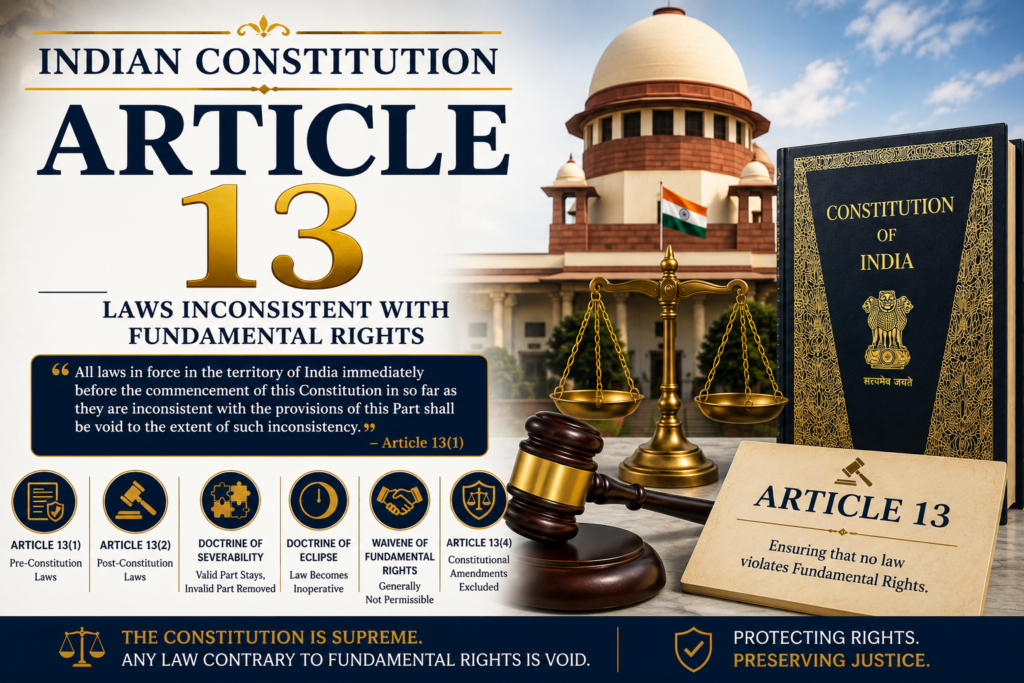
So, Article 13 serves two important purposes : (i) The first relates to laws which are existing ones or made prior to the constitution in force. It provides how such existing laws stand to be decided upon (in case they be inconsistent with rights laid down in part III). (ii) Secondly, it states how new laws should be made by the state which would then also need to adhere to the restrictions stated by rights under part III.
Structure of Article 13
The Article is divided into the following clauses which clearly outline the structure of the Article:
Article 13(1): It declares existing laws inconsistent with Fundamental Rights void.
Article 13(2): It prohibits the State generally to make any law taking away or abridging Fundamental Rights.
Article 13(3): Defines expressions “law” and” laws in force”.
Article 13(4): Clarifies the Article does not apply to constitutional amendments under Article 368.
Article 13(1) – Pre-Constitution Laws Article 13(1) pertains to pre-constitutional laws that were in force prior to the commencement of the Constitution of India. It mandates that all laws in effect within India just before the Constitution began to apply are considered null and void to the extent of any inconsistencies with the Fundamental Rights stipulated in Part III. On January 26, 1950, when India’s Constitution came into effect, a vast array of laws had already been enacted.
Article 13(1) did not simply revoke all existing laws; instead, their continued validity was conditioned on their compatibility with the constitutional Fundamental Rights.
Therefore, a pre-Constitution law can remain legally operative as long as it does not contradict a Fundamental Right. In cases where only certain portions of a law are at odds with Part III, the issue becomes whether these offending parts can be physically segregated from the valid ones. No Retrospective Application of Fundamental Rights A fundamental principle closely linked to Article 13(1) is that Fundamental Rights do not, as a general rule, apply retrospectively to overturn actions or events completed before the Constitution’s enactment that were entirely legal at the time. This means a pre-Constitution law does not retroactively lose its validity from its date of enactment just because it is later found to clash with a Fundamental Right after the Constitution is implemented.
Its constitutional relevance begins when the Constitution is put into practice.
For example, if an action was legal under a pre-existing, valid law prior to the Constitution’s implementation, an individual who carried out that action can’t usually claim later that the Constitution effectively voided the legal repercussions of an act they committed at a time when it was fully punishable. Hence, Article 13(1) primarily impacts the future functioning of conflicting pre-Constitution laws rather than nullifying all actions taken under them before January 26, 1950. The phrase “to the extent of such inconsistency” in Article 13(1) gave rise to what has become a pivotal principle in constitutional interpretation: the Doctrine of Severability.
The Doctrine of Severability in Article 13 The Doctrine of Severability is a significant aspect of Indian constitutional law, stemming from Article 13 of the Constitution. It dictates that if only a portion of a law contravenes Fundamental Rights, the entire law need not be struck down. Rather, only the parts incompatible with Fundamental Rights may be declared illegal, provided they can be physically separated from the valid parts.
This doctrine is anchored in the phraseology “to the extent of such inconsistency” in Article 13(1) and “to the extent of the contravention” in Article 13(2).
It implies that Article 13 does not necessitate declaring an entire legislative act null and void because a part of it violates Fundamental Rights. Meaning of the Doctrine of Severability “Severability” literally means ability to be divided into sections or parts. In the context of constitutional law, the Doctrine of Severability allows for the separation of an unconstitutional portion from a constitutional portion of a legislative act. If the valid portion can function independently upon the elimination of the unconstitutional part, it can be saved.
In simple terms: Unconstitutional Part + Valid Part Can both be separated?
Yes Invalid part is deleted and the valid part will survive. No If both are interlinked the entire law may become unconstitutional. For instance, let’s say an act contains ten clauses.
Out of these, two clauses may be found to be in conflict with Fundamental Rights. If the remaining eight clauses are sufficiently distinct and could serve the purpose of the legislation without the two clauses in question, then only the offending clauses can be nullified. Consequently, the Doctrine of Severability serves the objective of upholding legal enactments wherever possible, avoiding their wholesale nullification.
Tests for Applicability of the Doctrine of Severability When assessing whether a part of a law is severable from the rest, the courts examine the legislation’s overall framework and purpose.
Some key factors considered are: 1. Ability to Separate valid and invalid provisions Is it possible to separate the unconstitutional section from other parts? If the remaining part can stand on its own even after removing the offending portion, severability is likely. 2. Remaining law to be Complete and Workable Does the legislation remaining after the deletion of unconstitutional parts continue to be complete and functional?
If the removal of invalid parts renders the law meaningless, the whole act may be invalidated.
3. Legislative Intention The legislator’s intention plays a crucial role.
Would the legislators have enacted the valid parts even in the absence of the invalid parts? If the valid and invalid portions are intricately connected, their separation might not be advisable.
4. Object and Scheme of Legislation
The overarching purpose and structural design of the legislation are scrutinized. The saved parts must remain consistent with the central objective for which the law was enacted.
5. Substance rather than mere Physical Separation
Whether the valid and invalid parts appear in distinct sections or within the same section is not the sole determining factor. The primary focus is on their substantive separability in a way that upholds the legislative objective.
The doctrine of separability was applied by the Supreme Court of India in case of “A. K. Gopalan v. State of Madras (1950)”. This was one of the first cases in respect of enforcement of Fundamental Right, filed after commencement of Constitution of India. In the present case Supreme court upheld the validity of section 3 of the Preventive Detention Act, 1950 by separating the particular section which was inconsistent with the Constitution, from the remainder of the Act.
On the application of doctrine of separability Supreme court hold that, that since a section alone was unconstitutional and this can be separated from the rest of the Act then, invalidity of a section of an Act will not attract the entire Act and just the specific section will be considered as unconstitutional.
The principles governing severability and separability of provision of a statute have also been elaborated in case of “RMD Chamarbaugawala v. Union of India”.
The apex Court observed that the test for separating a provision of a legislation is to determine whether the remaining portion will have a substantial measure of the legislation if the invalid provisions were omitted there, if so, the valid portions remain valid. The essential point to find out under doctrine of severability is as to how far the law was intended by the legislature as regards its components, so, what all remains after striking of the same whether it contains substantial and a coherent whole is matter to be examined for severability. So for separating there are three major aspect- Legislative intension whether valid portion stands itself; valid portion constitute full workable code; are the valid portion so connect to the non- valid portion that they should be struck out altogether.
The Meaning, Scope and Applicability of Doctrine of Eclipse with reference of Relevant Article “13”(1).
The concept of eclipse, for the purpose of striking of the statutes/laws which are inconsistent to the fundamental rights guaranteed under Part III of Constitution of Indian is being presented in below:
THE DOCTRINE OF ECLIPSE Under ARTICLE13
The doctrine of eclipse states that a law that is inconsistent with Fundamental rights made before the commencement of the constitution but is not void at the time of enactment remains inoperable or dormant, and would again be effective and revive if the conflict between the law and constitutional rights is removed.
In this context, a prior law which conflicts with a fundamental right becomes inoperative only to the extent of such a contradiction. In simpler terms, the Constitution (Fundamental Rights) “eclipses”or “shadows” a law but does not erase it.
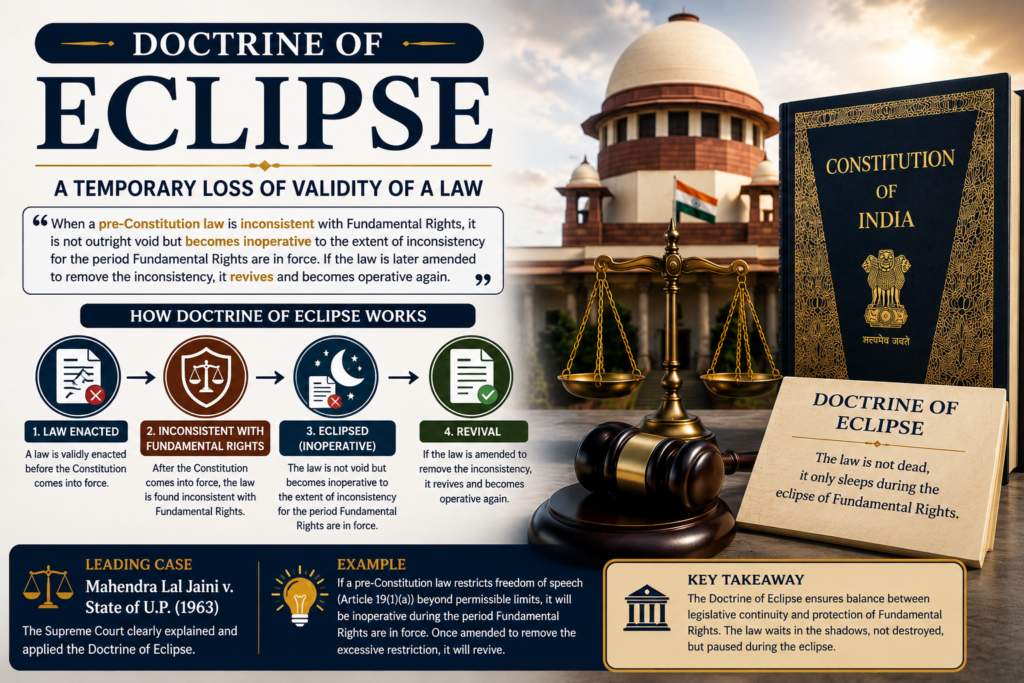
WHY apply doctrine of eclipse in 13(1). : – Article 13(1) starts “all laws in force in the territory of India immediately before the commencement of this Constitution shall be void to the extent of the said inconsistency”. The apex court interpreting this statement held that by this “to the extent”, a prior enacted law is not declared as void ab initio or altogether abrogated, but rather its operative part is made inoperative till the contradiction persist.
The doctrine means; that while the conflict will render the prior law non-operative during the period the conflicting rights constitutionally stand in force, if that conflict is resolved the said earlier act will resurrect.
In the words “the constitution “shadowed the act””. Therefore, a “shadowed law is not abolished, but it lays dormant”.
For, it’s a well know axiom, if there arises any conflictbetween there are any constitutional limitation and statutory provision, the limitation prevails and overrides the provision of the stat. In a nutshell.
This approach can be clearly seen in the judgment of Supreme court in case of “Bhikaji Narain Dhakras v/s State of M.P.” [1955] :–
Here, C.P and Berar Motor vehicles (amendment) Act, 1947 which allowed the State to create a monopoly in road transport business, were enacted prior to constitution. These provisions became inoperative on commencing of constitution in 1950 when fundamental rightto carryon any professionor business was enacted. However, this act was reaffirmed when in 1951 the first amendment was brought, wherein it permitted legislature to establish “any trade, business, industry or services to the exclusion, complete or partial, of citizens”.
The Supreme court in here observed that at the beginning this Act was given as “in eclipse position” or the ‘shadow’ of fundamental right was put upon this prior Act and; later on “after removing” of that “constitutional obstacles” which had previously caused the inconsistency, the prior enacted statute became “once again valid and operable”. Hence at large if there occurs the question of reasserting a once nullified by constitutional difficulty; then the constitution would again be at the same place in order to enforce.
Effect of the Doctrine
The doctrine introduces a key distinction between non-existence and nullity. Where a pre-constitutional law is repugnant to a Fundamental Right, that repugnant part becomes unenforceable after the constitution’s commencement but may linger in existence in abeyance. Effectively: Eclipsed law is not law which was not always law, that would simply mean it was never made.
Rather: An eclipsed law is one which operates in the shadow of a Fundamental Right, and is pushed to the extent that it fails to operate.
It was law when made but cannot operate in part after the commencement of the Constitution. Revival of the Eclipse The significant effect of the doctrine is the prospect of revival. When the source of the constitutional constraint-making the inoperative portion non-operational in the legal sense-is removed through some means (typically a constitutional amendment), then the constitutional eclipse from the face of the offending statute is lifted and it could regain its strength or be brought into play without reenactment. This was also affirmed by Bhikaji Narain Dhakras, a pre-constitutional Act held valid again by the Apex Court after amendment.
Doctrine of Eclipse and Pre-Constitutional Laws The Doctrine of Eclipse has classic application for pre-constitutional laws.
By definition, these laws existed before the promulgation of the constitution and, therefore, were valid prior to its commencement when the constitutionality standard had not yet emerged into its familiar Part III garb. Post-constitutional Laws when challenged, are directly and immediately invalidated without invoking the mechanism of ‘ eclipse’. Thus they are non-existence of law ab-initio rather than their being only overshadowed and inoperative for sometimes and regaining thereby lost force later on without legislative interposition.
Thus the original purpose for which the theory of Eclipse was propounded may, therefore, be seen as mostly as relevant when pre-constitutional statues are involved and in such cases it was held applicable by the Apex Court of India from cases like (1952) 1 SCC 161 and in Bhikaji Narain Dhakras to (1955) 2 SCR 1391 and later in Anuj Sharma. The safest thing is that the notion of eclipse may strictly applied only for the pre-constitution acts and it may therefore be appropriate to hold that the doctrine is restricted only to pre-constitution laws as the entire concept under Article 13(2) is entirely different.
Doctrine of Eclipse and Doctrine of Severability
Although both doctrines arise in connection with Article 13, they perform different functions.
| Doctrine of Eclipse | Doctrine of Severability |
| Deals with a law becoming inoperative because of inconsistency with a Fundamental Right | Deals with separating unconstitutional provisions from constitutional provisions |
| The inconsistent law is overshadowed or rendered dormant to the relevant extent | The invalid portion is removed while the valid portion may survive |
| Revival may become possible if the constitutional inconsistency is removed | Focus is on whether the valid portion can independently survive |
| Bhikaji Narain Dhakras is a leading case | R.M.D. Chamarbaugwala is an important case |
Purpose of Doctrine of Eclipse
Doctrine of Eclipse shows the importance that ‘void’ expression for purpose of Article 13 need not always mean wholly invalid in all aspects and situations. For laws enacted prior to the enactment of the constitution, a law which was perfectly valid at the time of enacting it can become void and in-operative when constitution came in to force because it infringes one of fundamental right/rights. A law would simply stay covered by eclipse, covered by cloud, till the moment there are constitutional impediments i.e. As long as constitutional issue would exist.
If some where, the issue is removed, then law could become operative again to. So basically a Pre- constitutional law inconsistent with the fundamental right not outright extinguished but kept under constitutional shadow / eclipse and if any where this eclipse could be removed the law will re-arise. Article 13(2): Post Constitutional Laws Article 13(2) applies on post constitutional law which comes in operation at and from 26 Jan, 1950. It not merely applies on Pre-constitutional law (as Article 13 (1) does) but imposes on state a positive constitutional disability.
Art 13(2) Says:- “The State shall not make any law which takes away or abridges the rights conferred by this Part and any law made in contravention of this clause shall to the extent of contravention be void.” so here State after 26 jan 1950 not only it was not possible to make law which takes away or abridges any Fundamental Right guaranteed under Part III, rather made it unconstitutional not merely in aspect of application but it its existence too, to the extent it abridges or take away FD Rules to have ‘Take away or Abridge’ Article 13(2) says that state shall not ‘take away’ or ‘abridge’ of Fundamental rights.
To take away means to cancel or make non -existing to take an advantage of the FD whereas to abridge means to restrict or reduce the coverage or scope which already guaranteed by the constitution . So A Law can be said unconstitutional under Article 13 (2) either where It fully restricts the scope of a Fundamental Rights. Or whether it gives it to the person only for restricted part of the FD.
But this is important not necessarily every restricted clause would make it void. Because of the reason of flexibility of the FD. SomeFD itself contains provisions permitting a State from imposing on FD ‘reasonable rest’ ‘to protect Public Health/ morality’, etc, Example:- FD under 19 (b) can be restricted by any law for good & valid reason like public health & morality.
Here the test will be ‘Reasonable Rest?’
The law imposing it whether reasonable rest. Whether it falls in allowed FD or outside to be checked What law would have the consequence as per art 13(2) If Art 13(2) violate any FD, then under Article 13 (2) shall to ‘the extent of the contravention’ be void. These words are more significant. ‘To the extent of the contravention’ not mean fully void in all its part but the parts ‘that conflict with the rights granted under fundamental rights.’ and in if the conflict is separable, then the rest parts are considered valid not the entire law declared ‘void’.
Prospective Application of Judicial Decisions Also related tounconstitutionallaws is the theory of the prospective application of court decisions. If a law is declared unconstitutional by a court, an issue of legality of past dealings of such a law may be raised before courts. A court will sometimes grant prospective effect to the constitutional decision and the ruling shall apply from the time of judgement onwards as a matter of principle with a view not to disturb the existing state of affairs, which was in conformity with the legal position prior to the pronouncement of judgment (or at best would result in considerable legal vacuum and anarchy if the contrary applied).
This concept must, however, be clearly distinguished from the language of Article 13.
The application prospective is concerned with the temporal effect of a decision while the latter with constitutional validity of legislative declaration against Fundamental Rights. IMPORTANCE OFARTICLE 13(2) There is of course a profound importance of Article 13(2).
It places a direct limitation on the legislative competence of State Parliament and state legislature have enormous law making powers but no legislature may use this ordinary law making power in a way which violates any Fundamental Rights even when the legislation is to that extent only in contravention of the constitution and that the ordinary law making power is to be exercised subject to the fundamental rights and Constitution supreme .
The Constitution has supremacy over all ordinary laws whether passed by Parliament or State Legislature if on a close scrutiny; any ordinary is in violation of the constitution in terms of violation of Fundamental Rights they can be declared void.
ARTICLE13(2)is thus a continous constitutional restraint upon the powers of state to make law contrary to the Constitution Fundamental Rights. Test of infringement of fundamental rights as indicated above, Article 13 says that if a law contains something to the contrary of any Fundamental Right then the same is void.
Now, what actually needs to be the interpretation of such law to as certain to that there exists contravention?
The court need to apply its own tests,and such tests need to be developed over time. It seems that just simply looking to the naming or title and objectof the law will not suffice.
The Court need to consider the effect. There was considerable development of the tests for interpretation by way of judicial pronouncement and the BANK NATIONALISATION CASEis an important one which broadened the horizon of approach.
RC.Cooper Vs. Union of India, A.. (1970) S.C 592:
this case is known as Bank Nationalisation Case. The question of infringement of a Fundamental Right as established as well recognized test for the interpretation of statute by considering its purpose as well as effect thereof in respect of contravention.
In this case Supreme Court has pointed to various principles. The court held that in determine whether a state action is violating a Fundamental Right, it should be interpreted considering effect on rights of a person and not just name/object/and form of the act, what is to be investigated the impact on person’s fundamental rights.
Effect of state action
The principle decided in the Bank Nationalisation case is: It is not by the form and object of state action alone, that its constitutional validity can be tested. On the other hand. It is the actual operation and the effect thereof upon the Fundamental Rights and their scope that has to be examined.
Hence: form or object of state action …
It is not the conclusive criterion its actual operation and effect on the fundamental rights …. Must be assessed by the Court The State action may, while a particular object is perfectly legitimate appear as invalid when it becomes a tool to violate some right guaranteed under part III of the constitution. It may sometimes happen, while examining such action whether, directly or indirectly, they create the impairment or restriction in Fundamental Rights. nature of the right and degree of harm In judging whether there has been encroachment upon Fundamental Right, the following factors may also be weighed : nature of the fundamental right Nature of the property to which access is sought. Interest of the individual against whom state action is taken.
Whether state action encroaches upon a fundamental right of the applicant or its function has direct and immediate or its remote or peripheral connection.
Nature of State Action Degree of harm done to the individual. Hence the real enquiry that is to be made here is whether the State action encroaches or injuriously affects some constitutionally protected right of the applicant and, if so, to what extent. Direct and Indirect Effect A related aspect of the above point is the consideration whether the State action has a direct, and not merely incidental or remote, relationship or connectien or impact on the particular constitutionally Protected Right or Activity.
This depends again upon the nature of the particular fundamental Right itself and also the way in which the State action affects it in practice. For example if a law is made by State which takes away from us our Fundamental Right of Lrty to do some business or our fundamental right of free speech the State can, hardly have a way to argue that there is merely some peripheral effects only because of the fact that we are engaged in activities relating to commerce or that our activity involves communication. On the contrary if it goes with regulation which is outside the content of any fundamental right and this regulation affects some fundamental right, incidentally or remotely or incidentally the impact may be deemed to be indirect or so remote not to be taken notice of for purpose of enquiry in Fundamental right jurisprudence.
Bank Nationalisation Case
Bank Nationalisation Case has introduced a sea of change into this aspect of interpretation. It helped to steer clear from the argument of mere technical form and directed the focus of examination to the actual operation of law made by the State on Fundamental rights. Hence the principle evolved is that The constitutional validity of a measure passed by the State has to be ascertained not merely from its form and object but also from its effect and operation.
Doctrine of Waiver of Fundamental Rights
The Doctrine of Waiver talks about whether a person can willingly let go off, waive, or surrender a fundamental right given to him under the Constitution.
Meaning of Waiver – In common legal parlance, waiver means voluntary relinquishment or giving up of a right that one is entitled to, in whole or in part. For example, a person may not file a police complaint even if one is legally entitled to.
However, this concept does not apply to the fundamental rights.
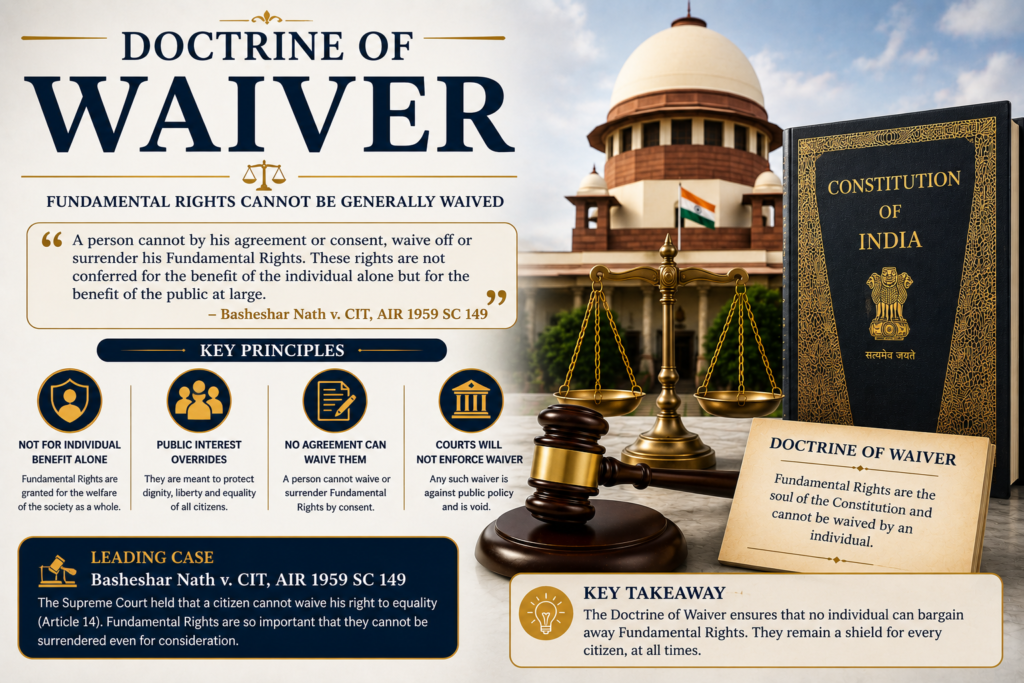
Under the Indian constitution, fundamental rights generally cannot be waived. A person cannot permit the State to pass a certain State action which is against the basic mandate of the Constitution on account of the person agreeing to give away a certain Fundamental Right of his/her. Basheshar Nath v. Commissioner of Income Tax In the landmark case of Basheshar Nath v.
Commissioner of Income Tax (1959), an individual named Basheshar Nath was served with a notice intimating that the Income Tax Department is investigating the tax liability of him as he had concealed substantial income in his returns.
In due course of time, a settlement was made regarding the payment of dues to the department, where in Mr. Nath agreed to pay Rs. 3 lakh to the Income Tax department in instalments, on the basis of a certain provisions of the Indian Income Tax Act, which allowed the asses see the opportunity to agree to pay back the due amounts so that the tax matter is closed and no prosecution would happen under Section 221(1) and Section 271(1)(a) of the Income Tax Act 1922. Subsequently, he sought to challenge this Income Tax act and moved the Supreme Court on the grounds that the act was violative of the fundamental right enshrined in Article 14 of Indian Constitution which provides for ‘Right to Equality’.
Since Mr. Nath had agreed to pay the dues as stated in the Settlement Agreement that was entered between him and the Income Tax Department, the respondent had put a claim that he had waived his rights under Article 14. So, the central question for decision in Basheshar Nath’s case was: Could the petitioner be estopped from raising a challenge to a law because of his voluntary consent in the settlement?
Here, the Court held that an individual cannot waiver off the protections available under Article 14 of the Indian Constitution.
Fundamental Rights Cannot Be Waived- As clarified in Basheshar Nath’s case, no person can waive any Fundamental Right conferred on him/ her, by simply agreeing to such a waiver which allows the government or state to act against the provisions of the constitution. Any individual agreement cannot give legitimacy or constitutional cover to an unconstitutional action by the government/state and can never supersede the Constitutional obligation on the state to act within the sphere of Part III of the Constitution.
Simply put: an unconstitutional action performed by a person/ authority and supported by the affected person will be still termed as an invalid, unjust, unconstitutional action! This also means: Unconstitutional action of state -> an agreement is made by a person.
Why should rights not be waiver-able?
The basis behind not allowing an individual to waive away his/her Fundamental rights rests upon the social objective and importance of such fundamental rights.
Such rights exist not only for the individual’s good, but are an integral part of the society structure and framework. If individuals are permitted to waive these rights easily and expediently, there would be a loss of this social structure in society. It would allow individuals to waive rights which might prove harmful to them in future but will be supported in the present by their own consent and hence they would facilitate the government action which would otherwise be against the constitutional provisions.
What if it’s an ordinary law of the land and not the Constitution?
Fundamental Rights are qualitatively different from ordinary laws that create certain rights. These fundamental rights are constitutionally guaranteed and serve not only as checks on governmental power but as basic building blocks of a democratic society. Ordinary rights created under legislation can often be waived because the legislature, in its legislative powers, also has the authority to enact laws which specify when and how rights granted thereunder may be waived by their recipients. Fundamental rights operate on a higher plane-an inherent constitutional floor designed to protect the fundamental liberties of persons regardless of the intentions or agreements of the state or the desires of the affected persons.
Importance of Doctrine of Waiver The Doctrine of waiver therefore acts as an effective tool which provides protection against any attempt of the government to undermine constitutional protection afforded by fundamental rights; it ensures that there exists a constitutional limitation for government actions, no matter how the particular aggrieved party wishes otherwise.
The Doctrine, most prominently demonstrated by the landmark judgment of Basheshar Nath v. Income Tax Commissioner , solidifies the concept that while some legal rights may be waiveable in day to day cases, constitutionally guaranteed fundamental rights, especially the equal treatment provision within Article 14 of Indian Constitution cannot be surrendered to authorize any deviation from the constitution by a governmental entity or instrument.
Article 13(3) – Meaning of “Law” and “Laws in Force”
Article 13(3) defines the expressions “law” and “laws in force” for the purposes of Article 13. This definition is important because Article 13 can operate only when the rule, regulation, custom or other legal measure in question falls within the constitutional meaning of law.
Article 13(3) provides:
“In this article, unless the context otherwise requires,—
(a) ‘law’ includes any Ordinance, order, bye-law, rule, regulation, notification, custom or usage having in the territory of India the force of law;
(b) ‘laws in force’ includes laws passed or made by a Legislature or other competent authority in the territory of India before the commencement of this Constitution and not previously repealed, notwithstanding that any such law or any part thereof may not be then in operation either at all or in particular areas.”
The definition makes it clear that the expression “law” under Article 13 is not restricted merely to legislation formally enacted by Parliament or a State Legislature. It has a considerably wider meaning.
Meaning of “Law” under Article 13(3)(a)
Article 13(3)(a) gives an inclusive definition of law. It includes different forms of legal rules that possess the force of law within the territory of India.
These include:
- Ordinances;
- Orders;
- Bye-laws;
- Rules;
- Regulations;
- Notifications;
- Customs; and
- Usages having the force of law.
Therefore, Fundamental Rights cannot be avoided merely because a legal restriction has been imposed through a rule, regulation or notification instead of through an Act of the legislature.
If such a measure has the force of law, it may be examined for consistency with Fundamental Rights.
Statutory Law
Statutory law consists of laws enacted by a competent legislature, including Parliament and State Legislatures.
Since ordinary legislation must remain consistent with the Constitution, a statutory provision that takes away or abridges a Fundamental Right beyond constitutionally permissible limits may be challenged under Article 13.
Article 13 therefore reinforces the principle that ordinary legislation is subordinate to the Constitution.
Delegated Legislation
Modern legislatures frequently lay down the general framework of a law while authorising the executive or another authority to formulate detailed rules for its implementation. Such law-making is commonly known as delegated or subordinate legislation.
Delegated legislation may appear in different forms, including:
- Rules;
- Regulations;
- Orders;
- Notifications; and
- Bye-laws.
The inclusion of these forms within Article 13 is important. The State cannot achieve indirectly through delegated legislation what it is constitutionally prohibited from doing directly through legislation.
Therefore, rules, regulations, notifications and bye-laws having the force of law must also conform to the Fundamental Rights guaranteed under Part III.
Ordinances
The term ‘law’ mentioned in Article 13(3)(a) expressly includes Ordinances. Therefore, the fact that an Ordinance is enacted not in the ordinary legislative process but under the ordinance making power of the executive, cannot exclude it from the purview of constitutional challenge. If the Ordinance is violative of a Fundamental Right, then its constitutional validity can be tested by applying Article 13.
Customs and Usages It also makes express mention of “custom or usage having the force of law” within its scope.
This point is significant as legislation is not the only source of law. Customs historically have been an important source of law as well. Hence, an custom when it has the force of law and is recognized by the legal system, may be covered by Article 13. To have the force of law a custom has to satisfy conditions recognized by the law for this purpose like certainty, continuity, reasonablness, etc.
Thus an application of rules that originate not from a statue, but a convention of long standing, would not be beyond Article 13 because of its source.
Meaning of “Laws in Force” Article 13(3)(b) gives a separate definition of the expression “laws in force” used in Article 13(1). It means “all laws passed or made by a Legislature or other Competent Authority in the Territory of India before the commencement of this Constitution and not repealed before such commencement”. A law comes under the definition of “laws in force” even though at the time of commencement of the constitution, the same had not been in operation in any part of the country.
This clause applies to those pre constitutional statutes whose existence had survived. The constitution therefore subjected the already existent framework to the rights guarantee under Part III.
Significance of Art.13(3).
Article 13(3) broadens the operation of Art.13 considerably. Judicial review can be applied not just to legislations passed by Parliament or State Legislature but rules, orders, notifications, bye-laws, custom and usage having force of law are also supposed to be in consonance with Fundamental Rights. If not, constitutional constraints cannot be overcome by enacting in different form of law making. Hence substance and effect of rules over name or form of the rule will prevails.
Personal Laws vis a vis Art. 13. An important question of controversy under Art.13 is whether personal laws are included in the expressions “law” or “laws in force” and as such are liable to be tested against the Fundamental Rights guaranteed in part III of constitution. It applies to rules regarding family and personal relationships such as marriage, divorce, maintenance, succession, inheritance and adoption etc dependent upon the personal law followed by each person. The controversy exists because Article 13(3)(a) explicitly includes in “law” “any custom or usage having in the territory of India the force of law”, and does not explicitly mention in “law” personal law.
State of Bombay v. Narasu Appa Mali. One of the leading cases on the topic concerning personal law and Fundamental Rights is State of Bombay v.
Narasu Appa Mali(1952) which was decided by the Bombay High Court.
In the instant case the Bombay Prevention of Hindu Bigamous Marriages Act, 1946, was challenged by an appeal. There arose an important question whether uncodified personal law falls within the operation of Art.13(1), or not. It was held by the Bombay High Court that since uncodified personal law was not covered by “laws in force” mentioned under Art.13(1) there existed a dichotomy between personal law itself and custom or usage having force of law which were mentioned in Art.13(3)(a).
Codified and Uncodified Personal Laws
A classification between codified personal law and uncodified personal law must be highlighted.
Codified Personal Law. The rules pertaining to personal law, when enacted by the legislature in the form of a statute, become statutory law. Thus statutory law can be challenged, like any other statutes, in constitutional proceeding and since the personal law rules are encoded in a statutory form, they are liable to be tested in a constitutional court in respect of questions concerning marriage, succession, maintenance, adoption and so forth. So, the mere fact that a statutory rule is intended to regulate the personal law matters, does not make it immune to the constitutional scrutiny.
Uncodified Personal law
The status of uncodified personal law traditionally continues to be an issue of controversy. Thus the rationale laid down in Narasu Appa Mali is followed in certain respects. The uncodified personal laws, it is argued, have not been made subject to the Fundamental Rights by “laws in force” as appearing in Art. 13 (1). And the debate is because Art.13(3)(a) specifically includes custom or usage having force of law, however, mention of personal laws are not explicitly there.
Custom and Personal law Are not Synonymous. Article 13 states that ‘law’ and shall include every ordinance, order, by-law rule, regulation, notification, custom or usage having in the territory of India the force of law’; therefore, the implication is that every rule affecting the personal status of individuals is not necessarily within the scope of Article 13. Custom or usage with force of law is expressly brought within the scope of article 13(3)(a), whereas the status of uncodified personal law has posed a separate constitutional problem.
Constitutional Debate.
The question between personal law and Fundamental Rights gives rise to broader aspect; can rules affecting fundamental right of an individual be given a legal sanctity when such personal laws contravene the Fundamental Rights such as liberty, non-discrimination and equality. While the constitutional treatment of personal laws, involves interplay of various constitution principles and rules and it may be erroneous to characterize “all personal laws are outside Article 13”.
CONSTITUTIONAL AMENDMENTS AND ARTICLE 13
Of the many Constitutional Controversies on Article 13 that we encounter, this one is certainly the most significant: whether the term ‘law’ under Article 13 (2) should include any constitutional amendment, made by Parliament under Article 368. Since article 13(2) is forbidding the State from making ‘any law’ which is null and void, the immediate concern that arose is about whether any constitutional amendment that affects fundamental rights can really be considered law.
Will the same stand void or not?
Supreme Court ‘s view evolved in a landmark series of constitutional decisions.
SHANKARI PRASAD V. UNION OF INDIA First coming in forefront during, the case was of Shankari Prasad Singh Deo v. Union of India (1951). During the year, the constitution had been amended first time in order to amend some of the rights mentioned in Part III of constitution, as it did effect certain rights including property rights etc.
The constitutionality of the first constitutional amendment was challenged on the grounds of it being ‘law’ within the scope of Article 13(2), and thus violating the same by it not protecting the fundamental rights, in order to amend them.
However the Supreme Court refuted this claim, the court observed that the term ‘law’ in Article 13(2) does not take in Constituent Amendments like the ones under article 368 of the constitution; which are performed in order to change the Constitution of India and thus it can amend rights.
SAJJAN SINGH V. STATE OF RAJASTHAN
The argument on the same reappeared in Sajjan Singh v.State of Rajasthan (1965). Similarities can be identified with Shankari Prasad; here as well, amendments affected some fundamental rights, and their constitutionality was put to question in terms of being ‘law’ within Article 13(2). Here too, the ruling was along the lines as adopted in shankari Prasad and it was held constitutional.
So, by now, according to Shankari Prasad & Sajjan Singh; constitutional amendment was not ‘Law’.
But this line of judgement soon took a complete somersault. ARTICLE 13(2) VS PARLIAMENT’S POWER TO AMEND : The changing tide – IC GOLAKNATH V. STATE OF PUNJAB What follows shankari prasad and Sajjan Singh is a landmark judgement where in all sudden the Supreme court reevaluated its positions and declared all constitutional amendments as Law! In the case I.
C. Golaknath v. State of Punjab (1967)
the constitutional validity of 17 constitutional amendments were debated and the court in it ruled that, the fundamental rights were supreme and inviolable and hence, Parliament could not amend any part of it in exercise of its power of amendment under Article 368. The court held that if any Amendment act affected and abridged any of thefundamental rights, it shall be declared void under Article 13. What this clearly did, was to undo the previous decisions of Shankari Prasad and Sajjan Singh.
GOLAKNATH and the Doctrine of prospective overruling This declaration by Golaknath posed serious concerns regarding the legality of several amendments already incorporated into the Constitution. Had these earlier amendments been based upon Parliament’s recognized power to amend Fundamental Rights, they would be declared unlawful had this decision been made fully retrospective, unsettling countless previous arrangements. The Court therefore resolved this dilemma by adopting and applying the concept of “Prospective Overruling.”
The principle is this: that where Parliament made 17 earlier Amendments into the Constitution, these amendments have, so far as the Court is concerned and according to the fresh vision by the Court of the constitutionality, all made legally the same, but this verdict only applies to the amendments to be made from this date forward i.e.
For prospectivity. Hence this overruled ‘golaknath ruling. So after Shankari Prasad, Sajjan Singh, the Supreme court in ‘Golaknath’ held, that parliamentary amendments as much as those were concerned in shankari Prasad, sajjan singh were all law. Yet since ‘Golak Nath’ as to be applied prospectively, so the previous amendments will still prevail and would hold to their validity but with the judgement in Golaknath, the parliament would have to curtail amending power on the fundamental rights.
KESAVANANDA BHARTI V.STATE OF KERALA
Following ‘Golaknath’, in the year of 1971, the Parliament reacted by passing the Constitution (Twenty-fourth Amendment) Act, 1971. This amendment declared the power of the Parliament to amend any provisions, not just including the Fundamental rights and Article 368, in such a way so, as to remove or abridged a right as a constituent power not being a ‘law’ for purpose of Art 13(2). It was an implicit rejection of the Golaknath interpretation.
Subsequently, a Special bench of thirteen judges of the Supreme Court was constituted in Kesavananda Bharati v. State of Kerala (1973) to look at this issue of supremacy. The Court, this time however, steered a course between the rigid positions of previous rulings.
It upheld the Parliament’s right to amend Fundamental Rights but with one fundamental caveat: The amendments must not alter the “Basic Structure of the Constitution.”
BASIC STRUCTURE DOCTRINE
The Kesavananda Bharati decision introduced what is arguably the most important development in Indian constitutional law since the initial drafting of the Constitution itself: the Basic Structure Doctrine. According to this principle, while Parliament can generally amend any provision of the Constitution, it cannot touch the essential, fundamental pillars upon which the entire structure of the constitution rests. If an amendment would change or damage these ‘basic features,’ it will be declared unconstitutional. What constitute ‘Basic Structure’ has not been explicitly listed but through various judgements, certain features of the Constitution like: • Secularism; • Democracy; • Federal character of the Constitution; • Rule of Law; etc. Have been established.
Therefore after Kesavananda, the stand is as such: PARLIAMENT CAN AMEND FUNDAMENTAL RIGHTS BUT IT CANNOT ALTER OR DESTROY THE BASIC STRUCTURE OF THE CONSTITUTION.
MINERVA MILLS LTD.V. UNION OF INDIA
Perhaps no other case since Kesavananda Bharati demonstrates the power of the basic structure doctrine more effectively than the Minerva Mills Ltd.V. Union of India (1980).
By introducing the Forty-second Amendment, which provided that no constitutional amendment can be questioned in any court and which extended Parliament’s power of amending the constitution infinitely, Parliament tried to increase its amending powers exponentially, essentially making such powers unlimited. The court, here in Minerva Mills rejected this notion and held that Parliament’s powers cannot be limitless and Parliament could not amend their own amendatory powers.
Such an alteration would destroy the Basic structure because it destroys its power to review every amendment to protect constitution.
In this case the Court also stated and held, importance of judicial Review in the field of judicial scrutiny and amendments. For it ensures that each institution may stand within the limits as prescribed by the Constitution itself. Therefore as far as Part III of Indian Constitution which are fundamental Rights concern, i.e. Article 13(2).
As of the landmark decisions i can claim that fundamental rights of any Indian could be modified but can never be destructed to the scale where no Indian will ever realize the essential characteristics of rights guaranteed by Part III, because any such attempt on part of parliament on amending rights into something else without affecting any substantial ‘basic feature ‘of the constitution could either have come up under the old position(in favour of parliament) either with effect to past, from shankari prasad as to sajjan singh cases, (but what followed was the Golaknath where it put it down, and from then on to a period where Golaknath had taken an interim overrule before, that, how to take up all the already amendments); until the final and present established idea about such issues from the landmark ‘Kesavanada Bharati’; until minerva Mills cases; wherein the court, while giving sufficient amplitude to amending powers has put an equal limitation that, a constitution is never a living body that needs constant change to sustain its life or otherwise; even so no amendment shall violate the very character and integrity of the constitution.
Thus from the various landmark decision on Art. 13, on part ‘Law’ meaning, and amendments to the constitution; its interpretation has surely led in the progressive evolution of the fundamental rights for all concerned.
Judicial Review under Article 13
Judicial review is the power of the constitutional courts to review the validity of legislative and executive action and determine whether it conflicts with the Constitution. If the law is inconsistent with any constitutional limitation, the courts can declare such law to be void to the appropriate extent.
Article 13 is closely related to the doctrine of judicial review, as it expressly lays down that “All laws in force in the territory of India immediately before the commencement of this Constitution in so far as they are inconsistent with the provisions of this Part \[Part-III] shall be void to the extent of such inconsistency”.
Therefore, Article 13 underlines the supreme character of the Constitution and restricts the legislative power of the State within certain limits imposed by the Constitution.
Article 13 and Constitutional Supremacy
It is important to note that India upholds the principle of constitutional supremacy rather than parliamentary supremacy in absolute terms.
Parliament and State Legislatures possess wide legislative powers but it has to be exercised strictly in accordance with the Constitution. Article 13 imposes a key limitation by stating that:
Pre-Constitutional laws
have no validity to the extent they are inconsistent with the Fundamental Rights
Post-Constitutional laws
shall be void if they take away or abridge the Fundamental Rights to an extent prohibited by the Constitution.
Hence, when a law is inconsistent with Part III, the Constitution will prevail.
Role of Courts under Article 13
The statement contained in Article 13, however, is not just a statement of abstract law; it is made effective by the Judiciary which adjudicates on cases and interprets whether a law violates a Fundamental Right.
When the constitutional validity of a law is challenged, the following issues may be raised before the court:
Whether the legislature has authority to make such law?
Whether the law violates Fundamental Right?
Whether the restriction is reasonable and not contrary to the Constitution?
Whether the law is valid in one aspect and void in another?
Whether the unconstitutional portion is severable from the rest?
The court may declare such law to be unconstitutional to the extent it is found inconsistent with Part III. This provision prevents the executive and legislature from interpreting the Constitution and deciding what parts violate a Fundamental Right and what part does not.
Article 13 and Article 32
Article 13 and Article 32 are closely linked with each other.
Article 32 guarantees the right to move the Supreme Court for the enforcement of Fundamental Rights.
When it is alleged that any law is inconsistent with Fundamental Rights, and a violation of the law is imputed on the part of the State, article 32 comes to the aid of the aggrieved person by allowing him to appeal to the Supreme Court. The Supreme Court may issue appropriate writs for the enforcement of Fundamental Rights:
Habeas Corpus
Mandamus
Prohibition
Certiorari
Quo Warranto
Dr. B.R. Ambedkar stated Article 32 is the “heart and soul of the Constitution” of India.
In this context, Article 13 can be said to lay down the procedure while Article 32 offers remedy before the Supreme Court;
Article 13 deals with the constitutional invalidity
Article 32 provides for constitutional remedies.
Article 13 and Article 226
In addition to their powers under Article 32, the Supreme Court’s writ jurisdiction can be exercised by the High Courts under Article 226. Article 226 empowers every High Court to issue directions, orders or writs in the nature of habeas corpus etc “for the enforcement of any of the rights conferred by Part III and for any other purpose”. However, writ jurisdiction under Article 226 is wider than that under Article 32 in terms of the nature of rights.
Judicial Review of Legislation:
One important aspect to understand is how it (Article 13) is used in the judicial review of a legislation. Let us say Parliament, or State Legislatures, passes any law under any part of the Constitution, and it is challenged that the said law violates equality given under Article 14, or freedom given under Article 19, or life & personal liberty given under Article 21; simply because a law has been passed by democratically elected parliamentarians does not grant it immunity from being reviewed from constitutional perspective, and the courts could look into whether it adheres to the criteria imposed on it by the Constitution or else it is considered unconstitutional. This is one consequence that a written and supremacy constitution has.
Judicial Review of Subordinate Legislation:
Under constitution we have a set up where we not only review any law passed by the Parliament or the state legislature, but also the subordinate legislation, since Article 13(3)(a) gives “law” definition that it include orders, bye-laws, rules, regulations and notifications. For an example a rule can not be made by executive under delegation from parliament that infringes a fundamental right on the fact that it has itself passed the law that would have infringed it. Such laws are therefore, subject to two constitutional and legal constraints: the parent statute, and the Constitution.
Judicial Review and Doctrine of Severability:
Under judicial review it does not have to be the case that entire legislation is scrapped if a certain section of the law offends. The Doctrine of Severability helps here. This means that if it is legally possible then the offending provision is declared unconstitutional, and if that is possible then the whole statute would not be repealed. Thus:
1 provision is against a fundamental right
2 court looks if it can be separated
3 If possible, that provision is invalidated and rest of it continues.
This is supported by the word “to the extent” that appears in Article 13 repeatedly; this means only the offensive provision is invalidated if severable.
Judicial Review and Constitutional Amendments:
Judicial Review of a constitutional amendment has an alternate nature when compared with judicial review of any common law. Article 13(4) clearly states that Article 13 does not apply to constitutional amendments made under Article 368; however the power of Parliament to amend constitution given under Article 368 is constrained with the principle of Basic Structure doctrine as established in Kesavananda Bharati v. State of Kerala, so though Parliament is vested with powers to amend anything including F. R., it cannot destroy or damage basic structure of constitution.
Thus; ordinary Laws: can be challenged against the fundamental rights including those given under the Article 13. Constitutional Amendments: it can be challenged in light of the basic structure of the constitution only.
Importance of Judicial Review:
The judiciary has performed an essential role under the constitutional scheme by virtue of judicial review over the legislature; which is the protection of the citizens’ Fundamental Rights, maintenance of constitutional supremacy, limits on the arbitrary governmental powers and ensuring organs of the state act within the bounds. Article 13 is an indispensable part of the entire concept of judicial review. It lays down a basic rule: the state is not higher than the Constitution, and laws, which contradict constitutionally established rights of the fundamental nature, cannot be taken to be higher than the constitution.
Hence the F.R.s themselves are given not only a declaration but also their due constitutional weight through the process of judicial review and also the authority of the law making and the executive powers of the state; that whatever is passed by either must respect fundamental rights and not make them worthless.