
Rape and Sexual Offences Explained Under BNS 2023
Learn Sections 63 to 79 of BNS 2023 in detail, covering rape, punishment, gang rape, sexual harassment, voyeurism, stalking and other offences against women.
The Bharatiya Nyaya Sanhita, 2023 (BNS) is the chief criminal law enactment which has succeeded the Indian Penal Code, 1860 w.e.f. 1 July 2024. Chapter V of the BNS talks about the offences against women and children, which includes rape, aggravated rape, gang rape, sexual harassment, voyeurism, stalking, and other such offences that affect the dignity, bodily integrity, and privacy of women.
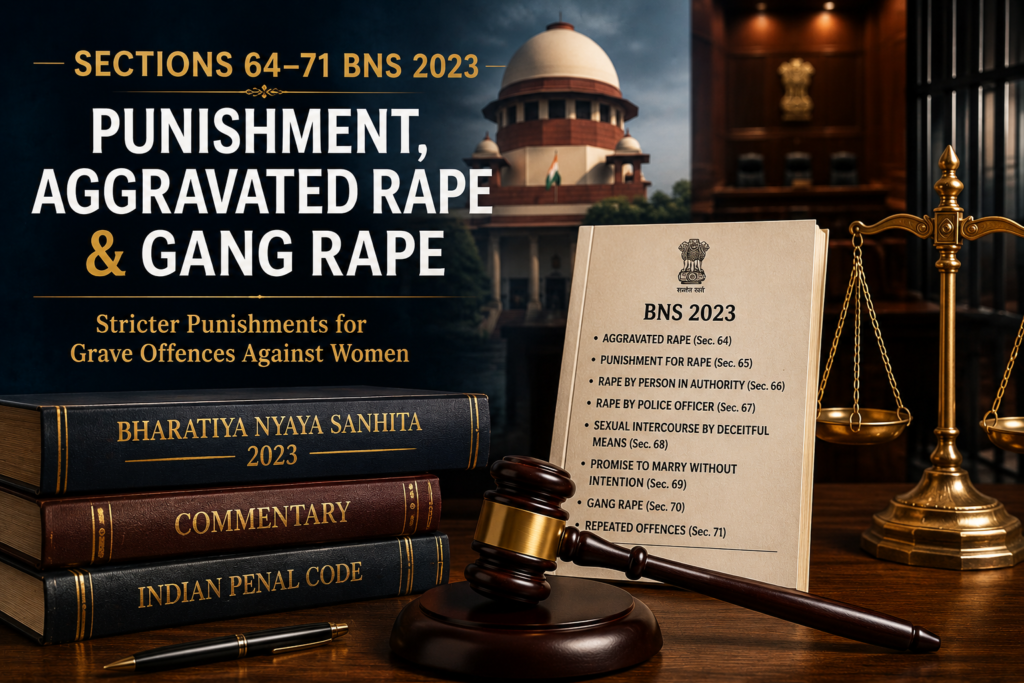
Sections 63 to 79 of the BNS 2023 provide for various provisions regarding rape and other sexual offences against women. Section 63 of BNS 2023 defines rape and the situations in which the sexual act amounts to rape. Sections 64 to 71 talk mainly about the punishment for rape, aggravated rape, other sexual offences, gang rape, and repeat offenders.
Sections 72 and 73 protect the identity of the victims and the publication of the proceedings of the court respectively. Sections 74 to 79 relate to outraging the modesty of the woman, sexual harassment, disrobing, voyeurism, stalking, and insulting the modesty of the woman.
This article gives a simple and systematic explanation of Sections 63 to 79 BNS 2023, their basic elements, punishments, exceptions and the corresponding provisions under the earlier IPC.
Overview of Sections 63 to 79 of BNS 2023
Sections 63 to 79 of the Bharatiya Nyaya Sanhita, 2023 (BNS) constitute an important provision under Chapter V that deals with the offences against women and children. The provisions relate to rape and other forms of rape, related sexual offences, gang rape, recidivist, the non-disclosure of the identity of the victim, sexual harassment and various forms of assaults or other acts that affect the dignity or privacy of women.
The provisions can be divided into the following two categories:
Sexual Offences: Sections 63–73
Section 63 – Rape: Definition of Rape and circumstances of the sexual act to be defined as rape.
Section 64 – Punishment for Rape: Punishment for the offence of rape and other aggravating circumstances thereof.
Section 65 – Punishment for Rape in Certain Cases: Additional penalty in cases where the offender commits rape on specified age group.
Section 66 – Causing Death or Persistent Vegetative State of Victim: Deals with extreme consequence caused to the victim by rape.
Section 67 – Sexual Intercourse by Husband During Separation: Deals with sexual intercourse of husband with his wife during separation without consent.
Section 68 – Sexual Intercourse by a Person in Authority: Deals with sexual intercourse committed by any person taking advantage of authority or fiduciary relation.
Section 69 – Sexual Intercourse by Employing Deceitful Means, etc.: Creating an offence involving sexual intercourse by employing specified deceitful means but not amounting to rape.
Section 70 – Gang Rape: Rape of one or more persons constituting a group or furthering the common intention to commit rape.
Section 71 – Punishment for Repeat Offenders: Enhanced punishment for persons previously convicted of specified sexual offences.
Section 72 – Disclosure of Identity of Victim: Protecting the identity of victims of specified sexual offences.
Section 73 – Publication of Court Proceedings Without Permission: Restrictions on publication of matters relating to specified court proceeding without the permission of court.
Criminal Force, Assault and Other Offences Against Women: Sections 74–79
Section 74 – Outraging Modesty: Assault or use of criminal force with the intention to outrage the modesty of the woman.
Section 75 – Sexual Harassment: Deals with the sexual harassment which is done in a prescribed manner such as unwelcome sexual advances, requests for sexual favors, showing pornography to women without their consent and making sexually colored remarks.
Section 76 – Disrobing of a Woman: Refers to any assault or criminal force that is exerted with the intention of disrobing a woman or compelling her to remain nude.
Section 77 – Voyeurism: Refers to watching, photographing or circulating any image of a woman involved in a private activity in a situation in which there arises an expectation of privacy.
Section 78 – Stalking: Pertains to stalking a woman repeatedly, contacting or following her, monitoring her electronic communication and other prescribed acts.
Section 79 – Insulting the Modesty of a Woman: Pertains to insulting the modesty of a woman through words, sounds, gestures, acts or intrusion in privacy of a woman.
Section 63 BNS 2023: Rape
The Bharatiya Nyaya Sanhita, 2023 (BNS) Section 63 defines rape. The provision gives details on the sexual acts that can constitute rape and the situations under which they amount to rape. Section 63 also provides the meaning of consent and two exceptions related to medical interventions and sexual intercourse between a man and his wife under the age limitation set out in the section.
Acts constituting rape
The provisions of Section 63 set out four categories of acts through which a man can be said to commit rape in case any of the specified circumstances accompany them.
The first category of acts under clause (a) includes penetration of the penis to any extent into the vagina, mouth, urethra or anus of a woman. This category also includes a situation where a man makes a woman perform the act with him or any other person. The provision refers to “to any extent”, which means that total penetration is not necessary for the act to fall within the category.
In Clause (b), rape includes insertion, to any extent, of any object or any other body part apart from the penis into the vagina, urethra or anus of a woman. This category also applies where the man makes the woman do such an act with him or with any other person. Clause (b) thus deals with specified categories of penetration with objects or body parts apart from the penis.
Clause (c) covers cases where a man manipulates any body part of a woman in such a way that it causes penetration into the vagina, urethra, anus or any part of the woman’s body. This clause also applies where the man makes the woman do such an act with him or with any other person. Clause (c) thus includes specific manipulation causing the penetration covered under the clause.
According to clause (d), rape includes application of the mouth to the vagina, anus or urethra of a woman. This category also applies where a man makes the woman perform such an act with him or any other person.
Seven Circumstances When the Acts are Considered Rape
The acts in (a) to (d) become rape in any of the seven circumstances under Section 63.
First, where the act is done against her will is one circumstance.
Second, where the act is done without her consent is another circumstance. These two circumstances have been mentioned separately under (i) and (ii) of Section 63.
Thirdly, where the woman consents to the act but such consent is obtained as a result of putting the woman or any person in whom she is interested in fear of death or hurt, the consent becomes one of the circumstances under statutory definition of rape.
Fourthly, where there is an issue of belief of the woman regarding the identity of the man, then the circumstance occurs if the man knows that he is not her husband but the woman consents to the act because she believes that he is her lawful husband.
Fifthly, where the woman consents but at the moment of giving such consent she is unable to understand the nature and consequences of what she is agreeing to because of unsoundness of mind, intoxication, or administration by the man or through another person of any stupefying or unwholesome substance, then such inability to understand nature and consequences of the act at the moment she gives consent becomes a statutory circumstance of rape.
Sixthly, the circumstance of age of the woman is provided under Section 63 where the statutory provision states that the acts in (a) to (d) constitute rape irrespective of whether there is consent by the woman when she is under eighteen years old.
Seventhly, where the woman is unable to communicate consent then this circumstance of inability to communicate consent has been expressly mentioned as one of the circumstances under which the acts in clauses (a) to (d) are rape.
Definition of Consent Under Section 63
The Explanation 2 to Section 63 provides definition of consent. Consent means unequivocal voluntary agreement where the woman communicates her willingness to participate in the particular sexual act through words, gesture or any other mode of verbal or non-verbal communication.
Furthermore, Section 63 stipulates that the lack of physical resistance on the part of the woman during the act of penetration should not imply consent to the sexual act simply because there was no physical resistance. It is clear from the above section that the lack of physical resistance alone cannot amount to consent.
Explanation Pertaining to Definition of Vagina
According to Explanation 1 to Section 63, for the purpose of Section 63, the word “vagina” shall mean the vagina as well as the labia majora. Explanation 1 is a statutory explanation and therefore, falls within the scope of the definition of Section 63.
Exception 1 – Medical Procedure or Intervention
According to the first exception to Section 63, no medical procedure or intervention shall amount to rape. Hence, a medical procedure or intervention as per this statutory exception would not be considered to be rape under Section 63.
Exception 2 – Sexual Intercourse between Husband and Wife
The second exception to Section 63 provides that sexual intercourse or sexual acts done by a man with his wife are not rape if she is above the age of eighteen. Thus, the second exception contains an age condition wherein rape does not occur if the wife is not below eighteen years of age.
It is pertinent to mention that Exception 2 to Section 63 is to be considered along with Section 67 BNS that deals with sexual intercourse between a husband and wife living separately without her consent. According to Section 67, “sexual intercourse” refers to any of the acts provided under clauses (a) to (d) of Section 63.
Section 63 In Simple Words
In layman’s language, Section 63 provides that rape can occur in respect of four different categories of sexual acts and seven different circumstances in which such acts may constitute rape. Rape can happen where there is a sexual act against the woman’s will or without her consent, or where there is obtaining of her consent by fear or mistaken identity, or where the woman lacks capacity to understand the nature of the sexual act on account of any mental deficiency, mental disorder, illness, drunkenness or unconsciousness, or where she is below eighteen years of age or where she cannot communicate consent.
Section 64 BNS 2023: Penalty for Rape
Section 64 of the Bharatiya Nyaya Sanhita, 2023 provides the penalty for rape defined under Section 63 of the Act. There are two sub-sections in the section. While sub-section (1) provides the penalty for rape in general cases, sub-section (2) provides increased penalty for rape committed in some special circumstances.
Section 64(1): Penalty for Rape
According to Section 64(1), a person committing rape, except in the circumstances covered under sub-section (2), shall be punishable with rigorous imprisonment for a term of not less than ten years, which may extend to imprisonment for life. The offender is also punishable with fine. Thus, under the general provision of this section, the minimum penalty for rape would be ten years of rigorous imprisonment, and the maximum penalty would extend to imprisonment for life, along with being punishable with fine.
Section 64(2): Rape in Aggravated Circumstances
Section 64(2) provides for circumstances in which rape is committed in such circumstances which are deemed to be serious by the statute. Under such circumstances, the penalty will be rigorous imprisonment for a term of not less than ten years, which may extend to imprisonment for life. Under this sub-section, imprisonment for life means imprisonment for the remaining life of that person. The offender is also punishable with fine.
The first aggravating circumstance exists when a police officer commits rape within the limits of the police station to which that police officer is appointed, in the premises of any station house, or upon a woman who is in that police officer’s custody or in the custody of a police officer subordinate to that officer.
The second aggravating circumstance is when a public servant commits rape upon a woman who is in that public servant’s custody or in the custody of a public servant subordinate to that person.
The third aggravating circumstance arises when a member of the armed forces deployed in an area by the Central Government or a State Government commits rape in that area.
The fourth circumstance involves a person who is a member of the management or staff of a jail, remand home, or other place of custody established by or under any law, or of a women’s or children’s institution. When such a person rapes an inmate of the jail, remand home, place of custody or institution, the aggravated provision applies.
The fifth circumstance is when a person who is a member of the management or staff of a hospital rapes a woman in that hospital. The provision takes note of the special nature of trust and authority that characterises hospitals and their managements and staffs.
The sixth circumstance is when the offender is a relative, guardian or teacher of the woman, or a person in a position of trust or authority towards her, and rapes her. Therefore, this provision applies to cases where the offender is in a position of trust, responsibility or authority towards the woman.
The seventh circumstance is where the rape is committed during communal or sectarian violence. The aggravated provision therefore applies especially in cases of rape during communal or sectarian violence.
The eighth circumstance is where a person rapes a woman knowing her to be pregnant. Knowledge of the woman’s pregnancy is therefore an express element in this particular clause.
The ninth circumstance is where a person rapes a woman who is incapable of giving consent. The incapacity to give consent of the woman is therefore an aggravating factor under Section 64(2).
The tenth circumstance is where the offender is in a position of control or dominance over the woman and rapes her. Control or dominance over the woman therefore constitutes a crucial element in this circumstance.
The eleventh circumstance is where the offender rapes a woman who suffers from mental or physical disability. The circumstance is separately provided for under Section 64(2).
The twelfth circumstance is where the offender commits rape and at the same time causes grievous bodily harm, maims or disfigures or puts the woman’s life in danger. The provision therefore encompasses rape coupled with serious physical consequences on the woman’s life.
The thirteenth circumstance is where the offender repeatedly rapes the same woman. The repeated rape of the same woman is therefore explicitly provided for as an aggravating circumstance under Section 64(2).
Explanation to Section 64(2)
The four explanations given in Section 64(2) explain certain expressions used in the section. In relation to this sub-section, “armed forces” means the naval, army and air forces and also includes personnel of the Armed Forces as defined under any law in force, which include paramilitary forces and auxiliary forces under the control of the Central Government or a State Government.
The term “hospital” includes the precincts of the hospital and also extends to the precincts of an institution for the reception and treatment of persons during their convalescence, or for the reception of persons who require medical treatment or rehabilitation.
“Police officer” means the same thing as “police” under the Police Act, 1861.
The expression “institution for women or children” refers to an institution which is established and maintained for the reception and care of women or children. Such institutions are known as orphanages, homes for neglected women or children, widow’s home, or by some other names.
Section 65 BNS 2023: Penalty for Rape in Some Cases
In Section 65 of the BNS, there is increased penalty for rape when the age of the victim falls under some particular ages. There are two sub-sections regarding rape of a woman of certain age in this section.
Section 65(1): Rape of a Woman Under Sixteen Years
In Section 65(1), a person guilty of rape of a woman of below sixteen years is punishable with rigorous imprisonment not less than twenty years. The maximum punishment of imprisonment may go up to life imprisonment, where imprisonment for life means imprisonment for the remainder of the lifetime of the offender. Additionally, the offender is subject to a fine.
The amount of fine to be imposed in the sub-section must be just and reasonable to meet the cost of medical expenses and rehabilitation of the victim. The statute further stipulates that any fine under this sub-section must be paid to the victim. In other words, the fine in this case is not only an additional monetary punishment but also associated with the victim’s cost of medical expenses and rehabilitation.
Section 65(2): Rape of a Woman Under Twelve Years
Under Section 65(2), there is a provision for rigorous imprisonment not less than twenty years with a maximum punishment of life imprisonment, which is imprisonment for the remainder of the natural life of the offender. Moreover, the offender may be punished by fine or death.
Just like the previous sub-section, the fine under this sub-section should be just and reasonable to cover the cost of medical expenses and rehabilitation of the victim, and any fine must be paid to the victim. Consequently, Section 65(2) makes one of the harshest punishments for rape of a woman under twelve years in the BNS.
There is a need to differentiate between Sections 65(1) and 65(2). Both prescribe twenty years’ rigorous imprisonment, but Section 65(2), concerning a woman of below twelve years, in addition to others punishes with death.
Section 66 BNS 2023: Punishment for Causing Death or Resulting in Persistent Vegetative State of Victim
Section 66 of the BNS addresses an extremely serious consequence that occurs while committing particular rape offences. The section applies when a person commits an offence that is punishable under Section 64(1) or 64(2) and, in the process of committing such an offence, inflicts an injury which leads to the death of the woman or puts her in a persistent vegetative state.
Under Section 66, the punishment is rigorous imprisonment for not less than twenty years. The punishment under this section can extend to life imprisonment, which means imprisonment for life, that is, for the rest of the offender’s natural life, or he can be punished with death. In short, Section 66 provides for three tiers of punishment in its statutory framework: twenty years of rigorous imprisonment, life imprisonment for the rest of the offender’s life, or death.
It is important to note that Section 66 does not apply only because of the death or persistent vegetative state suffered by the victim. Under Section 66, there must be the case of the accused committing an offence which is punishable under Section 64(1) or Section 64(2), and then in the process of doing so the accused inflicts an injury leading to the death of the woman or putting her into persistent vegetative state.
Definition of Persistent Vegetative State
Section 66 uses the expression “persistent vegetative state” but it does not itself define what is meant by that term. As such, the expression should be interpreted against the background of the law and medicine rather than by inserting another definition of the expression into Section 66.
Section 67 BNS 2023: Sexual Intercourse by Husband upon His Wife During Separation
Section 67 of the Bharatiya Nyaya Sanhita, 2023 relates to sexual intercourse by the husband upon his own wife when she is living separately and does not consent to the sexual intercourse. The separation may be under a decree of separation or otherwise. In such cases, the husband may be imprisoned for a period of not less than two years and which extends up to seven years, and he will also have to pay fine.
Under Section 67, the statutory requirement is that the woman must be the man’s own wife, she must be living separately and the sexual intercourse must be committed without her consent. The section is not restricted to separation being under the decree of separation. The section makes it clear that even a wife living separately under decree of separation or otherwise will be included under Section 67. Thus, the statutory requirement is that the wife is living separately and the sexual intercourse is committed without her consent.
The statutory punishment prescribed under Section 67 is imprisonment of either description for a period of not less than two years and up to seven years along with liability to pay fine. This statutory provision therefore creates an offence separate from the one of rape under Section 64, in which separate punishment is prescribed.
Explanation of Sexual Intercourse under Section 67
The Explanation to Section 67 provides a specific meaning to the expression “sexual intercourse.” Under Section 67, sexual intercourse means any of the acts referred to in clauses (a) to (d) of Section 63. These are the four acts referred to in the definition of rape in Section 63. This means that the expression in Section 67 has been specifically associated with the acts defined in Section 63.
It is important to read Section 67 along with the marital exemption provided in Section 63. Section 67 separately deals with the situation in which the husband commits sexual intercourse on his wife when she is living separately without her consent. Therefore, Section 67 is a separate statutory provision in the circumstances specified therein.
Punishment under Section 67
A person convicted under Section 67 may be punished with imprisonment of either description for a minimum term of two years and a maximum term of seven years, and the person is also liable to fine.
Section 68 BNS 2023: Sexual intercourse by a person in authority
Section 68 of the BNS provides for offences relating to sexual intercourse by a person in authority, fiduciary relationship or other specified positions where the position is used to induce or seduce a woman to have sexual intercourse. Notably, the provision specifies that the sexual intercourse referred to in Section 68 does not amount to the offence of rape. The punishment is rigorous imprisonment of not less than five years but which may be extended to ten years and is liable to fine.
The provision in Section 68 applies to several persons. First, the provision applies to a person in a position of authority or in fiduciary relationship. Second, the provision applies to a public servant. Third, the provision applies to a superintendent or manager of a jail, remand home or other places of custody established by or under any law, or a women’s or children’s institution. Fourth, the provision applies to a person who is on the management of a hospital or is a member of the staff of a hospital.
For the offence to apply under Section 68, there must be an abuse of the special position or relationship held by the offender to induce or seduce a woman in his custody or under his charge or in his place of work to have sexual intercourse. In essence, the provision in Section 68 requires abuse of the special position or relationship held by the offender. At the same time, the provision in Section 68 requires that the sexual intercourse does not amount to rape.
Persons Covered Under Section 68
First, a person in a position of authority or in a fiduciary relationship may be covered by Section 68, where he abuses such position to induce or seduce the woman to have sexual intercourse. Notably, the provision explicitly covers public servants, where the statutory conditions are met.
Second, the provision in Section 68 explicitly covers a superintendent or manager of a jail, remand home or other places of custody or women’s or children’s institutions. Such persons have authority or control over inmates or persons in their care and where the position is abused in the manner specified in the provision.
The offence of sexual intercourse with a woman in custody under section 68 also extends to persons associated with the management or employees of the hospital if they make use of their official positions to induce or seduce a woman in their custody, charge or presence in the hospital to have sexual intercourse with them.
Meaning of Sexual Intercourse under Section 68
As per Explanation 1 to Section 68, “sexual intercourse” means any of the acts set forth in clauses (a) to (d) of Section 63. Hence, the expression has the same statutory definition as four acts provided in Section 63.
As per Explanation 2 to Section 68, Explanation 1 to Section 63 shall also apply in respect of Section 68. Thus, the definition of “vagina” given in Explanation 1 to Section 63, which includes labia majora, shall also apply to Section 68.
Explanation 3 to Section 68 gives the meaning of superintendent. With regard to the jail, remand home, other place of custody, or a women’s or children’s institution, it includes a person holding any other office in that jail, remand home, place or institution through whom that person can exercise control over its inmates.
According to Explanation 4 to Section 68, the expressions “hospital” and “women’s or children’s institution” shall be construed as in clauses (b) and (d) of the Explanation to Section 64(2). Thus, the definitions made in Section 64(2) are adopted in Section 68.
Punishment under Section 68
A person coming under Section 68 and fulfilling its criteria shall be punished with rigorous imprisonment for a term of not less than five years but may extend to ten years and also fine. Thus, the minimum punishment prescribed by the section is five years and the maximum punishment is ten years.
Section 69 BNS 2023: Sexual Intercourse by Employing Deceitful Means, etc.
Section 69 of the BNS describes an offence relating to sexual intercourse by employing deceitful means or making promise of marriage with no intention of keeping such promise, but where such sexual intercourse does not constitute the crime of rape. The penalty is imprisonment of either description for a term which may extend to ten years, with liability to pay fine.
The section thus applies in two circumstances. One is where a person has sexual intercourse with a woman through deceitful means. Two is where a person has sexual intercourse with a woman having promised her to marry without any intention of fulfilling the promise. In both cases, the important statutory condition is that the sexual intercourse does not amount to rape.
Deceitful Means
The Explanation to Section 69 provides that “deceitful means” includes any of the following specified conduct. This includes inducement for employment, a false promise of employment, a false promise of promotion, or marriage by suppressing one’s identity.
Thus, the Explanation specifically provides for the above-mentioned forms of conduct as falling within the meaning of the expression “deceitful means” in the context of Section 69. The section does not provide that any broken promise of marriage automatically amounts to an offence under Section 69. It specifically mentions promise of marriage without any intention of fulfilling the same and also requires that the sexual intercourse does not amount to rape.
Sexual Intercourse under Section 69
Section 69 uses the expression “sexual intercourse”, but unlike Section 67 and Section 68, the section does not define it in an Explanation by referring to clauses (a) to (d) of Section 63. The section should thus be interpreted in the context of its own statutory language instead of creating a definition which is not mentioned in Section 69.
Punishment under Section 69
Imprisonment of either description for a term which may extend to ten years may be imposed upon a person guilty of the offence under Section 69, and the person may be liable to fine. Unlike Sections 67 and 68, Section 69 does not stipulate a minimum term of imprisonment.
Section 70 BNS 2023: Gang Rape
Section 70 of the Bharatiya Nyaya Sanhita, 2023 pertains to the offence of gang rape. The section provides a particular definition for the case where a woman is raped by one or more persons forming a group or acting with a common intention. In such cases, all those persons are regarded as committing the offence of rape and are punishable under the provisions of Section 70. There are two sub-sections to this particular section, one for cases where the woman raped is under eighteen years of age and another for women who are above eighteen years of age.
Section 70(1): Gang Rape of a Woman
Under Section 70(1), if a woman is raped by one or more persons who form a group or act in furtherance of a common intention, then all those persons are treated as committing the offence of rape. Hence, the provision extends the liability of an offence beyond the person who performs the sexual act. When the requirements of this provision are satisfied, all those persons who form part of the relevant group or act in furtherance of the common intention are said to commit rape.
The punishment for this section is rigorous imprisonment for at least twenty years. The punishment may extend to imprisonment for life and the section also expressly provides that imprisonment for life means imprisonment for the remainder of his natural life. Also, there shall be a penalty of fine.
The fine provided under Section 70(1) must be just and reasonable enough to cover the medical expenses and rehabilitation of the victim. Moreover, under this section it is provided that the fine awarded under this sub-section must be paid to the victim. Hence, Section 70(1) specifically relates to the fine to the medical expenses and rehabilitation of the victim.
Section 70(2): Gang Rape of a Woman Under Eighteen
Section 70(2) covers a serious category of gang rape. It pertains to cases where a woman under eighteen years of age is raped by one or more persons constituting a group or acting in furtherance of a common intention.
Under Section 70(1), each of those persons is presumed to commit the offence of rape. Age of the victim is thus the difference between the two sub-sections.
The punishment for the crime under Section 70(2) is imprisonment for life, which means imprisonment during the lifetime of the individual concerned, with fine, or with death.
The fine must be proportionate and fair to meet the expenses of the victim, and any fine imposed under
Section 70(2) is payable to the victim.
Thus, it can be seen that Section 70(2) provides significantly heavier punishment than Section 70(1). Whereas the punishment under Section 70(1) is minimum of twenty years’ rigorous imprisonment, extending even to imprisonment for the lifetime of the offender, the punishment for Section 70(2) is imprisonment for the lifetime of the offender, with fine or with death.
Importance of Group or Common Intention
The important element of Section 70 is that it talks of commission of rape by one or more persons constituting a group or acting in pursuance of a common intention. As soon as the elements of the provision are satisfied, each of those persons will be deemed to have committed the offence of rape.
The provision thus lays down a special rule of liability for the gang rape. It must however be noted that the article cannot say that merely presence at the scene of crime alone makes a person liable under Section 70.
Section 71 BNS 2023: Imposition of Enhanced Punishment for Reconviction
Section 71 of the Bharatiya Nyaya Sanhita, 2023 imposes an enhanced punishment on a person convicted for reconviction of any of the certain serious sexual offences mentioned in the said provisions. This provision imposes the enhanced punishment on a person if he has been previously convicted for an offence punishable under Section 64, Section 65, Section 66, or Section 70 and subsequently convicted of an offence punishable under any of those sections.
Accordingly, there are two convictions of a person under the provision of Section 71. The first one is that the person should have been previously convicted for an offence punishable under Section 64, Section 65, Section 66, or Section 70. The second one is that the person has been subsequently convicted of an offence punishable under any of these four sections.
Under Section 71, the punishment is imprisonment for life, which, in this section, explicitly says that imprisonment for the remainder of that person’s natural life or death. Hence, Section 71 provides for two punishments for a person falling under the conditions mentioned in Section 71: imprisonment for life or death punishment.
Significant point regarding Section 71
This provision does not operate just based on accusations or suspicion on a person who has committed more than one sexual offences. This provision works only if the person has been previously convicted for an offence punishable under Section 64, Section 65, Section 66, or Section 70 and subsequently convicted for an offence under any of those sections.
Section 72 BNS 2023: Disclosure of Identity of Victim of Certain Offences, etc.
Section 72 of the Bharatiya Nyaya Sanhita, 2023 ensures confidentiality of the identity of the person against whom certain specified sexual offences are alleged to have been committed or found to have been committed. The section bars the printing or publication of the victim’s name or any other matter that may reveal the identity of the victim. The object of the section is to preserve the privacy and confidentiality of the victim’s identity in cases involving serious sexual offences.
Offences under Section 72
Section 72 applies where there is a case of offence under Section 64, 65, 66, 67, 68, 69, 70 or 71 alleged or found to have been committed. The person against whom the said offence is alleged or found to have been committed is termed as the “victim” for the purposes of Section 72.
Accordingly, the protection of Section 72 extends to the victims of the offences including rape, aggravated rape, offences relating to rape, sexual intercourse during separation between husband and wife, sexual intercourse with authority, sexual intercourse with deceitful methods, gang rape and offences by repeat offenders.
Publication of Victims’ Identity Prohibited
Section 72(1) states that whoever prints or publishes the name of the victim, or any matter that may reveal the identity of the victim, is punishable with imprisonment of either description for a term which may extend to two years and is also liable to fine.
Therefore, the prohibition extends beyond merely publishing the victim’s name. In cases where the victim’s name is not mentioned but the matter printed or published discloses his/her identity then it would also fall within the ambit of the section.

Thus, publication of information about the victim’s family, address or any other matter which may reveal the identity of the victim falls within the section. The important statutory criterion is that whether the matter published reveals the identity of the victim or not.
Exceptions to the Prohibition
Section 72(2) states that the prohibition in sub-section (1) shall not apply in case of any specified form of printing or publication.
First, the exception arises in case where the printing or publication is carried out by or with the written order of the officer-in-charge of the police station or the police officer investigating the offence and if it is done in good faith for the purposes of the investigation. Therefore, publication done in writing in good faith for the purposes of the investigation is not prohibited under sub-section (1).
Secondly, the exception exists in case where the printing or publication is carried out by the victim himself or with the written authorization of the victim. Thus, the victim is entitled to publish the information in question himself or authorize such publication in writing.
Thirdly, the exception exists in case where the victim is deceased, child or of unsound mind. In such cases, printing or publication can be done by or with the written authorization of next of kin of the victim.
Notably, there is another restriction placed on this third exception in the section. That is to say that next of kin cannot give any written authorization to anybody else other than the chairman or secretary of any recognized welfare institution or organization.
Recognized Welfare Institution or Organization
Explanation to Section 72(2) defines the expression “recognized welfare institution or organization.” It is defined as any social welfare institution or organization recognized for this purpose by the Central Government or the State Government.
It is clear from the above definition that this provision does not allow publication of the identity of a deceased, child or mentally unsound victim by any person claiming to be a relative. This is because the statutory conditions relating to next of kin, written authorization and recognized welfare institutions or organizations have to be fulfilled.
Punishment under Section 72
Any person violating the provisions of Section 72(1) will be punished with imprisonment of either description extending up to two years and is also liable to fine.
Section 73 BNS 2023: Printing or Publishing Any Matter in Relation to Court Proceedings Without Permission
Section 73 of the Bharatiya Nyaya Sanhita, 2023 is related to the printing or publication of matter in relation to court proceedings regarding offences mentioned in Section 72. It states that the previous permission of the Court is needed before printing or publishing any such matter.
The above provision is applicable to a situation where a person prints or publishes any matter in relation to any proceeding before a Court with respect to an offence mentioned in Section 72 without obtaining the previous permission of that Court.
Previous Court Permission Required
The basic condition under Section 73 is that the person needs to get the previous permission of the Court before printing or publishing any matter concerning specified court proceedings.
If a person prints or publishes such matter without having the required previous permission, then the person may face imprisonment of either description for up to two years and may also have to pay a fine.
In this way, Section 73 is especially concerned with publication regarding court proceedings, whereas Section 72 mainly safeguards the identity of the victim from being disclosed by printing or publishing any matter.
Offences Covered Under Section 73
The above provision makes reference to Section 72. Thus, it applies to court proceedings concerning the offences covered under Section 72, i.e., offences under Sections 64 to 71.
This means that Section 73 does not impose a general prohibition on the publication of all criminal court proceedings. It is particularly relevant with regard to court proceedings related to offences covered under Section 72.
Publication of Judgment of High Court or Supreme Court
The Explanation to Section 73 gives an important exception. The printing or publication of the judgment of any High Court or the Supreme Court is not an offence under Section 73.
Thus, the publication of the judgment of the High Court or Supreme Court is not an offence even when it concerns proceedings of offences mentioned in Section 72.
Punishment under Section 73
A person who violates Section 73 by printing or publishing the relevant matter without the previous permission of the Court may be punished with imprisonment of either description for a term which may extend to two years, and is also liable to fine.
Section 74 BNS 2023: Assault or Use of Criminal Force Against a Woman to Outrage Her Modesty
Section 74 of the Bharatiya Nyaya Sanhita, 2023 addresses the act of assault or use of criminal force against a woman to outrage her modesty, or where the person committing the act knows that it will outrage her modesty.
There are two crucial conditions in this provision. First, the accused must assault or use criminal force against a woman. Second, the accused must either intend to outrage her modesty or know that the act will outrage her modesty. In other words, the mental condition as referred to in the section is an essential aspect of the offense.
It is not required in this provision that the accused must declare an intention to outrage the modesty of the woman. This is because it covers cases where the person either intends to outrage her modesty or knows that it will have such an effect.
Punishment under Section 74
A person who commits an offence under Section 74 is liable to be punished with imprisonment of either description for a period of at least one year but not exceeding five years, together with a fine.
Section 75 BNS 2023: Sexual Harassment
Section 75 of the Bharatiya Nyaya Sanhita, 2023 is a provision dealing specifically with the crime of sexual harassment. Sub-section (1) mentions four categories of sexual misconduct that would amount to sexual harassment where committed by a man.
The first category is physical contact and advances with explicit sexual overtures. This refers to physical contact and advances with explicit sexual overtures, which are unwelcome.
The second category is demand or request for sexual favours. Hence, demanding or requesting sexual favours amounts to sexual harassment as per the statutory provision.

The third category is exhibition of pornography against the wishes of a woman. Where a man exhibits pornography to a woman against her will, then the said misconduct falls under Section 75(1).
The fourth category is making of sexually coloured remarks. Such remarks are treated separately as sexual harassment under Section 75(1)(iv).
Punishment for Physical Contact, Sexual Favours and Pornography
Sub-section (2) of Section 75 lays down the punishment where the offence is committed in terms of clauses (i), (ii) or (iii) of Section 75(1). The offender shall be punished with rigorous imprisonment for a term which may extend to three years, or with fine, or with both.
Accordingly, three forms of misconduct come under the ambit of punishment:
• Physical contact and advances with explicit sexual overtures;
• Demand or request for sexual favours; and
• Exhibition of pornography against the wishes of a woman.
This punishment would include rigorous imprisonment of up to three years, fine or both.
Punishment for Sexually Coloured Remarks
Sub-section (3) of Section 75 separately provides for the punishment in case of the misconduct under clause (iv) of Section 75(1), i.e., making of sexually coloured remarks.
For this offence, the punishment would be with imprisonment of either description for a term which may extend to one year, or with fine, or with both.
Thus, there are two distinct punishment provisions under Section 75. The first three categories of sexual harassment under Section 75(1)(i)–(iii) carry rigorous imprisonment of up to three years, or fine, or both, while sexually coloured remarks under Section 75(1)(iv) carry imprisonment of either description of up to one year, or fine, or both.
Section 76 BNS 2023: Assault/Use of Criminal Force on Woman with Intent of Disrobing Her
Section 76 of Bharatiya Nyaya Sanhita, 2023 provides for an offense involving assault or use of criminal force on a woman with the intent of disrobing her or making her naked. It also includes a situation where a person abets the commission of such an act.
This implies that there are two ways a person can commit this offense. Firstly, he/she could directly assault or apply criminal force against a woman with the said intention. Secondly, he/she could abet such an act with the said intention.
The critical element of this provision is the intention to disrobe a woman or make her naked. This means that this section concentrates on the special intention involved in the said assault or criminal force.
Punishment Under Section 76
Anyone found guilty of an offense under Section 76 is liable to be punished with imprisonment of either description for a period not less than three years but not more than seven years.
Section 77 BNS 2023: Voyeurism
Section 77 of the Bharatiya Nyaya Sanhita, 2023 deals with the offence of voyeurism. This provision arises where a person watches or takes the image of a woman while she is engaged in a private act under circumstances in which she would ordinarily expect not to be watched. It also includes disseminating the image. The provision makes provisions for punishment for a first conviction as well as for a second or subsequent conviction.
There are three kinds of acts captured in Section 77. The first is that a person can watch a woman engage in a private act where under circumstances, she would normally expect not to be watched either by him or by another person acting under his directions. The second one is taking the image of a woman while she is engaged in such an act. Thirdly, the disseminates such an image. In other words, Section 77 captures the secret observation, as well as capturing or disseminating the images, of women engaged in a private act.
Meaning of Private Act
Explanation 1 to Section 77 gives the meaning of “private act.” A private act means the act of watching in a place under circumstances that would reasonably provide privacy, where the genitals, posterior or breasts of the victim are exposed or partly covered with underwear. It also includes situations where the victim is using the toilet or engaging in a sexual act that is not normally done in public.
From the above explanations, it appears that the circumstances in which private acts take place should include those in which a woman would reasonably expect some privacy. The statutory definition specifically refers to the exposure or partly covered genitals, posterior, or breasts, use of a lavatory or engaging in a sexual act not normally done in public.
Consent to Capture but Not to Dissemination
Explanation 2 of Section 77 includes an important rule regarding consent. If the victim consents to the capture of the images or to the act but not to the dissemination of the image or act to third parties and the image or act is subsequently disseminated, then such dissemination constitutes an offence under Section 77.
Accordingly, consent to the taking or capture of an image does not necessarily imply consent to its subsequent dissemination. The section clearly differentiates between consent to take or capture images and consent to disseminate images.
Punishment for Voyeurism
Under Section 77, the punishment for the first offense is imprisonment of either description for a term of at least one year but not exceeding three years, together with the obligation to pay a fine.
In the case of a second or subsequent offense, the offender is liable for imprisonment of either description for a term of at least three years but not more than seven years, together with the obligation to pay a fine. Therefore, the penalties are greater in the case of second or subsequent conviction.
BNS Section 78 2023: Stalking
Section 78 of the Bharatiya Nyaya Sanhita, 2023 provides for the offence of stalking. The offence refers to specified acts performed by a man against a woman, including following and contacting or attempting to contact her even after she has clearly indicated that she does not want the contact, and also monitoring her use of the internet, e-mail or other forms of electronic communication.
Following or Repeatedly Contacting a Woman
According to Section 78(1)(i), stalking is committed when a man follows a woman and makes contact or attempts to make contact with her with a view to fostering personal relations, despite a clear indication from her that she is not interested.
This provision, therefore, has various elements. First, there is the following of the woman, followed by contact or attempted contact and this must be done repeatedly for fostering personal relations despite her disinterest.
There is, indeed, a specific provision of a clear indication of disinterest in the statutory provision. Therefore, it would not be right to describe the provision as criminalizing every act of following of a woman as stalking.
Monitoring Electronic Communication
In Section 78(1)(ii), there is a separate provision for monitoring of the use by the woman of the internet, e-mail or any other form of electronic communication. Thus, stalking under this provision need not necessarily be physical or involving repeated attempts at personal contact but may also include monitoring of electronic communication.
Exceptions to Stalking
Section 78 has a proviso under which the act shall not constitute stalking if the man accused of stalking proves any of the specified circumstances.

First, there is a circumstance that it was done for the prevention and detection of crime, and the man was entrusted by the State with such duty.
The other circumstance is that it was done under any law, or to comply with the condition imposed by any person under any law.
Finally, the third circumstance is where, in the particular circumstances, the act was reasonable and justified.
These exceptions are part of the statutory provision and therefore, must be taken into account while determining whether a particular act constitutes stalking.
Section 79 BNS 2023: Word, Sound, Gesture or Act Intended to Insult Modesty of a Woman
Section 79 of the Bharatiya Nyaya Sanhita, 2023 provides for offences relating to words, sounds, gestures or acts intended to insult the modesty of a woman, and intrusion upon her privacy.
It applies where any person, having the intention of insulting the modesty of a woman, either utters any word or makes any sound or gesture, or exhibits any object in whatever manner, with the intention that the word or sound would be heard, and that the gesture or object would be seen, by the woman. In addition, the section applies to intrusion upon the privacy of the woman.
Thus, what the statutory provision specifically looks into is the intention to insult the woman’s modesty. The action can come in various ways, for example, through words, sound, gesture or exhibition of an object. It is also important to note that the statutory provision includes intrusion upon the woman’s privacy.
Where there is a word or sound, the person must have the intention that it is heard by the woman. Where there is a gesture or object, the person must intend that it is seen by the woman. This is what is stated under the statute.
Punishment Under Section 79
Any person who is guilty of an offence under Section 79 is punished by simple imprisonment of up to three years and also fine. Unlike Sections 77 and 78, Section 79 does not give different punishment levels for first and subsequent convictions.
Important Case Laws for Sections 63–79 BNS
Kaini Rajan v. State of Kerala
Case Citation: (2013) 9 SCC 113
BNS provision applicable: Section 63
This is one of the best decisions that explains the concept of “against her will” and “without her consent.” The Supreme Court has analyzed the elements of rape as provided under Section 375 IPC and highlighted the difference between various situations where sexual intercourse can be held as rape. This decision is thus very useful to understand the seven situations mentioned under Section 63 BNS.
Independent Thought v. Union of India
Citation: (2017) 10 SCC 800
BNS provisions: Section 63, especially Exception 2 and Section 65
This is an extremely significant case in the context of the article. The Supreme Court resolved the issue arising from the contradiction between the marital exception to rape under Section 375 IPC and the protection accorded to children under the POCSO Act. The Court interpreted the marital exception in such a way that sexual intercourse with wife below 18 years of age amounts to rape. The Court held in particular that the former age of 15 in the IPC exception could not prevail over the statutory protection of children.
It is highly significant in the context of the present wording of BNS because Exception 2 to Section 63 speaks about wife “not being under eighteen years of age.”
Pramod Suryabhan Pawar v. State of Maharashtra
Citation: (2019) 9 SCC 608
BNS provision involved: Section 69
This is the most compelling case for your treatment of false promises to marry.
Here, the Supreme Court differentiated between a genuine promise of marriage that is subsequently violated from one that is false from the very beginning and has been made without any intention of fulfillment. In this case, the court ruled that a false promise in order to vitiate the consent of the woman on the grounds of misconception of fact must have a direct connection with her participation in the act of sexual intercourse.
It is relevant because the Section 69 BNS involves sexual intercourse after making a promise of marriage without any intention of fulfillment.
Mukesh & Anr. v. State for NCT of Delhi
Citation: (2017) 6 SCC 1
BNS provision pertinent to this case: Section 70
This is none other than the famous Nirbhaya case which is highly relevant to our discussion on gang rape and serious sexual crimes. The official record of the Supreme Court confirms this case as (2017) 6 SCC 1.
This case involves multiple accused and serious sexual crime.
Nipun Saxena & Anr. v. Union of India & Ors.
Citation: (2019) 2 SCC 703
BNS provision involved: Section 72
This is the most significant case involving Section 72.
The Supreme Court has ruled on the matter of protection of the identities of the victims of rapes and other sexual crimes and ruled that such identities should be kept secret and not revealed by the media, including print as well as electronic or social media.
This is especially relevant to your article because in an order dated August 2024, the Supreme Court has expressly referred to Nipun Saxena as well as Section 72 BNS while ruling about removal of material from electronic media.
Rupan Deol Bajaj v. K.P.S. Gill
Citation: (1995) 6 SCC 194
BNS provisions involved: Sections 74 & 79
This is a key Supreme Court case on the scope of the term “modesty” in offences against women.
The Supreme Court discussed the concept of outraging the modesty of a woman and said that the act should be judged in terms of whether it has the capacity to shock the sensibilities of the woman. The Supreme Court continues to refer to Rupan Deol Bajaj while talking about the concept of modesty.
It is thus very useful in the context of the BNS provisions, which make use of the concept of modesty in Sections 74 and 79.
Vishaka v. State of Rajasthan
Citation: (1997) 6 SCC 241
BNS Section applicable: Section 75
It is the seminal Supreme Court judgement in respect of sexual harassment of women at workplace.
The Vishaka Guidelines were evolved by the Supreme Court in respect of workplace sexual harassment in the absence of any relevant legislation in force then. It may be noted that the Supreme Court still holds Vishaka as an important case in respect of workplace sexual harassment.
In respect of our article, we need to take care about using Vishaka judgement as the BNS Section 75 is a criminal section relating to specified sexual harassments whereas Vishaka dealt with constitutional protection from workplace sexual harassment.
State of Punjab v. Gurmit Singh
Citation: (1996) 2 SCC 384
BNS provision applicable: Section 63
This is an important judgment regarding the evidence of a prosecutrix in cases of rape. The Supreme Court has often quoted the Gurmit Singh judgment for the proposition that the evidence of a prosecutrix needs to be carefully considered, and that it does not need to be corroborated simply because it is the evidence of a rape case.
This judgment is relevant because while discussing the Section 63, you should not confine yourself to the statutory definition of rape.