

Right Of Private Defence Section 34-44 BNS
Meaning and Nature of the Right of Private Defence
The right of private defence is the legal right of a person to protect his own body or property, or the body or property of another person against any of the particular offences. The right of private defence recognises the fact that in certain dangerous circumstances, a person might not have enough time to seek help from the police or other public officials. Thus, the law allows a person to take necessary force to protect himself or another person from any such danger.
As per Bharatiya Nyaya Sanhita, 2023, the right of private defence is enshrined in Sections 34 to 44. Particularly, Section 35 recognises the right of private defence of the body and property of oneself and of another person. Further, the provisions also provide an explanation of the right in terms of the situations where the right can be exercised, the quantum of force that may be used in the process, and the restrictions on the same.
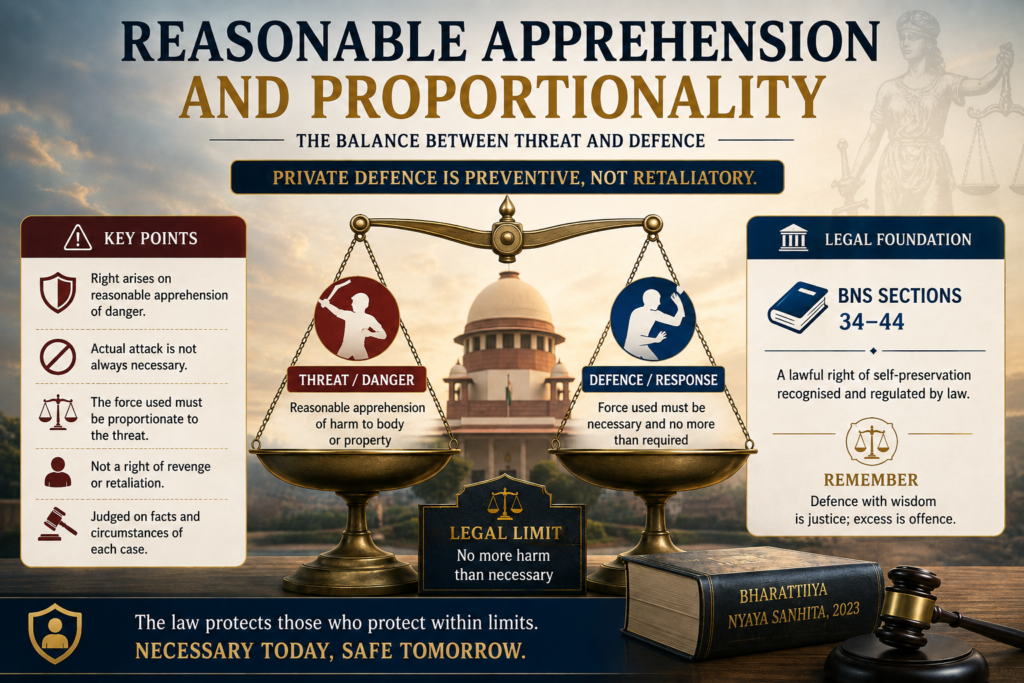
The nature of the right of private defence is defensive and preventive in nature. The purpose of the right is not to punish the wrongdoer or take revenge but rather to prevent the unlawful attack and protect oneself or property from the imminent danger. Thus, the right continues only up to the time there is reasonable apprehension of any danger. After the danger ends, the right of private defence usually comes to an end.
It must be borne in mind that this right is not absolute and unlimited in nature. A person exercising the right must do so in accordance with the statutory provisions. In particular, Section 37 of BNS provides that the right cannot be exercised in all cases, and the person cannot cause unnecessary damage in order to exercise the right. Whether the right has been lawfully exercised depends on the facts and circumstances of each individual case.
Therefore, the right of private defence under the BNS is the right of protection from necessity and reasonable apprehension of danger. The right allows a person to exercise the defensive action against particular offences and acts if the circumstances allow doing so and if there are statutory restrictions. The right cannot be used to cause more harm than is necessary for the purpose of defence, nor can it be exercised as a form of punishment or retaliation.
Statutory Scheme of the Right of Private Defence in the BNS, 2023
The provisions related to the right of private defence appear in Sections 34 to 44 of the Bharatiya Nyaya Sanhita, 2023 (BNS). All the provisions mentioned above constitute the complete statutory scheme with regard to the right of private defence. They explain the legal concept of the right of private defence, persons and things in respect of which the right exists, circumstances of the commission of certain acts where the right may be exercised, limitations in exercising such right, amount of force that may be used, and duration of the right.
The statutory scheme can be summarised as follows:
Sections 34 to 37 contain the general provisions on the right. Section 34 states that nothing shall be considered as an offence if committed in the exercise of the right of private defence. The right itself is defined in Section 35, which states that the right may exist as to the protection of one’s body or property and the body or property of another person. Section 36 discusses the exercise of the right in cases where the act is committed by a person who is not legally liable for his/her act owing to factors like unsoundness of mind, intoxication, immaturity, or misconception. Section 37 contains limitations in exercising the right and sets out cases in which no right of private defence exists. Moreover, this section states that the right does not include the infliction of more harm than that required to protect oneself.
Sections 38 to 40 discuss the right of private defence of the body. Section 38 defines cases in which the right includes causing death. In the cases not covered by Section 38, the right may include causing any kind of harm except death, which is provided for in Section 39. Section 40 defines the beginning of the right of private defence of the body and the duration of this right.
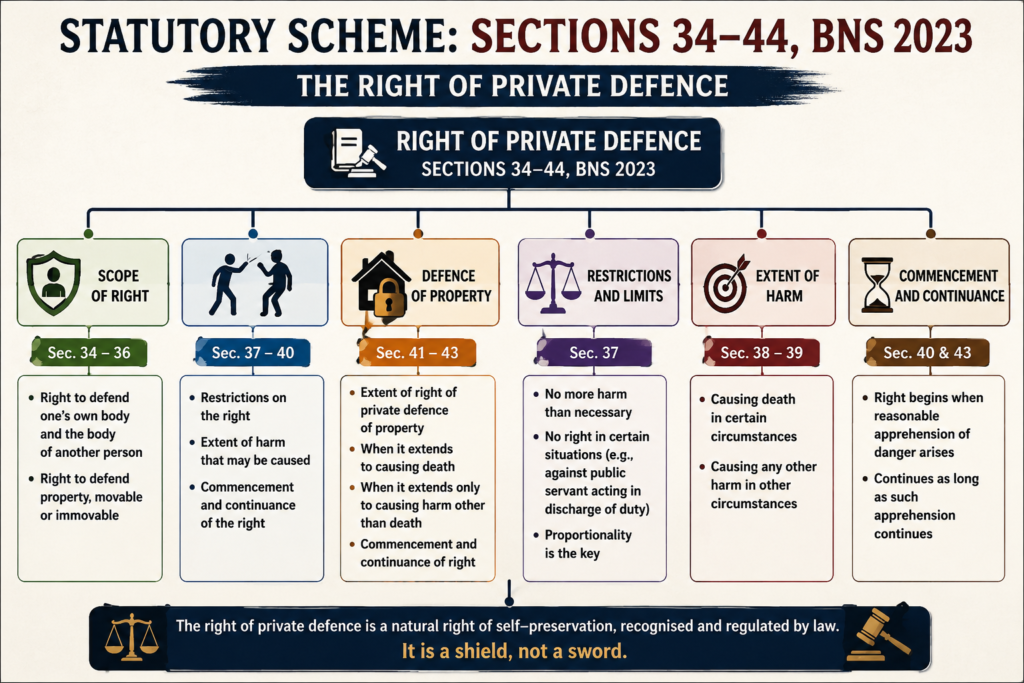
Sections 41 to 43 discuss the right of private defence of property. Section 41 sets out cases in which the right includes causing death. Section 42 describes cases in which the right includes causing harm other than death. Section 43 contains the beginning and the duration of the right of private defence in different cases of offences against property.
Fourthly, Section 44 relates to a rare case where there is a serious assault and risk of injury to an innocent person. Section 44 applies where a person exercising his or her right of private defence of the body in a situation of a serious assault cannot do so without putting an innocent person at risk of being injured.
Together, Sections 34 to 44 can be viewed as one integrated statutory provision. A right of private defence must be tested by ascertaining whether there was a right at all, whether the restrictions set out in Section 37 apply, what force could be used lawfully, and whether the act occurred within the time when the right of private defence subsists.
Thus, there is a rational flow in the statutory scheme, which is as follows: existence of the right; scope of the right; specific cases; restrictions on the right; extent of permissible force in the defense of the body and property; onset and subsistence of the right; and protection of innocent persons. This structure provides the basis for an understanding of the right of private defence under the BNS, 2023.
Section 34: Acts Done in Private Defence
Section 34 of the Bharatiya Nyaya Sanhita, 2023 says that:
“Nothing is an offence which is done in the exercise of the right of private defence.”
This section embodies the basic tenet of the law of private defence. If any act amounts to an offence, it will not be considered an offence if it has been done in the exercise of the right of private defence.
However, the protection granted by Section 34 is not absolute. A person can avail himself of this section only if his act comes within the ambit of the right of private defence defined in subsequent sections of the BNS. This means that Sections 35 to 44 should also be considered along with Section 34 to ascertain if the right existed, whether there was any restriction, and whether the force employed was lawful.
Simply put, Section 34 does not confer any absolute right to use force. It gives protection to acts that are done lawfully in the exercise of the right of private defence. Whether any particular act is protected or not is based on the facts and circumstances of the case.
In this way, Section 34 forms the basic foundation of the entire law relating to private defence under the BNS. The following sections lay down the scope, limitations, extent, beginning, and continuance of the right.
Section 35: Right of Private Defence of Body and Property
Section 35 of the Bharatiya Nyaya Sanhita, 2023 contains the general ambit of the right of private defence. According to this section, every person has the right to defend body and property under certain conditions, subject to the limitations mentioned in Section 37.
Right of Private Defence of the Body
According to Section 35(a), every person has the right to defend his or her:
• own body; and
• the body of any other person
from any crime committed on the human body.
Thus, the right of private defence extends beyond self-defence. Any person can invoke this right in case of a crime committed against the body of another individual. This implies that the law acknowledges the right of defending oneself as well as someone else from any criminal acts committed against the human body.
Right of Private Defence of Property
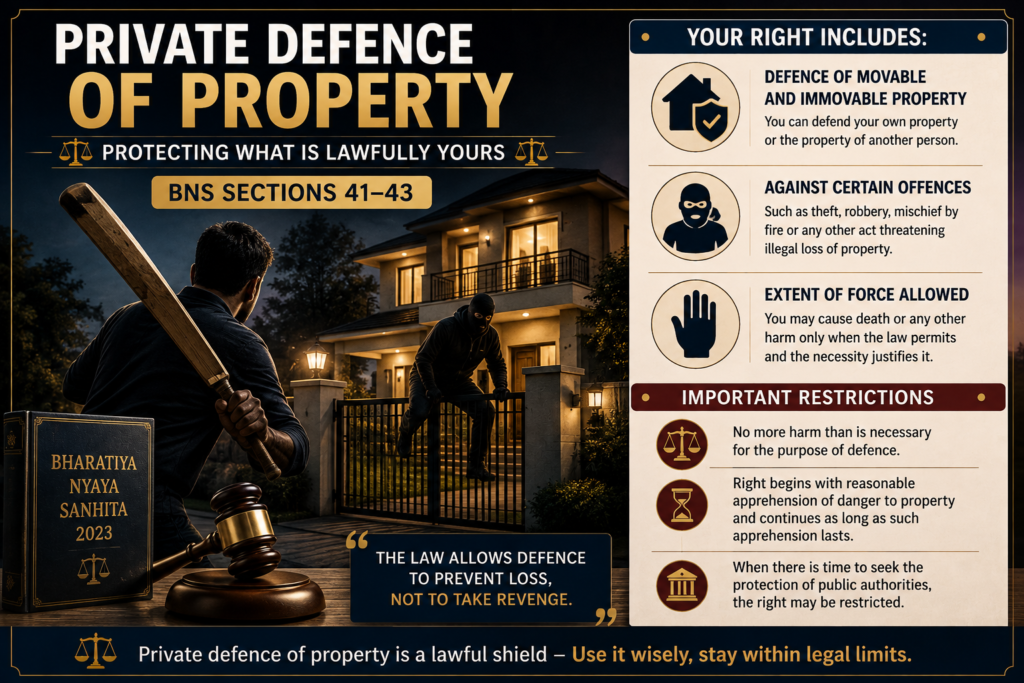
According to Section 35(b), every person has the right to defend the property of his or her own or of any other person, which may be movable or immovable. Such a right can be used against:
• a theft;
• a robbery;
• a mischief; or
• a criminal trespass.
This right can also be used against an attempt to commit a theft, robbery, mischief, or a criminal trespass.
Section 36: Right of Private Defence Against an Act of a Person of Unsound Mind, etc.
Section 36 of the Bharatiya Nyaya Sanhita, 2023 provides for a case where an act would be a particular offense but is not an offense by virtue of legal incapacity or misconception of the person performing the act. Such a person who has been subjected to the act will have the same right of private defense as in case the act were that offense.
It applies where the act is not a particular offense due to:
• The youth of the person performing the act;
• The lack of maturity of understanding of the person;
• The unsoundness of mind of the person;
• The intoxication of the person; or
• Any misconception of the person.

Essentially, Section 36 is based on the principle that the right of private defense cannot depend only on whether the person committing the act can be made criminally responsible. In a case where the act would be a particular offense, but does not constitute such an offense owing to one of the conditions stated in the section, the person to whom the act is being committed can exercise the same right of private defense as in case the act were the offense.
Act of a Person of Unsound Mind
When a person of unsound mind performs an act which would be a particular offense but is not the offense because of unsoundness of mind of the person, the person who has been subjected to the act has the same right of private defense as if the act were the offense.
The first illustration in relation to Section 36 highlights this principle. For instance, where Z, who is a person of unsound mind, tries to kill A, then Z cannot be charged with the offense. However, A will have the same right of private defense against Z as against a person of sound mind.
Youth or Want of Maturity of Understanding
Section 36 may apply in a situation where an act would otherwise amount to a certain offence, but it does not amount to that offence due to the youth or lack of mental development of the person committing the act. Under such circumstances, the person against whom the act is done is entitled to exercise his right of private defence just as if the act amounted to that particular offence.
Intoxication
Again, the provision applies to a situation where an act, which would otherwise amount to a certain offence, does not amount to that offence due to the intoxication of the person performing the act. In such cases, the person against whom the act is committed is entitled to exercise his right of private defence as if the act amounted to that offence.
It should be noted that Section 36 does not provide that any act committed by an intoxicated person is not an offence. It applies where, in the circumstances of each individual case, the act does not amount to the offence because of intoxication.
Act Done Under Misconception
Section 36 further applies to a situation where an act, which would otherwise amount to a certain offence, does not amount to that offence due to the misconception on the part of the person performing the act.
This is illustrated in the second illustration in the section. A goes into a house at night and he is lawfully entitled to go in. Z, acting on good faith, believes that A is a burglar and attacks him. Under the circumstances, Z cannot commit any offence because he is labouring under the aforementioned misconception. Despite this, A has the right of private defence against Z as if Z was not labouring under the said misconception.
Section 37: Acts against which there is no right of private defence
Section 37 of the Bharatiya Nyaya Sanhita, 2023 prescribes important restrictions on the exercise of the right of private defence. The right of private defence under Sections 34 to 36 is not an absolute one. Section 37 prescribes certain acts against which the right of private defence cannot be claimed and further provides that the exercise of this right does not amount to infliction of more harm than is absolutely necessary for defence.
Acts Done by a Public Servant
As per Section 37(1)(a), there is no right of private defence against an act which does not reasonably cause the apprehension of death or grievous hurt when the act is done or attempted to be done, by a public servant:
• acting in good faith; and
• under color of his office.
This restriction will apply notwithstanding the fact that the act may not be strictly justifiable by law.
Thus, the right of private defence cannot be claimed in respect of such an act merely because the act is not strictly justifiable by law. But this restriction will not apply if the act reasonably causes apprehension of death or grievous hurt.
Acts Done by the Direction of a Public Servant
As per Section 37(1)(b), there is no right of private defence against an act which does not reasonably cause the apprehension of death or grievous hurt when the act is done or attempted to be done by the direction of a public servant acting in good faith under color of his office.
Even though the direction given by the public servant may not be strictly justifiable by law, but it will not deprive the person of the right of private defence when the act reasonably causes apprehension of death or grievous hurt.
Where there is time to seek the protection of public authorities
As per Section 37(1)(c), there is no right of private defence in cases in which there is time to have recourse to the protection of the public authorities.
No More Harm Than Necessary for the Purpose of Defence
According to section 37(2), the right of private defence in no case extends to the infliction of more harm than it is necessary to inflict for the purpose of defence.
This means that the harm inflicted, even in situations where the right of private defence is available, should not exceed that harm which is necessary for the purpose of defence. The right of private defence can therefore not be used to inflict unnecessary or excessive harm.
Private defence is aimed at protection and not punishment or retaliation. A person cannot continue to employ force to retaliate once the purpose of defence has been attained.
Explanation 1: Knowledge of Person Being a Public Servant
Explanation 1 concerns the situation where the act was done or attempted to be done by the public servant as such. The restriction concerning acts of the public servant does not deprive the person of the right of private defence unless that person:
• knows that the person who committed or attempted to commit the act is a public servant; or
• has reasonable belief that the person is a public servant.
Thus, if the person has neither knowledge nor reasonable belief that the other person committed the act as a public servant, then the restriction applicable to acts of the public servant will not deprive the person of the right of private defence.
Explanation 2: Knowledge of Direction from Public Servant
Explanation 2 relates to the situation where the act was done or attempted to be done by the direction of the public servant. The restriction applicable to the act committed on direction of the public servant does not deprive the person of the right of private defence unless:
• he or she knows or has reason to believe that the person committing the act was acting upon the direction of the public servant; or
• that person states the authority under which he or she is acting; or
• where the person acting under the direction has written authority, that authority is produced if demanded.
Thus, the restriction relating to the act committed by the direction of a public servant applies only when the person has either actual or reasonably inferable knowledge of that official direction or where the relevant authority is produced in accordance with the provision.
Section 38: Where the Right of Private Defence of the Body extends to causing Death
Section 38 of the Bharatiya Nyaya Sanhita, 2023 sets out when the right of private defence of the body will extend to the voluntary causing of death or of any other harm to the assailant. The right is expressly subject to the conditions set forth in Section 37.
This section deals with cases in which the offence which occasions the exercise of the right is of the description set out in Section 38.
In such cases, the law contemplates that the serious nature and immediacy of the threat may justify the voluntary causing of death to the assailant in the course of the right of private defence.
Reasonable Apprehension of Death
Section 38(a): The right extends to causing death where there is such an assault as may reasonably cause the apprehension that death will otherwise be the consequence of the assault.
What is essential is that the apprehension of death should be a reasonable one, and actual death need not have occurred.
It is sufficient if the assault is of such a kind that it may reasonably create an apprehension of the death of the party assaulted.
Reasonable Apprehension of Grievous Hurt
Section 38(b): The right extends to causing death where there is such an assault as may reasonably cause the apprehension that grievous hurt will otherwise be the consequence of the assault.
An assault which creates a reasonable apprehension of grievous hurt may thus justify causing death in private defence, subject to other statutory requirements.
Assault with the Intention of Committing Rape
Section 38(c): The right extends to causing death where there is an assault with the intention of committing rape.
The provision takes into account the serious nature of an assault directed against the committing of rape, and authorises the person who is exercising the right, subject to Section 37, to cause the death of the assailant.
Assault with the Intention of Gratifying Unnatural Lust
Section 38(d): The right extends to causing death in the case of assault with the intention of gratifying unnatural lust.
Assault with Intent to Kidnap or Abduct
Under Section 38(e), the right applies to the situation where there is an assault with the intent of kidnapping or abducting.
Assault with Intent to Wrongfully Confining a Person
Section 38(f) covers a situation where there is an assault with the intent of wrongfully confining a person in circumstances which may create a reasonable apprehension that the person cannot seek help from the public authorities to obtain freedom from such confinement.
This right does not cover all situations of wrongful confinement; the circumstances must be such that there is a reasonable apprehension that the person will not be able to seek help from the public authorities for the release.
Throwing or Administering Acid
Under Section 38(g), the right extends to causing death in cases where there is:
• throwing or administering acid; or
• attempt to throw or administer acid,
where there is a reasonable apprehension that grievous hurt will otherwise be the consequence of such act.
Section 39: Where the Right of Private Defence of the Body Extends to Causing Any Harm Other Than Death
Section 39 of the Bharatiya Nyaya Sanhita, 2023 relates to the extent of the right of private defence of the body, except in cases governed by Section 38. It lays down that if the offence occasioning the exercise of the right is not of any of the descriptions referred to in Section 38, then the right of private defence of the body shall not extend to the voluntary causing of death to the assailant.
However, it extends, subject to the conditions laid down in Section 37, to the voluntary causing to the assailant of any harm other than death.
Thus, Section 39 clearly draws a distinction between two scenarios. If the offence comes within any of the descriptions referred to in Section 38, then the right may extend to the voluntary causing of death. But, if it does not come within any of those descriptions, then the right does not extend to causing death but only to causing harm other than death.
The right as per Section 39 is also subject to the limitations as contained in Section 37. Thus, it means that the right should not involve causing more harm than necessary for the purpose of defence. Furthermore, the right must also be understood in the context of other provisions relating to the existence, commencement, and continuation of the right of private defence.
Therefore, Section 39 lays down the general rule regarding the extent of the right of private defence of the body when the situation is outside Section 38. In such a case, a person may cause voluntary harm to the assailant, but cannot cause voluntary death to the assailant.
Section 40: Commencement and Continuance of the Right of Private Defence of the Body
Section 40 of the Bharatiya Nyaya Sanhita, 2023 prescribes the commencement and continuance of the right of private defence of the body. The section clearly states that the right of private defence is based upon a reasonable apprehension of danger to the body.
Commencement of the Right
The right of private defence of the body commences as soon as the reasonable apprehension of danger to the body arises from an attempt or threat to commit the offence.
Consequently, the person who is exercising the right is not required to wait till the time the offence is committed or till such time that physical injury is caused to his body. The right may arise as soon as there is an attempt or threat to commit the offence as far as it creates reasonable apprehension of danger to the body.
The term “reasonable apprehension” means that the apprehension should have some justification which would make it reasonable to believe that there is danger to the body. An imaginary, remote or speculative apprehension is not sufficient to create reasonable apprehension.
No Necessity for Commitment of Offence
Section 40 explicitly states that the right may commence even though the offence has not been committed. Accordingly, a person is permitted to use his defensive power against any attempt or threat, if the circumstances justify an apprehension of danger to the body.
The object of such a provision is to give the right of private defence even when the attempted or threatened offence is not yet complete. Thus, the right of private defence is a preventive or protective right.
Continuance of the Right
The right continues as long as the reasonable apprehension of danger to the body continues.
As soon as the apprehension of danger ceases, the right of private defence itself ceases. Hence, any act committed after the cessation of the reasonable apprehension cannot be justified as an act of private defence.
Section 41: When the Right of Private Defence of Property Extends to Causing Death
Section 41: Application of Private Defence Right in Case of Causing Death Voluntary causing of death or of any other harm to the wrong-doer is covered under the right of private defence of property when the provisions of Section 41 of the Bharatiya Nyaya Sanhita, 2023 is applicable. The application of the right is subjected to the limitations specified under Section 37.
The following circumstances are covered under Section 41, wherein the right is applicable in case of causing death voluntarily:
Robbery
According to Section 41(a), the right of private defence of property is applied to causing death or any other harm to the wrong-doer where the offense, the committing or attempting to commit which leads to the exercise of the right, is robbery.
In case of robbery and attempted robbery, the right of private defence of property may be applied to causing death or any other harm to the wrong-doer, according to the limitations of Section 37.
House-Breaking After Sunset and Before Sunrise
According to Section 41(b), the right of private defense of property is applied to causing death where the offense, the committing or attempting to commit which leads to the exercise of the right, is house breaking after sunset and before sunrise.
The following offenses lead to applying of the right under this Section.
The offenses committed in the time frame from sunset to sunrise are house breakings.
Mischief by Fire or Any Explosive Substance
According to Section 41(c), the right is applied to causing death or any other harm where the mischief committed by the fire or any explosive substance on:
• A building;
• A tent; or
• A vessel,
provided that the building, tent, or vessel is used:
• As human dwelling;
• As a place for the custody of property.
Theft, Mischief, or House-Trespass Creating Apprehension of Death or Grievous Hurt
According to Section 41(d), it includes death or other injury in cases of theft, mischief, or house-trespass, if the same is either committed or attempted by circumstances which reasonably cause an apprehension that death or grievous hurt will be the consequence if the right of private defence is not used.
Therefore, it is not every instance of theft, mischief, or house-trespass that gives a person the right to use his right of private defence to inflict death on him. The circumstance should be such as reasonably give the apprehension that death or grievous hurt will be the result if the right of private defence is not exercised.
Section 42: Where Private Defence of Property Includes Causing Any Harm Except Death
Section 42 of Bharatiya Nyaya Sanhita, 2023 speaks of the scope of the right of private defence of property when the offence committed or attempted falls outside the purview of Section 41.
It states that when the offence occasioning the right of private defence is theft, mischief or criminal trespass, and it is not one of those specified in Section 41, the right of private defence of property does not include the voluntary causing of death. The right of private defence of property includes the voluntary causing to the wrongdoer of any harm other than death, subject to the limitations mentioned in Section 37.
Theft
When theft or an attempt to commit theft occasions the exercise of the right of private defence of property and is not of any of the descriptions referred to in Section 41, the right of private defence of property does not include the voluntary causing of death. However, the right of private defence of property may include the voluntary causing of any harm except death to the wrong-doer subject to Section 37.
Mischief
In the same way, when mischief or an attempt to commit mischief occasions the exercise of the right of private defence of property and is not of any of the descriptions mentioned in Section 41, the right of private defence of property does not include the voluntary causing of death. It may, however, include the causing of any harm other than death to the wrongdoer, subject to the restrictions specified in Section 37.
Criminal Trespass
Section 42 is applicable even where criminal trespass or an attempt to commit criminal trespass occasion the exercise of the right of private defence and is not one of the descriptions mentioned in Section 41.
Section 43: Commencement and Continuance of the Right of Private Defence of Property
Section 43 of the Bharatiya Nyaya Sanhita, 2023 enunciates the criteria for commencement of the right of private defence of property and its continuance for various kinds of offences affecting the property.
Commencement of the Right
As per Section 43(a), the right of private defence of property arises when there is a reasonable apprehension of danger to the property.
Accordingly, the right arises once there is an apprehension of reasonable danger to the property. It is not necessary to wait until the offence against the property is committed.
The apprehension of danger should be reasonable. An imaginary or remote apprehension of danger will not suffice.
Continuance Against Theft
As per Section 43(b), the right of private defence against theft shall continue until:
• the offender effects his retreat with the property;
• public authority gets the assistance; or
• the property is recovered from the offender.
Accordingly, the right against theft continues until the offender effects his retreat with the property or gets the assistance of public authorities or the property has been recovered.
Continuance Against Robbery
As per Section 43(c), the right of private defence against robbery continues as long as the offender:
• causes or attempts to cause death;
• causes or attempts to cause hurt; or
• causes or attempts to cause wrongful restraint;
or as long as the fear of instant death, instant hurt, or instant personal restraint continues.
Accordingly, the right shall continue until the circumstances specified under the provision prevail.
Continuance Against Criminal Trespass or Mischief
As per Section 43(d), the right of private defence against criminal trespass or mischief continues as long as the offender continues committing criminal trespass or mischief.
Thus, the period during which the right may continue depends on the period during which the offender commits the relevant offence.
Continuance Against House-Breaking After Sunset and Before Sunrise
Under Section 43(e), the right of private defence against house-breaking after sunset and before sunrise continues as long as the house-trespass which has been begun by such house-breaking continues.
Thus, the right continues for the duration of the house-trespass that was initiated by the house-breaking.
Section 44: Right of Private Defence against a Deadly Assault Where There is Risk of Injury to an Innocent Person
Section 44 of the Bharatiya Nyaya Sanhita, 2023 addresses the situation of right of private defence in an exceptional circumstance. It is concerned with the situation of right of private defence where a person is subjected to an assault from which the apprehension of death is reasonably created but cannot be exercised without risking an innocent third person.
The section makes it clear that, in such a case, right of private defence includes the running of such a risk.
Reasonable Apprehension of Death by an Assault
This section applies only where the defender exercises his right of private defence against an assault reasonably creating the apprehension of death.
That means the application of this section is not applicable in every assault but it must be such an assault that the defender reasonably gets an apprehension of death.
The Situation Where It is Impossible for the Defender to Effectively Exercise the Right without a Risk to an Innocent Person
In such a case, the defender shall be in such a condition that he is unable to effectively exercise the right of private defence without a risk of harm to an innocent person.
That means the risk of harm to an innocent person can arise when it becomes inevitable as a consequence of the exercise of the right against the deadly assault. The mere possibility of a risk will not make the section applicable.
The Right of Private Defence Includes Running of the Risk
In this case, where the above-mentioned conditions are fulfilled, the right of private defence includes running of the risk of harming an innocent person.
That means it does not give any unrestricted right to a person to harm an innocent person intentionally.
Case Laws
Darshan Singh v. State of Punjab, (2010) 2 SCC 333
This is a landmark judgment with respect to the right of private defence and is directly applicable to the scope of Sections 34 to 44 BNS. It has been stated that the right in question is primarily a right of self-protection. Such a right can arise only if there exists a reasonable fear of imminent harm. The person who exercises such a right cannot be expected to measure the quantum of force in mathematical terms. However, the right cannot be used as an excuse for revenge or retaliation and the exercise of force must be within the limit of defense. This judgment has particular relevance to the general right of private defense, the limitations thereof and the exercise of the said right.
James Martin v. State of Kerala, (2004) 2 SCC 203
It has been held by the Supreme Court that the right of private defense is a right of defense and not one of retribution. The claimant does not have to establish his right beyond reasonable doubt; it would be enough if the circumstances on record establish the existence of such a right reasonably. Further, the right of private defense cannot be exercised beyond the extent of protection necessary and the same cannot be claimed once the danger ceases to exist. The relevance of this judgment lies in the limitations imposed on the right of private defense through Section 37 BNS.
Puran Singh v. State of Punjab, (1975) 4 SCC 518
In this case, the Supreme Court has recognized the availability of right of private defense in case there is a reasonable apprehension of danger to one’s life/property and there is no sufficient time for seeking help from public authorities. The Court has clearly ruled that the right cannot be availed for retaliatory purposes or revenge. The person availing the right must act within the limits of necessity. This case is thus directly applicable to the right of private defense of the body and property as per Sections 35, 37, 40 & 43 BNS.
Munshi Ram v. Delhi Administration, (1968) 2 SCR 455
The decision in this case is of immense importance for understanding the right of private defence especially in connection with property. The Supreme Court ruled that one can defend his possession and property from any act of unlawful aggression. Moreover, it ruled that the fact of existence of the right of private defence could be inferred from the facts and evidences on record even if the accused has not relied upon such a defence. But, in any case, the force used should not exceed the bounds of law. It is highly pertinent to Sections 35, 41, 42 and 43 BNS dealing with private defence of property.
Deo Narain v. State of Uttar Pradesh, (1973) 1 SCC 347; AIR 1973 SC 473
The Supreme Court ruled that the right of private defence is a right of self-defence and not of aggression or retaliation. One does not have to wait till an assault is made to him if there is a danger looming at the horizon and force used cannot be in excess of that necessity in the given situation. As soon as the apprehension of danger is removed, the right of private defence ceases to exist. This case is significant for Section 37 of restrictions on the right of private defence, for circumstances in which defence of the body may be resorted to under Sections 38-39 and for the beginning and continuation of the right under Section 40 BNS.