
FIR Under BNSS: How to File an FIR, When Police Can Refuse and What to Do Next
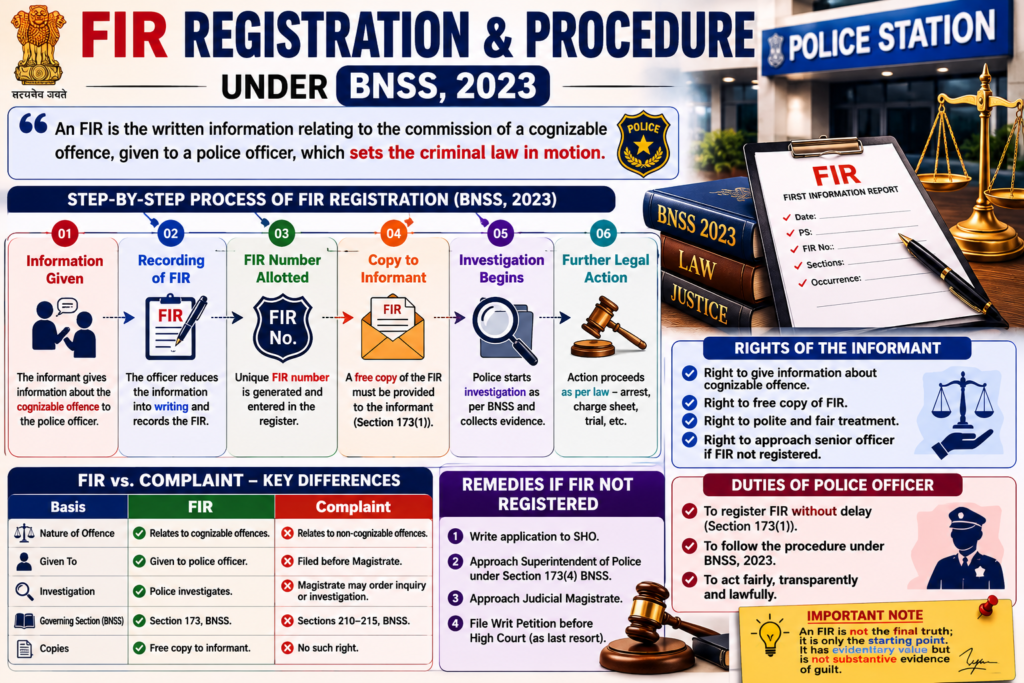
A First Information Report (FIR) is information recorded by the police about the commission of a cognizable offence. It usually marks the beginning of the criminal law process and enables the police to commence the investigation according to the law. The Supreme Court has indicated that the FIR sets the criminal law in motion and provides the police with the information regarding the criminal activities alleged.
Under the Bharatiya Nagarik Suraksha Sanhita, 2023 (BNSS), the provision dealing primarily with information relating to cognizable offence is Section 173. This provision acknowledges various modes of giving information, including oral and electronic communication, and creates a statutory framework for recording this information and providing its copy to the informant.
Section 173 also envisages that information relating to a cognizable offence may be provided irrespective of the area where the offence was committed, a vital feature associated with the notion of a Zero FIR. In addition, this provision stipulates the procedure that applies to electronically submitted information and provides for a mechanism to approach the Superintendent of Police if the officer in charge of any police station refuses to record such information.
The BNSS also lays down a limited preliminary inquiry in specified cases where the offence is punishable with imprisonment of three years or more but less than seven years, subject to the conditions prescribed by the statute. At the same time, the Supreme Court has re-emphasized that in cases where the information received discloses the commission of a cognizable offence, registration of an FIR is mandatory, with preliminary inquiry permitted only up to the limits mentioned above.
Understanding the FIR process, therefore, becomes important for anyone who has to report a cognizable offence or come up against police inaction. This article aims to explain what an FIR is, how one can file an FIR under the BNSS, how e-FIR and Zero FIR work, when a preliminary inquiry may be conducted, what to do if the police station refuse to register an FIR, and what legal remedies are available thereafter.
What Is an FIR?
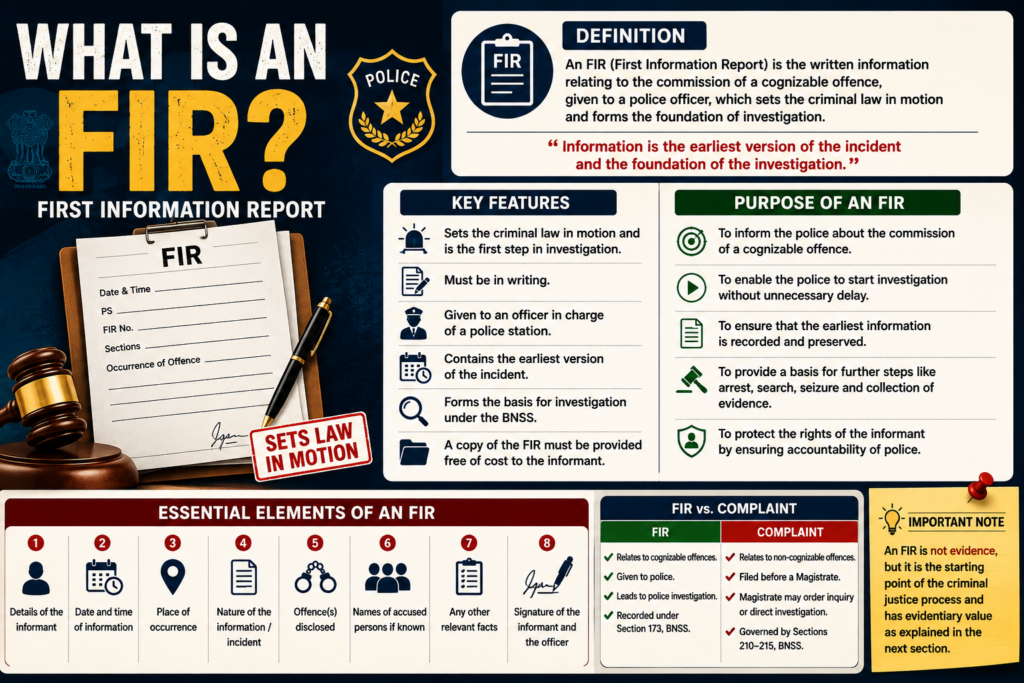
FIR stands for First Information Report. This is information recorded by the police about the commission of a cognizable offence. The principal provision of the BNSS dealing with information relating to a cognizable offence is Section 173.
An FIR usually heralds the beginning of the formal criminal investigation process. Upon receiving the information disclosing a cognizable offence, the registration of an FIR sets the criminal law in motion and empowers the police to carry out the investigation as per law. The Supreme Court has often reiterated the obligation of the police to register an FIR if the information received discloses a cognizable offence, subject to the limited exceptions mentioned in the law.
An FIR, however, is not a finding that the accused is guilty of an offence. It merely records the information received by the police at the initial stage of the criminal process. The truth of the allegations, the role and identity of the accused, and the existence of sufficient evidence to prosecute are issues that are examined later during the investigation process and judicial proceedings.
It is also relevant to draw a distinction between an FIR and a complaint. As per the BNSS, a “complaint” is an oral or written allegation made to a Magistrate, with a view to the Magistrate taking action under the Sanhita, and does not include a police report.
The framework of FIR under the BNSS enables the complainant to give information concerning a cognizable offence by electronic communication. At the same time, Section 173 also permits a person to give information relating to a cognizable offence irrespective of the area where the offence was committed. This provision becomes crucial in relation to the notions of e-FIR and Zero FIR, which have been dealt with separately below.
In sum, an FIR is information recorded by the police at the initial stage regarding an alleged cognizable offence and serves as an important precursor to the criminal investigation process.
FIR Under Section 173 Of BNSS
The procedure for recording information relating to a cognizable offence is governed primarily by Section 173 of the Bharatiya Nagarik Suraksha Sanhita, 2023 (BNSS). The provision pertains to giving of information to police, electronic communication, territorial jurisdiction, provision of free copy of recorded information, preliminary inquiry in specified cases and remedies where officer in charge refuses to record information.
1. Information about a cognizable offence can be given irrespective of the place of offence
Section 173(1) states that every information relating to the commission of a cognizable offence may be given irrespective of the area where the offence was committed.
This implies that a person need not approach the police station having territorial jurisdiction over the area where the alleged offence took place. This provision gives rise to what is commonly known as a Zero FIR wherein information relating to a cognizable offence may initially be given to a police station irrespective of territorial jurisdiction and thereafter dealt with in accordance with law.
2. Information can be given orally or through electronic communication
Section 173(1) provides for two major modes of giving of information relating to a cognizable offence, namely:
• Orally Or
• Through Electronic Communication.
Where the information was given orally, the officer in charge of the police station must reduce it to writing or cause it to be reduced to writing and read over to the informant. The person giving the information will be required to sign it.
Where the information was given through electronic communication, it shall be taken on record after having been signed by the person giving the information within three days. The substance thereof shall be entered in a book kept by the police officer in the prescribed form.
3. Special procedure for certain offences against women
Section 173 provides that in cases where information is given by a woman stating that certain offences of the Bharatiya Nyaya Sanhita, 2023 (BNS) have been committed or attempted against her, the information shall be recorded by a woman police officer or any woman officer.
This provision has been made with a view to providing an appropriate mechanism for recording information in the event of a woman being subjected to specified offences.
4. Special safeguards in case of persons with mental or physical disabilities
Section 173 specifically provides that in cases where a person who is temporarily or permanently mentally or physically disabled is reporting any of the specified offences, the information shall be recorded:
• at the person’s residence or at another convenient place of their choice;
• in the presence of an interpreter or special educator, where applicable;
• through videography; and
• the statement of the person must be recorded by a Judicial Magistrate as soon as possible in accordance with section 183(6)(a).
5. A free copy of the recorded information must be given
As per Section 173(2) a copy of the information recorded under Section 173(1) must be given forthwith and free of cost to the informant or the victim.
The informant or victim must preserve this copy carefully as it constitutes an integral part of the record of the reporting of the alleged offence.
6. Preliminary inquiry in certain cases
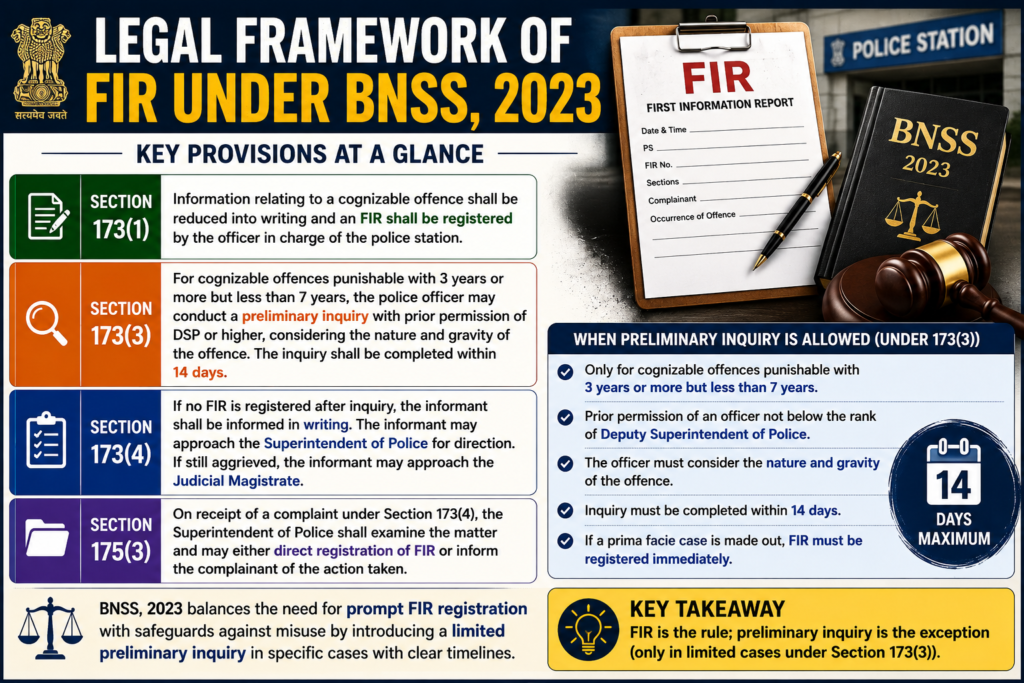
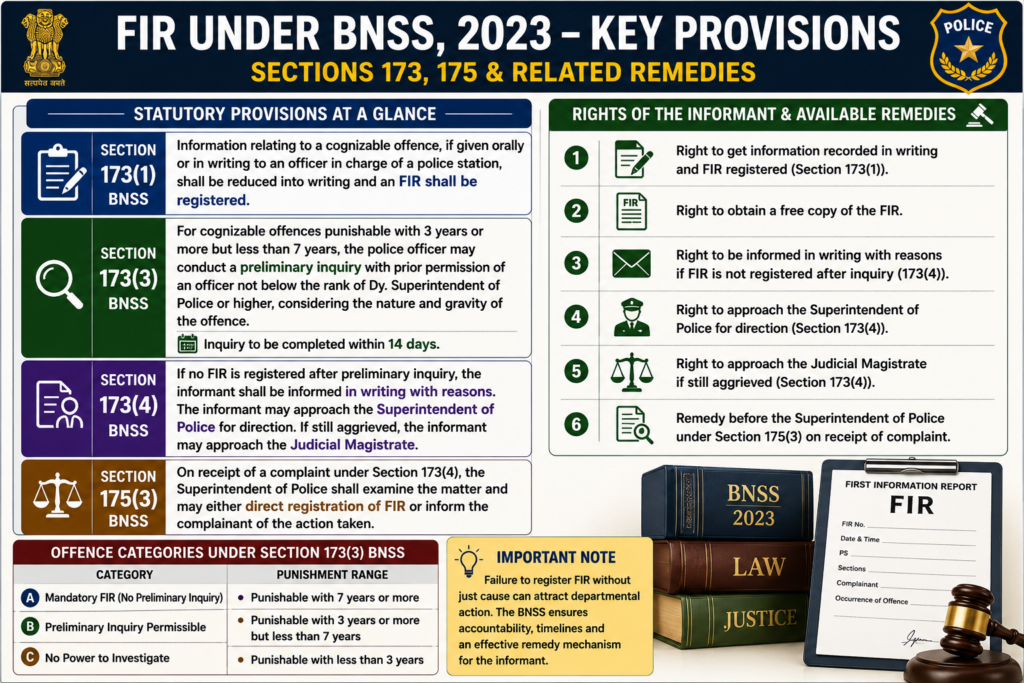
Section 173(3) provides for a limited mechanism for preliminary inquiry in cases where information relates to a cognizable offence punishable with 3 years or more but less than 7 years.
It must be noted that Section 173(3) does not provide an unbridled power to the police to conduct a preliminary inquiry. As per this provision, the officer in charge of the police station will have to obtain prior permission from an officer not below the rank of Deputy Superintendent of Police and will have to consider the nature and gravity of the offence before proceeding with a preliminary inquiry.
Where a preliminary inquiry is conducted, it must be concluded within 14 days for the purpose of ascertaining if a prima facie case exists for the commission of the offence. Where such a prima facie case exists, the police may proceed to conduct the investigation.
7. What If the Police Refuse to Record the Information?
In cases where the officer in charge of the police station refuses to record information relating to a cognizable offence, Section 173(4) of the BNSS provides a statutory remedy for the aggrieved person to seek redressal.
The aggrieved person may send the substance of the information in writing and by post to the concerned Superintendent of Police (SP).
If the Superintendent of Police is satisfied that the information discloses the commission of a cognizable offence, the SP may:
• investigate the case personally; or
• direct a subordinate police officer to investigate the case.
The investigating officer will have the powers of an officer in charge of the police station in relation to that offence.
If the aforesaid remedy fails to address the grievance of the aggrieved person, an application may be made to the Magistrate under Section 175(3) of the BNSS.
Who Can File an FIR Under the BNSS?
The Bharatiya Nagarik Suraksha Sanhita, 2023 (BNSS) allows any person who has suffered or witnessed the commission of a cognizable offence to report it to the police or file an FIR. Section 173(1) specifically states that ‘every information’ relating to the commission of a cognizable offence may be given to the officer in charge of a police station. Who can file an FIR under these provisions depends on the context and circumstances of the case. However, it is evident from Section 173(1) that an FIR can be filed by a person who is not directly involved or affected by the alleged offence provided certain conditions are met.
Can the Victim File an FIR?
Yes,
the victim is entitled to give information or file an FIR. They also have the right to report the commission of a cognizable offence either orally or through electronic communication, provided that the provisions of Section 173(1) are followed.
Where information is given orally, the police must reduce it to writing or take it down in writing at the instance of the police, read it over to the informant, and obtain their signature(s);
Can a Witness File an FIR?
Yes,
the informant providing information to the police does not have to be the victim or the person who directly suffered loss or injury caused by the commission of the offence.
The witness or any other person having information concerning the commission of a cognizable offence may report it to the police or file a report under Section 173(1) of the BNSS. It is not necessary that a witness to the offence or a person who suffered loss or injury should come before the police station and report the commission of a cognizable offence. The essential requirement is that the information provided by the informant should pertain to the commission of a cognizable offence and should be given voluntarily.
Can a Relative or Another Person Report the Offence?
Yes,
a relative or an innocent bystander may also provide information relating to the commission of a cognizable offence to the police.
Section 173(1) of the BNSS provides that any person who has knowledge or information concerning the commission of a cognizable offence may give the same to the police. This provision allows even a relative of the victim or an innocent bystander who witnessed the commission of the offence to give information to the police station as long as no prohibition is imposed by any law.
Does the Informant Have to Be an Eyewitness?
No,
Section 173(1) does not require that an eyewitness should report a cognizable offence to the police. A person may report information which they have received from someone else or may provide information which may be corroborative, but the reliability and weight of such evidence would be tested during the trial and judicial proceedings.
Section 173(1) of the BNSS does not impose a requirement that the informant who reports the commission of a cognizable offence must have been present at the scene of the offence or seen the offender committing the act.
Does the Informant Need to Know the Exact Offence or Legal Section?
No,
the person who approaches the police station to report the commission of a cognizable offence will not be required to mention or report the specific provision of the Bharatiya Nyaya Sanhita, 2023 (BNS) which was violated. The informant would be required to give a true and correct account of the incident and the police will determine whether an offence was committed and if so, which provision of the BNS was violated.
Can Information Be Given Electronically?
Yes,
Section 173(1)(ii) of the BNSS allows an informant to give information or report the commission of a cognizable offence by electronic communication. The information received through electronic communication would be taken on record after it has been signed by the informant within 3 days of its receipt.
Special Safeguards for Certain Victims
Section 173(1) of the BNSS also provides for special safeguards for persons and categories of offences. This section envisages recording of information by a woman police officer or any woman officer in case of information provided by a woman concerning certain offences under the BNS. It also makes provisions for additional safeguards for persons who are temporarily or permanently mentally or physically disabled such as recording of the information at the residence of the informant or any convenient place of their choice, in the presence of an interpreter or special educator, if available and videography and recording of the statement by a Judicial Magistrate in terms of Section 183(6)(a) of the BNSS, in specified cases.
Where Can an FIR be filed under the BNSS?
The Bharatiya Nagarik Suraksha Sanhita, 2023 (BNSS) provides under section 173 (1) that information relating to the commission of a cognizable offence may be given irrespective of the area where the offence was committed.
This provision implies that a person who has information relating to commission of a cognizable offence need not determine the territorial jurisdiction of the police station where the offence is alleged to have occurred before giving the information to the police. Information may be given even if the alleged offence took place outside the area of the police station to which the officer in charge belongs.
Can an FIR be filed at any police station?
For the purpose of giving information relating to a cognizable offence section 173 (1) of the BNSS provides that such information may be given irrespective of the area where the offence was committed.
In other words, the police should not refuse to take the information merely on the ground that the alleged offence occurred outside the territorial limits of that police station and the question of territorial jurisdiction may be determined later in accordance with the law.
What is a Zero FIR?
The expression Zero FIR is not in the text of section 173 BNSS. A commonly used term in law, it refers to the practical operation of the statutory rule that information relating to commission of a cognizable offence may be given irrespective of the area where the offence was committed.
After recording the information, further investigation and other steps in the procedure shall be taken in accordance with the law and relevant rules or procedures with regard to territorial jurisdiction.
Why is this provision important?
The purpose of this provision is to ensure that a person’s right to report a cognizable offence is not denied on the mere ground that the person is in a different location from the place where the offence allegedly occurred.
This can be important in circumstances where a person travels from one place to another, or encounters the commission of a cognizable offence in more than one place, or the circumstances do not allow for immediate access to the police station having territorial jurisdiction.
Does the territorial jurisdiction become irrelevant?
No. Section 173 does not abolish territorial jurisdiction.
Although the provision allows information relating to a cognizable offence to be given irrespective of the area where the offence was committed, it does not mean that every police station is expected to take up the investigation of the offence irrespective of the territorial jurisdiction.
Territorial jurisdiction continues to have its relevance in the investigation and subsequent criminal proceedings. The key point at the FIR stage is that the information should not be refused merely because the alleged offence occurred outside the local area of the police station.
How to file an FIR under the BNSS: Step by Step Procedure
The Bharatiya Nagarik Suraksha Sanhita, 2023 (BNSS) provides information relating to the commission of a cognizable offence may be given to the police orally or through electronic communication and such information may be given irrespective of the area where the offence was committed under section 173.1.
The following steps are indicative of the steps that a person may take to report an information concerning a cognizable offence under the BNSS.
Step 1: Note down the important facts
Before approaching the police, the informant should note down the important facts and circumstances of the alleged offence. Some examples of the important facts and circumstances of the offence may include:
• date and time of occurrence;
• place of occurrence;
• a clear description of what happened;
• details of persons involved, if known;
• names and contact details of witnesses, if available; and
• details of relevant documents or evidence.
The information should be given truthfully and accurately.
Step 2: Give the information to the police
Information relating to a cognizable offence may be given to the officer in charge of a police station. Under section 173. 1 of the BNSS, the information may be given irrespective of the area where the offence was committed.
The information may be given either orally or through electronic communication.
Giving information to the police is the first step in the procedure. Depending upon the nature of the alleged offence and the circumstances prescribed under section 173, the information may lead to registration of the FIR or, in the limited category provided under section 173. (3), a preliminary inquiry may be undertaken in accordance with the requirements of the statute.
Step 3: Give the information orally or electronically
Where the information is given orally, the police official must reduce it to writing or have it reduced to writing under his direction. The information must then be read over to the informant and the person giving the information must sign it.
Where information is given through electronic communication, section 173 (1) (ii) provides that it is taken on record after being signed by the person giving the information within three days.
Step 4: Provide relevant documents and evidence
The informant should provide any material that could help the police understand or investigate the alleged offence. Depending on the facts of the case, such documents may include photographs, videos, messages, emails, documents, medical records, transaction records or details of witnesses.
Wherever possible, the informant should retain copies or back-up of important documents and electronic evidence submitted to the police.
Step 5: Check the information recorded by the police
Where the information is given orally and reduced to writing, the informant should carefully verify the contents of the information before signing.
The informant should ensure that the important facts have been recorded correctly. Any significant error or omission should be brought to the notice of the police official before signing.
Step 6: Sign the information
Where the information is given orally, the person giving the information should sign the written information after reading it over to him.
Where information is given through electronic communication, it must be signed by the person giving the information within three days in order for it to be taken on record under section 173 (1) (ii).
Step 7: Get a free copy of the information recorded
Under section 173 (2) of the BNSS, a copy of the information recorded under section 173 (1) must be provided forthwith and free of cost to the informant or the victim.
The informant or victim should retain this copy and other relevant records relating to the reporting of the offence.
Step 8: Note the FIR and case details
Where an FIR is registered, the informant should securely store the relevant case details, including the FIR number, date of registration and the police station involved.
Copies of any documents submitted to the police, acknowledgments and relevant electronic communications should also be retained. These records may be useful for following the investigation or seeking an appropriate legal remedy, where necessary.
What if the offence happened outside the police station’s area?
Section 173 (1) of the BNSS provides that information relating to a cognizable offence may be given irrespective of the area where the offence was committed.
Therefore, a person does not have to determine the police station’s territorial jurisdiction before giving information to the police. This provision is the legal basis for the practice commonly known as a Zero FIR.
Territorial jurisdiction may be relevant at later stages, but it should not serve as a barrier to giving information concerning a cognizable offence.
What if the police do not register the FIR immediately?
Registration is not an automatic consequence in every situation. In particular, section 173 (3) provides a limited mechanism for a preliminary inquiry in cases involving a cognizable offence punishable with three years or more but less than seven years, subject to prior permission from an officer not below the rank of Deputy Superintendent of Police and the other conditions prescribed.
Where the information discloses a cognizable offence but in a situation that is not covered by that section, the question of registration of FIR would be determined according to the law and principles laid down by the Supreme Court.
What if the police refuse to record the information?
If the officer in charge refuses to record information relating to a cognizable offence, the BNSS provides a statutory remedy at section 173 (4).
The aggrieved person may send the substance of the information in writing and by post to the concerned Superintendent of Police. If the Superintendent of Police is satisfied that the information discloses the commission of a cognizable offence, the SP may investigate the case or direct a subordinate police officer to do so.
If appropriate action is still not taken, the aggrieved person may approach the Magistrate under section 175 (3) of the BNSS.
A detailed explanation of these remedies is provided separately in the section “What to do if police refuse to register an FIR”.
What Information Should an FIR Contain?
The Bharatiya Nagarik Suraksha Sanhita, 2023 (BNSS) does not prescribe a particular format containing a mandatory list of facts that should be contained in an FIR. However, when reporting a cognizable offence, the informant should normally give a clear, factual and truthful account of the incident and of the information reasonably available to them.
Under Section 173 BNSS, information relating to the commission of a cognizable offence may be given orally or by means of electronic communication. Where the information is given orally and reduced to writing by the police, it must be read over to the informant and signed by the person giving the information.
The following details should normally be given, where known and relevant to the incident:
1. Details of the Informant
The informant should give relevant identifying and contact details such as:
• name;
• address;
• contact details; and
• other particulars, where necessary.
These details allow the police to communicate with the informant during the course of the proceedings.
2. Date, Time and Place of the Incident
The informant should give, as accurately as possible:
• the date of the incident;
• the approximate or exact time;
• the place where it occurred; and
• any other relevant details concerning the location.
Where a particular detail is unknown the informant should state what is known rather than guessing.
3. Description of the Incident
The information should contain a clear and truthful description of what allegedly happened.
The informant should explain the relevant facts and circumstances and, where possible, give them in a logical or chronological sequence. The emphasis should be on the facts rather than on the technical legal terminology.
4. Details of the Person Allegedly Involved, If Known
Where the identity of the person allegedly responsible is known, the informant may give relevant details, such as:
• name;
• address;
• physical description;
• relationship with the victim, where relevant; and
• other information that may be of assistance for identification.
Where the person responsible is unknown, the informant should simply state that fact. A person does not need to know the identity of the alleged offender before reporting a cognizable offence.
5. Details of Witnesses, If Available
The informant may give the names and contact details of persons who witnessed the incident or may have relevant information.
Where the identity or contact details of a witness are unknown, the informant should not invent such details.
6. Details of Available Supporting Material
The informant should mention any material that may be relevant to the alleged offence, including, where applicable:
• photographs or videos;
• messages or emails;
• documents;
• medical records;
• financial or transaction records;
• CCTV footage; and
• other such relevant material.
The existence of such material may be mentioned to the police even though its collection, verification and evidentiary assessment are for the investigation.
7. Details of Injury, Loss or Damage, Where Relevant
Depending on the nature of the alleged offence, the informant may give information relating to:
• physical injuries;
• property lost, taken or damaged;
• financial loss;
• threats or intimidation; or
• any other consequences of the alleged incident.
Where available, records that may support any of these details should also be disclosed to the police.
8. Explanation for Delay, Where Applicable
Where there has been a delay in reporting the incident, the informant should explain the circumstances for the delay, if known.
A delay in reporting does not in itself establish that the allegations are false. The reason for the delay may be relevant to the assessment of the facts and should therefore be stated truthfully.
9. The Information Should Be Accurate and Truthful
The informant should give the facts accurately and truthfully and should not exaggerate the incident or say things which are not personally known to them.
The informant is also not required to identify the exact legal section that may apply to the conduct described. The important task at this stage is to communicate the relevant facts concerned with the alleged offence. The police must determine the applicable legal provisions based on the information received and the investigation conducted.
Does Every FIR Need to Contain All These Details?
No. These are practical categories of information, not a statutory checklist requiring every informant to include each item before information can be recorded.
A person may not know the identity of the accused, the exact time of the incident, the names of witnesses and the full extent of the loss at the time of reporting. The person should give whatever information is reasonably available and accurately identify what is not known.
The investigation may go on to establish further facts, identify persons involved, collect evidence and clarify the circumstances of the alleged offence.
Can Police Refuse to Register an FIR? What to Do If Police Refuse
When a person provides information to the police about a cognizable offence, the matter falls under Section 173 of the Bharatiya Nagarik Suraksha Sanhita, 2023 (BNSS). Information that discloses a cognizable offence usually has to be dealt with in accordance with the law governing registration and investigation. At the same time, Section 173(3) of the BNSS provides a mechanism for preliminary inquiries in certain instances. Thus, a lawful preliminary inquiry is different from an unjustified refusal to record information.
When Is FIR Registration Required?
Section 173(1) of the BNSS applies to every information that relates to the commission of a cognizable offence. If the information discloses a cognizable offence, the police are generally required to register the FIR in accordance with the law.
The Supreme Court in Lalita Kumari v. Government of Uttar Pradesh has held that registration of FIR is mandatory where the information discloses the commission of a cognizable offence, subject to the limited exceptions provided by law.
The purpose of this principle is to ensure that information about a cognizable offence is not treated with indifference simply because an investigation or verification of the allegations might be necessary.
Can Police Conduct a Preliminary Inquiry Before Registering an FIR?
Yes, but only within the framework set out in Section 173(3) of the BNSS.
When the information relates to a cognizable offence punishable with three years or more but less than seven years, the officer in-charge of the police station may, with the prior permission of an officer not below the rank of Deputy Superintendent of Police, conduct a preliminary inquiry.
The officer has to take into account the nature and gravity of the offence. When a preliminary inquiry is conducted, it has to be completed within fourteen days for the purpose of determining whether a prima facie case exists. If a prima facie case exists, then the police may proceed with the investigation.
Section 173(3) of the BNSS thus does not give the police an unconditional power to postpone FIR registration in all cases of cognizable offences. The requirements contained in the provision must be fulfilled before a preliminary inquiry can be conducted.
Can Police Refuse to Record an FIR Because the Offence Occurred in Another Area?
Ordinarily, the territorial jurisdiction should not prevent the information from being given.
Section 173(1) of the BNSS specifically provides that information relating to a cognizable offence may be given irrespective of the area where the offence was committed. This statutory provision establishes the basis for the common practice known as a Zero FIR.
Accordingly, a police station should not refuse to receive information about a cognizable offence on the ground that the alleged offence was not committed within its territorial limits.
Can Police Refuse Because the Informant Has No Documentary or Other Evidence?
The lack of documentary, electronic or other supporting material does not, in itself, prevent a person from reporting a cognizable offence.
At the initial stage, the task of the informant is to provide information about the alleged offence. The collation, verification and assessment of evidence are matters that fall to be dealt with during the investigation.
The informant should provide whatever relevant materials are available, but the lack of such materials does not automatically imply that the information cannot be given to the police.
What Should You Do If Police Refuse to Record the Information?
Section 173(4) of the BNSS provides a specific statutory remedy where the officer in-charge of a police station refuses to record information referred to in Section 173(1). The aggrieved person may follow the steps outlined below:
Step 1: Prepare the Information in Writing
Prepare a written statement outlining the facts of the alleged cognizable offence to the best of your ability.
The written information should contain the relevant facts, including the date, time and place of the incident, details of persons involved where known, information about witnesses where available, and details about relevant supporting materials.
Step 2: Send the Information to the Superintendent of Police
Under Section 173(4) of the BNSS, the substance of the information may be sent in writing and by post to the concerned Superintendent of Police (SP).
The SP shall determine whether the information discloses the commission of a cognizable offence.
In practice, the person should retain a copy of the written information and keep the postal receipt and the delivery records, where available.
Step 3: What Can the Superintendent of Police Do?
If the Superintendent of Police is satisfied that the information discloses the commission of a cognizable offence, Section 173(4) of the BNSS allows the SP to:
• investigate the case personally; or
• direct a subordinate police officer to investigate the case.
The police officer who conducts the investigation will have the powers of an officer in-charge of the police station with respect to that offence.
Step 4: Approach the Magistrate Under Section 175(3) BNSS
Section 173(4) of the BNSS further provides that the aggrieved person may make an application under Section 175(3) of the BNSS to the Magistrate where appropriate.
Section 175(3) of the BNSS gives the Magistrate the power to order an investigation in accordance with the provisions of that section.
The application should be supported by the relevant facts and material including, where applicable, a copy of the information submitted to the police and the materials to show that the statutory remedy before the Superintendent of Police has been pursued.
Should a Person Immediately Approach the Magistrate?
The statutory sequence should be followed with care.
When the officer in-charge refuses to record the information, Section 173(4) of the BNSS expressly provides the remedy of approaching the Superintendent of Police. Then, the provision allows the aggrieved person to make an application under Section 175(3) to the Magistrate.
It is therefore advisable to properly record the information submitted, the response obtained from the police and the steps taken before approaching the Magistrate.
What If the Police Say That the Matter Is Non-Cognizable?
If the information does not disclose a cognizable offence, then the procedure is different. Section 174 of the BNSS governs information that relates to non-cognizable cases.
Thus, not every complaint made to the police will result in an FIR being registered. The nature of the alleged offence and the applicable statutory procedure must be taken into account.
Preliminary Inquiry and Refusal Are Not the Same
A preliminary inquiry under Section 173(3) and an outright refusal to record information are separate legal concepts.
A preliminary inquiry falls within a narrower ambit and is available with respect to cognizable offences punishable with three years or more but less than seven years, upon obtaining prior permission from an officer not below the rank of Deputy Superintendent of Police, taking into account the nature and gravity of the offence, and completing the inquiry within fourteen days.
Unjustified refusal to record information disclosing a cognizable offence is a separate concept and may invite the remedy provided under Section 173(4). Practical Precautions When Police Refuse to Record Information
A person who is facing a refusal should carefully preserve:
• a copy of the written information submitted to the police;
• acknowledgment or other proof of submission, where available;
• postal receipts and delivery records when using the Section 173(4) remedy;
• relevant photograph, videos, messages, documents and other evidence; and
• communications received from the police in respect of the matter.
These records can help to establish what information was provided, when it was provided and any response, if any, received.
FIR for Non-Cognizable Offences Under Section 174 BNSS
Not every complaint made to the police leads to the registration of an FIR. On the other hand, where the information received by the police relates to a non-cognizable offence, a different procedure applies as provided in section 174 of the Bharatiya Nagarik Suraksha Sanhita, 2023 (BNSS).
A non-cognizable offence is an offence in respect of which the police do not have the power to investigate unless they have obtained the order of a Magistrate to that effect. Further, section 174(3) explicitly bars the power of the police to arrest a person without a warrant merely because the Magistrate has authorized them to investigate.
What Happens When Information About a Non-Cognizable Offence is Given?
Under section 174(1) BNSS, when any information is given to the officer in charge of a police station within the limits of their station relating to the commission of a non-cognizable offence, they must enter, or cause to be entered, the substance of that information in the prescribed book.
Further, the police officer must:
1. Refer the informant to the Magistrate; and
2. Submit, to the Magistrate, the daily diary of all such cases once every fortnight.
Thus, it is evident that a different procedure applies to recording information in respect of a non-cognizable offence as compared to a cognizable offence under section 173.
Can Police Investigate a Non-Cognizable Offence without a Magistrate’s Order?
No.
Under section 174(2) BNSS, no police officer can investigate a non-cognizable case without the order of a Magistrate who has the power to try the case or commit the case for trial.
What Powers do Police have After the Magistrate Orders Investigation?
Under section 174(3) BNSS, when the police receive the order from the Magistrate, they may exercise the same powers in respect of the investigation as an officer in charge of a police station may exercise in a cognizable case, except the power to arrest without a warrant.
Thus, it can be inferred that, although the police can investigate a non-cognizable case with the order of a Magistrate, it does not empower them to arrest a person without a warrant.
What if a Case Contains both Cognizable and Non-Cognizable Offences?
Section 174(4) BNSS provides that if a case falls under both cognizable and non-cognizable offences, the case would be deemed to be a cognizable case.
It means that if any of the offences in a case is cognizable, the entire case would be dealt with as a cognizable case even if the other offence/s are non-cognizable.
Cognizable vs Non-Cognizable Offence
The basic procedural distinction can be understood as follows:
| Cognizable Offence | Non-Cognizable Offence |
| Information is dealt with under Section 173 BNSS | Information is dealt with under Section 174 BNSS |
| Police investigation is governed by the provisions applicable to cognizable cases | Police cannot investigate without a Magistrate’s order |
| Arrest powers are governed by the provisions applicable to cognizable offences | Section 174(3) does not confer power to arrest without warrant |
| Section 173(1) permits information to be given irrespective of the area where the offence was committed | Section 174(1) applies to information concerning a non-cognizable offence given within the limits of the police station |
Does Every Police Complaint Become an FIR?
No, An FIR is associated with information relating to a cognizable offence under Section 173 BNSS. Where the information concerns only a non-cognizable offence, the procedure under Section 174 applies instead.
However, where a case relates to two or more offences and at least one is cognizable, Section 174(4) provides that the case is deemed to be a cognizable case.
What Happens After an FIR Is Registered?
Registration of an FIR is commonly the beginning of the investigation process. Once the information relating to a cognizable offence is recorded, the police investigate the case in accordance with the Bharatiya Nagarik Suraksha Sanhita, 2023 (BNSS).
Sections 175 to 178 and 193 BNSS contain the key provisions governing police investigation, reporting to the Magistrate, supervision of the investigation and submission of the police report after the completion of the investigation.
1. Police Can Investigate a Cognizable Case
Under Section 175(1) BNSS, an officer in charge of the police station may, without an order of a Magistrate, investigate a cognizable case which a competent court having jurisdiction over the relevant locality would have power to inquire or try.
In view of the nature and gravity of the offence, the Superintendent of Police may investigate the case or require a Deputy Superintendent of Police to investigate the case.
2. A Report Is Sent to the Magistrate
Under Section 176(1) BNSS, if the officer in charge has reason to suspect commission of an offence which the police are empowered to investigate, the officer shall forthwith send a report to a Magistrate who is empowered to take cognizance of the offence on a police report.
The officer shall thereafter proceed personally or depute an authorised subordinate officer to investigate the facts and circumstances of the case. As may be necessary, the police may also take measures for discovery and arrest of the alleged offender, subject to the requirements of law.
3. Investigation of the Crime Scene and Collection of Evidence
The investigation may call for the police to proceed to the relevant spot and to examine the facts and circumstances of the alleged offence.
Depending on the circumstances of the case, the police may collect and preserve relevant physical, documentary and electronic evidence, examine persons acquainted with the circumstances of the case, identify persons involved, and take other investigative steps permitted by law.
Registration of an FIR does not prove the truth of the allegations or the guilt of the accused. These questions shall be examined during the investigation and, if applicable, during the subsequent judicial proceedings.
4. Circumstances in Which the Investigation May Not Be Undertaken in the Ordinary Manner
Section 176(1) sets out limited circumstances in which the officer in charge need not proceed personally to the spot or depute a subordinate officer.
Where information concerning an offence is given against a person by name and the case is not of serious nature, the officer in charge need not necessarily proceed personally or depute a subordinate officer to investigate at the spot.
The provision also says that if the officer in charge considers that there is no sufficient ground for entering upon an investigation, the officer shall not investigate the case.
Under Section 176(2), in the circumstances covered by these provisions, the officer shall state reasons in the report and comply with the prescribed reporting requirements. In the situation mentioned where there is no sufficient ground for investigation, the informant shall be notified in the prescribed manner.
5. Special Procedure for Certain Offences
Section 176(1) has a special safeguard for offence of rape. Statement of the victim is to be recorded at the residence of the victim or at a place of her choice and as far as practicable, by a woman police officer and in the presence of the persons specified in the provision.
The statement may also be recorded by audio-video electronic means, preferably using mobile phone.
6. Forensic Examination in Certain Serious Offences
Under Section 176(3) BNSS, in relation to offence punishable with seven years or more, from the date notified by the State Government, the officer in charge is required to cause a forensic expert to visit the crime scene to collect forensic evidence and also to cause the process to get videographed through a mobile phone or another electronic device.
If the necessary forensic facility is not available in the State, the provision allows the State Government to notify use of appropriate facility in another State, until the required facility is developed or made available.
7. Investigation Is Subject to Police Supervision
Under Section 177 BNSS, where the State Government so directs, a report sent to the Magistrate under Section 176 can be submitted through the designated superior police officer.
The superior officer may give appropriate instructions to the officer in charge of police station and after recording the instructions in the report, transmit it to the Magistrate without delay.
This provision also allows the superior officer to direct further investigation, in circumstances covered by Section 193(4), pending the orders of the Magistrate.
8. Role of the Magistrate During Investigation
Under Section 178 BNSS, after receiving the report under Section 176, the Magistrate may direct investigation, may proceed personally or depute a subordinate Magistrate to conduct a preliminary inquiry or otherwise dispose the case in accordance with the BNSS.
Thus, the investigation process is governed by a framework which involves both police and judicial processes.
9. Investigation Must Be Completed Without Unnecessary Delay
Under Section 193(1) BNSS, every investigation under the relevant chapter shall be completed without unnecessary delay.
For specified offences under the BNS and the Protection of Children from Sexual Offences Act, 2012, Section 193(2) provides that the investigation has to be completed within two months from the date on which the information was recorded by the officer in charge of police station. The specified offences under the BNS are Sections 64, 65, 66, 67, 68, 70 and 71 and Sections 4, 6, 8 and 10 of the POCSO Act.
10. Police Must Submit a Report After Completing the Investigation
Under Section 193(3) BNSS, as soon as the investigation is completed, the officer in charge of the police station shall forward a report to the Magistrate who is empowered to take cognizance of the offence on a police report. The report shall also be allowed to be forwarded by electronic communication.
The report contains the prescribed information, which includes:
• names of the parties;
• nature of information;
• names of persons who appear to be acquainted with the circumstances of the case;
• whether offence appears to have been committed and if so, by whom;
• whether accused has been arrested;
• whether the accused has been released on bond or bail bond;
• whether the accused has been forwarded in custody under Section 190;
• medical examination report of the woman in the specified offences; and
• sequence of custody in case of electronic device.
The statutory expression is police report. Depending on the outcome of the investigation and applicable procedural terms, such a police report may commonly be called a charge sheet or final report. The statutory provision itself, however, refers to the expression police report.
11. Informant or Victim Must Be Informed About the Progress of Investigation
Section 193(3)(ii) BNSS requires the police officer to inform the informant or victim of the progress of the investigation within ninety days, by any means including electronic communication.
The officer shall also communicate the action taken in the manner prescribed by the State Government, to the person who first gave the information concerning commission of the offence, where applicable.
12. Relevant Documents and Witness Statements Are Forwarded to the Magistrate
Under Section 193(6) BNSS, in cases to which Section 190 applies, the police officer has to forward to the Magistrate along with the police report:
• documents or relevant extracts on which the prosecution proposes to rely, other than those already sent during the investigation; and
• statements recorded under Section 180 of persons whom the prosecution proposes to examine as witnesses.
Section 193 also contains provisions about the material which the investigating officer may request the Magistrate to exclude from copies supplied to the accused under the circumstances specified by law.
13. Copies of the Police Report and Documents Must Be Supplied in Accordance With Law
Under Section 193(8) BNSS, subject to the provisions relating to exclusion of specific portions of the statements, the police officer shall submit the required number of copies of police report and other duly indexed documents to the Magistrate for supply to the accused, as required under Section 230 BNSS.
This provision expressly states that supplying the report and other documents through electronic communication is duly served.
14. Further Investigation Can Take Place
The completion of the initial investigation and submission of police report may not prevent further investigation.
Under Section 193(9) BNSS, further investigation may be made after the report is forwarded to the Magistrate. If further evidence whether oral or documentary is obtained, the officer in charge shall submit a further report or reports regarding that evidence to the Magistrate.
If further investigation is to be taken during the trial, permission of the court trying the case is required. Such further investigation shall be completed within ninety days, unless the court permits otherwise.
FIR vs Complaint vs Police Report/Charge Sheet
The terms FIR, complaint and police report are often used interchangeably in conversation but have different meanings under Bharatiya Nagarik Suraksha Sanhita, 2023 (BNSS).
An FIR refers to the initial information provided to the police about a cognizable offence, a complaint is an allegation made to a Magistrate with a view to the Magistrate taking action under the BNSS and a police report is the report submitted by the police to the Magistrate in accordance with the investigation procedure.
What Is an FIR?
An FIR (First Information Report) is the information recorded in accordance with Section 173 BNSS concerning the commission of a cognizable offence.
Section 173 provides that such information may be given orally or by electronic communication and the procedure for recording that information.
The FIR is generally concerned with the commencement of the police investigating the alleged cognizable offence.
An FIR is concerned primarily with the initial information received by the police.
What Is a Complaint?
Under the BNSS, complaint means an allegation made orally or in writing to a Magistrate with a view to the Magistrate taking action under the Sanhita alleging that a person, whether known or unknown, has committed an offence.
The statutory definition expressly provides that a police report is not a complaint.
There is, however, a key exception. A report made by a police officer in a case, which upon investigation, discloses the commission of a non-cognizable offence, is deemed to be a complaint and the police officer making that report is deemed to be the complainant.
Thus, in the ordinary statutory sense, a complaint is made to a Magistrate, not an FIR to the police.
What Is a Police Report?
Under the BNSS, a police report is the report forwarded by a police officer to a Magistrate under Section 193(3) upon completion of the investigation contemplated by the Sanhita.
The police report includes the prescribed information about the investigation and outcome reached by the investigating officer, including matters such as the persons involved, what information was received, whether an offence appears to have been committed and by whom and the status of the accused.
The statutory expression is “police report.” “Charge sheet” is a common term used when the police report places the accused for prosecution based on the investigation. However, “charge sheet” is not the expression used in the statutory definition of “police report” under the BNSS. Therefore, in a precise legal article, the statutory term police report should be used.
FIR vs Complaint vs Police Report
| Basis | FIR | Complaint | Police Report |
| Meaning | Information relating to the commission of a cognizable offence recorded under Section 173 BNSS | Allegation made orally or in writing to a Magistrate seeking action under the BNSS | Report forwarded by a police officer to a Magistrate under Section 193(3) after investigation |
| Given / made by | Information is given to the police | Made to a Magistrate by the complainant | Prepared and forwarded by the police |
| Stage | Initial stage of reporting a cognizable offence | May be initiated by approaching the Magistrate with an allegation | Generally follows the police investigation |
| Purpose | Sets the criminal law process in motion in relation to the reported cognizable offence | Seeks action by the Magistrate under the BNSS | Communicates the result and relevant details of the police investigation to the Magistrate |
| Relevant provision | Section 173 BNSS | Section 2, definition of “complaint” | Section 2, definition of “police report” read with Section 193(3) |
| Prepared by police? | The police record the information supplied to them | No, ordinarily made by the complainant to the Magistrate | Yes |
| Does it establish guilt? | No | No | No; it presents the result of the investigation to the Magistrate |
FIR and Complaint Are Not the Same
An FIR and a complaint differ primarily in the authority to whom the information or allegation is presented and the procedural route involved.
An FIR concerns information relating to a cognizable offence given to the police under Section 173 BNSS. A complaint, in the statutory sense, is an allegation made to a Magistrate with a view to the Magistrate taking action under the Sanhita.
Therefore, not every written application submitted to the police is technically a “complaint” within the statutory definition of that term.
Police Report and Charge Sheet
A police report is the statutory report forwarded by the police to the Magistrate under Section 193(3) BNSS after completion of the investigation.
The term “charge sheet” is commonly used in legal practice for a police report where the investigation results in material supporting prosecution. However, the statutory terminology under the BNSS is police report.
It is therefore preferable to use “police report” when explaining the statutory provision and mention “charge sheet” as the commonly used term where appropriate.
Can a Police Report in a Non-Cognizable Case Be Treated as a Complaint?
Yes, The BNSS expressly provides that where a report made by a police officer, after investigation, discloses the commission of a non-cognizable offence, that report is deemed to be a complaint, and the police officer making the report is deemed to be the complainant.
This is a specific statutory exception to the general distinction between a complaint and a police report.
Evidentiary Value of an FIR
An FIR is an important document in a criminal case, but it does not, on its own, establish the truth of all the facts stated in it or prove the guilt of the accused. The Supreme Court has repeatedly held that an FIR is not substantive evidence of the facts stated in it and that its evidentiary use is subject to the applicable law of evidence.
The main purpose of an FIR is to set the criminal law in motion and provide the investigating agency with the earliest information of the alleged offence. Its evidentiary significance therefore must be distinguished from the evidence collected subsequently during the investigation and produced before the court.
Is an FIR Substantive Evidence?
Generally no, An FIR is not substantive evidence of the facts stated in it. A court ordinarily cannot regard the contents of an FIR as proof that the incident occurred in the manner described or that the accused committed the offence.
The FIR may have evidentiary relevance in accordance with the applicable provisions of the Bharatiya Sakshya Adhiniyam, 2023 (BSA) and the principles laid down by the Supreme Court.
How Can an FIR Be Used to Corroborate Its Maker?
Where the person who made the FIR subsequently gives evidence as a witness, the FIR may, subject to the applicable law, be used to corroborate that person’s testimony.
The FIR does not independently prove the facts stated in it. Its relevance flows from its relationship with the subsequent testimony of its maker and the extent to which the earlier and later versions are consistent.
Can an FIR Be Used to Contradict Its Maker?
Yes, Where the maker of the FIR subsequently gives evidence in court and the later testimony differs materially from the earlier version, the FIR may, subject to the applicable evidentiary rules, be used to contradict the maker.
The significance of an omission or inconsistency depends upon its nature and materiality. Every omission in an FIR does not automatically constitute a contradiction.
Does the Evidentiary Use of an FIR Depend on Who Made It?
Yes, The evidentiary use of an FIR generally depends on who made it, the circumstances in which it was made, and the purpose for which it is sought to be relied upon.
An FIR cannot ordinarily be treated as substantive evidence of the facts stated in it merely because those facts appear in the FIR. Its evidentiary significance must be ascertained under the applicable rules of evidence and the circumstances of the particular case.
What If the FIR Was Made by the Accused?
A special issue arises when the accused themselves make the FIR.
An accused person may make statements in an FIR that contain admissions or a confession. However, a confessional statement made by an accused cannot simply be treated as substantive evidence of guilt merely because it appears in the FIR.
The admissibility and evidentiary effect of such statements must be determined in accordance with the applicable law governing confessions and statements made by accused persons.
The Supreme Court has emphasised that a confessional FIR made by an accused cannot automatically be used as substantive evidence against its maker.
Does Delay in Filing an FIR Affect Its Evidentiary Value?
Delay in lodging an FIR does not automatically make the prosecution case false or unreliable.
The court may consider the delay in the context of the facts and circumstances of the particular case.
Relevant considerations may include whether the delay has been satisfactorily explained and whether the circumstances surrounding the delay create a possibility of fabrication, consultation, embellishment or manipulation.
Thus, an unexplained or suspicious delay may affect the assessment of the prosecution case, but the mere existence of delay is not by itself conclusive.
Can Omissions or Improvements in an FIR Be Relevant?
Yes, Although an FIR is not substantive evidence, significant omissions, inconsistencies or later improvements between the FIR and the testimony given in court may be relevant to the assessment of a witness’s credibility and the reliability of the prosecution version.
However, the court must distinguish between a material contradiction and an omission that is merely incidental or insignificant.
Can an FIR by Itself Lead to Conviction?
Ordinarily no, an FIR by itself is not substantive evidence upon which the guilt of an accused can ordinarily be established. A conviction must be based on legally admissible evidence properly evaluated by the court in accordance with the applicable law.
The FIR may assist the court in assessing the consistency and credibility of the prosecution case, but it does not replace the evidence required to prove the charge.
FIR and the Bharatiya Sakshya Adhiniyam, 2023
The Bharatiya Sakshya Adhiniyam, 2023 (BSA) governs the law of evidence applicable to criminal proceedings under the current legal framework.
Accordingly, the evidentiary use of statements contained in an FIR should be considered separately from the procedural role of the FIR under the BNSS. The BNSS governs the recording and investigation framework, while the BSA governs the admissibility and evidentiary use of relevant statements and other evidence, subject to judicial interpretation.
Important Supreme Court Judgments on FIR
The Supreme Court of India has rendered a number of important judgments on the registration, investigation, publication and quashing of FIRs, some of which continue to be of relevance with the coming into force of the Bharatiya Nagarik Suraksha Sanhita, 2023 (BNSS) and in particular when read along with the specific statutory framework applicable under section 173 for registration of FIRs.
Lalita Kumari v. Government of Uttar Pradesh
In the case of Lalita Kumari v. Government of Uttar Pradesh, (2014) 2 SCC 1, the Supreme Court – in a Constitution Bench – held that registration of an FIR is mandatory where the information received by the police discloses the commission of a cognizable offence. It held that the police cannot conduct a preliminary inquiry to determine the credibility or truthfulness of the information received before registering the FIR, except in limited categories which the police are expressly empowered to deal with. This judgment establishes the principle that registration of FIRs is mandatory in cases where information received by the police discloses the commission of a cognizable offence. Under the present BNSS framework, this principle must be read with section 173(3) BNSS, which provides an express statutory preliminary-inquiry mechanism for the specified category of cognizable offences punishable with three years or more but less than seven years. The Supreme Court has expressly distinguished the Section 173(3) BNSS mechanism from the preliminary-inquiry framework considered in Lalita Kumari.
Youth Bar Association of India v. Union of India
In the case of Youth Bar Association of India v. Union of India, (2016) 9 SCC 473, the Supreme Court considered the issue of access to FIRs and held that FIRs should ordinarily be uploaded on the relevant police or State Government website within 24 hours of registration, with recognised exceptions where the disclosure of the FIR may adversely affect ongoing investigations, privacy or other protected interests. Thus, this judgment is important for the principle of transparency concerning FIRs and the principle that the right of access is not absolute.
Neeharika Infrastructure Pvt. Ltd. v. State of Maharashtra
In the case of Neeharika Infrastructure Pvt. Ltd. v. State of Maharashtra, (2021) 6 SCC 662 (a three-Judge Bench), the Supreme Court considered the principles governing judicial interference with criminal investigations and the quashing of FIRs. The Court held that the police have a statutory duty to investigate cognizable offences and that, in principle, courts should not at the threshold thwart a legitimate investigation. When considering a petition for quashing an FIR, the court should not embark on a detailed examination and analysis of the reliability and genuineness of the allegations as though on a trial. Quashing of an FIR is an exceptional remedy and must always be applied with caution to avoid the abuse of the process of law.
State of Haryana v. Bhajan Lal
In the case of State of Haryana v. Bhajan Lal, 1992 Supp. (1) SCC 335, the Supreme Court identified illustrative categories of cases in which the High Court may exercise its extraordinary jurisdiction to quash an FIR or criminal proceedings. These categories include: (1) where, even if the allegations were to be accepted as true, they do not disclose the commission of an offence; (2) where the allegations are so absurd or inherently improbable that no prudent person could possibly believe them; and (3) other circumstances indicating abuse of the process of law. The principles enunciated in this judgment continue to be referred to by courts while considering petitions for quashing of FIRs or criminal proceedings, even if the provisions of the BNSS are being applied.
Recent Supreme Court Interpretation of Section 173 BNSS
The Supreme Court has also started clarifying how the new section 173 BNSS is different from what it was under the former Code of Criminal Procedure. In a 2025 judgment, the Court explained that section 173(3) BNSS is an express statutory exception to section 173(1). Unlike the limited preliminary inquiry framework discussed in Lalita Kumari, section 173(3) BNSS envisages a preliminary inquiry in the specified category of cognizable offence punishable with three year or more but less than seven years, subject to prior permission of an officer not below the rank of Deputy Superintendent of Police and subject to consideration of the nature and gravity of the offence. The Court further explained that, if the preliminary inquiry establishes a prima facie case, the police should immediately register an FIR and proceed with investigation; if no prima facie case is established, the first informant should be informed so that the statutory remedy under section 173(4) may be pursued.
What These Judgments Establish
These decisions establish a number of important principles relating to FIRs. The judgment in Lalita Kumari establishes the principle that registration of FIRs is mandatory in cases where the information received by the police discloses the commission of a cognizable offence and the present BNSS introduces, by way of section 173(3), a specific preliminary-inquiry mechanism for the specified category of cognizable offences. The judgment in Youth Bar Association establishes principles of access to FIRs subject to recognised exceptions. The judgments in Neeharika Infrastructure and Bhajan Lal explain the limited circumstances in which courts may interfere or quash criminal proceedings at the FIR stage. Recent decisions of the Supreme Court interpreting the BNSS have clarified that section 173(3) must be read as a specific mechanism and should not be read as a general licence for police to undertake a preliminary inquiry in every cognizable offence to determine whether there is a need to register an FIR or not.